

We are on the verge of being able to capitalize on space. SpaceX, Elon Musk’s company is about to issue publicly traded shares next month in the largest IPO ever done at an estimated US$75 billion. Would we buy it? The short answer is no, but let’s back up a bit.
What exactly is a data centre and how would that work in space?
A data centre is a facility that houses computer systems and related equipment to store, process, and distribute data and applications. In simple language that means when you use cloud-based services from Google or Microsoft your data is being processed in massive data centres. For example, “Hey Google, what would be a prediction for the population of the GTA in 2030?” Your question goes out, Google accesses reams of stored data to process an answer or a prediction for you. All this goes on – the data storage and the processing of an answer – in a giant data centre. But there is a problem. The average cloud data centre is about the size of two football fields. They require enormous amounts of energy, about the same as the requirement of 100,000 households and when they use that much energy, they must cool down the servers which takes tons of water. On average, 300,000 gallons of water per day, or the equivalent of 50,000 residents. These data centres are huge and the need is accelerating exponentially based on the needs of AI.
Enter… space. Space is a vacuum and so it effectively has no temperature. The heat generated by the servers is radiated into space without any requirement for water, or, for free. The extraterrestrial data centres will also be solar powered, or, energy for free. This makes total sense. It also creates its own questions that have yet to be addressed. For example, as aviators ourselves, Zoe and I are accustomed to having defined airspace classes at different altitudes, A,B,C,D,E, and G. Class A airspace goes up from 18,000 feet to 60,000 feet. What happens after that? The international space station is 400 kilometres up. Starlink satellites are 550 kilometres up. Right now there are 10,000 Starlink satellites up there (a SpaceX division) and soon there will be multiples of that. Who and how is that going to be regulated? Will the U.S. govern between 100 and 200 kilometres up? China 200 to 300? Who knows.
The next question is how does SpaceX make money on this? One of two ways. They can either launch and maintain satellites (data centres) that are proprietary to a business like Amazon, or they can lease them computing capacity on satellites owned by SpaceX itself. It has been said that at least for now, SpaceX owns the solar system. We just rent it. But wait, how does all that information get back to terra firma? Two ways, either by radio frequencies or invisible lasers. “Beam me down Scottie.”
As rosy as this all sounds, there is indeed FOMO about the SpaceX IPO. SpaceX is currently burning through cash at a staggering rate, losing roughly $1.43 billion per month. Doesn’t sound great does it. Additionally, previous huge IPOs have not necessarily been profitable. See the table below from Barron’s Magazine
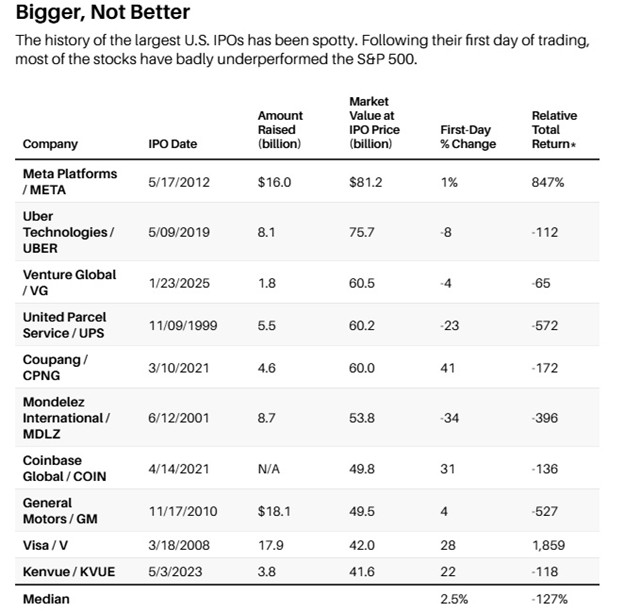
Their total return, relative to the S&P 500, of the group on average, since their IPO date is a loss of 127%. Ouch.
In summary
Our view is that for now we are not in the FOMO camp. If the SpaceX IPO is like many others, it may be safter to wait until the share price plummets and then buy in… or not.
If you would like to talk further about this, we do find it fascinating and would be happy to talk to you about it.
“Live long and prosper.” – Spock