
SUMMARY
Escalating tensions involving Iran have introduced new geopolitical uncertainty into global financial markets.
Oil prices have risen as investors assess the risk of disruptions to Middle East energy supply.
Roughly one-fifth of global oil supply moves through the Strait of Hormuz, making the region critical to global energy markets.
Higher oil prices could slow the decline in inflation and potentially delay interest rate cuts.
Historically, geopolitical conflicts create short-term market volatility but rarely alter long-term investment trends.
CURRENT SITUATION
In late February, tensions in the Middle East escalated following coordinated strikes targeting Iranian military infrastructure. Iran subsequently responded with missile and drone attacks against Israeli and U.S. positions in the region.1 While the situation continues to evolve, the conflict has introduced a new layer of geopolitical uncertainty into global financial markets.
The Middle East remains one of the most important energy‑producing regions in the world. A large portion of global oil supply moves through the Strait of Hormuz, a narrow shipping corridor between Iran and Oman. Approximately 20 percent of global petroleum liquid consumption flows through this route.2
Even the possibility of disruptions to this shipping channel can influence oil prices, as markets incorporate additional geopolitical risk. Research teams at RBC Capital Markets and TD Economics note that the duration of the conflict and the stability of shipping routes will likely determine the magnitude of the economic impact.3
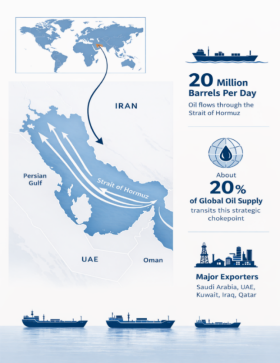
Source: Image generated using AI (ChatGPT)
WEALTH IMPLICATIONS
The Inflation Question
Higher oil prices can quickly filter through the global economy. Energy costs influence transportation, manufacturing, and a wide range of consumer goods.
Economic analysis from RBC Global Asset Management suggests that sustained oil prices near US$100 per barrel could place modest upward pressure on inflation and potentially delay interest rate cuts in developed economies.4
For Canada, the effect may be somewhat mixed. As a major energy exporter, higher oil prices can support certain sectors of the Canadian economy even, as they place pressure on global growth.
How Markets are Responding
Financial markets have responded with increased volatility but relatively little evidence of broader financial system stress.
Historically, geopolitical conflicts tend to cause short‑term swings in financial markets but rarely derail long‑term investment trends unless they lead to sustained disruptions in global energy supply or trade.
Staying the Course
For long-term investors, geopolitical events are rarely a reason to alter a well-constructed investment strategy. Diversified portfolios are designed to weather periods of uncertainty and market volatility.
In the near term, higher energy prices may benefit energy producers and commodity-linked sectors, while industries sensitive to fuel costs may face pressure. Over longer horizons, however, market performance tends to be driven primarily by economic growth, corporate earnings, and innovation.