
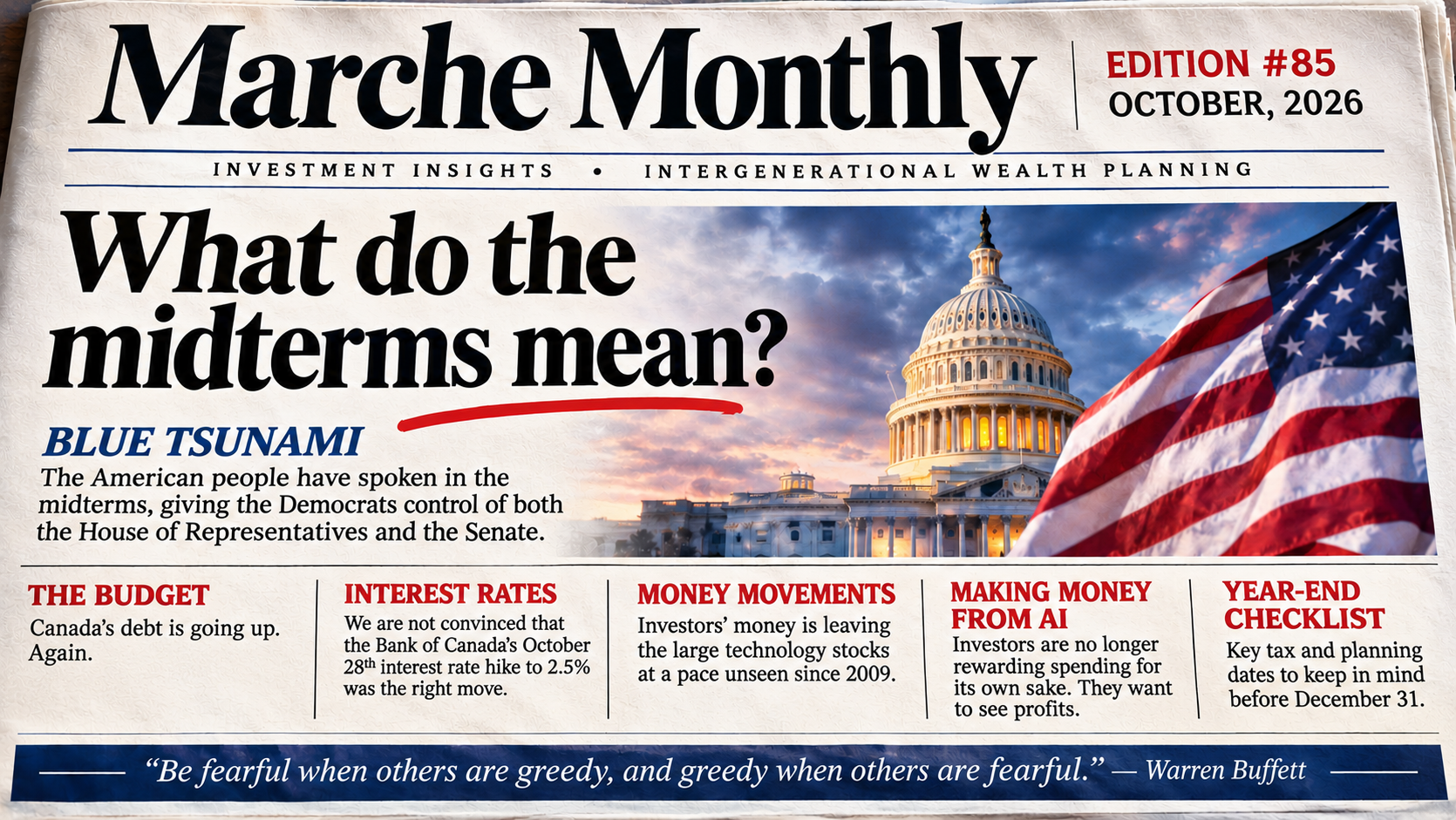
BLUE TSUNAMI
The American people have spoken in the midterms, giving the Democrats control of both the House of Representatives and the Senate. It remains to be seen what damper this may place on President Trump’s ability to do what he wants, as he has demonstrated a willingness to govern through executive orders and retains the power to veto legislation passed by Congress.
It is worth noting that since 1874, the S&P 500 (which we consider to be the authoritative indicator of how the overall markets are doing) has risen the year following midterms in 32 out of 38 elections, producing an average return of 14%.
That said, regular readers of Marche Monthly know that our clients do not own the markets (they own a portfolio of businesses that we want to own for many years, in alignment with their overall planning), and that at any rate, the long-term performance of our portfolios will not be affected by who wins US elections.
The ultimate determinant of our portfolios’ performance is not geopolitical events, but the quality of the companies we own, and their earnings over time. We remain very comfortable with our core holdings, including regulated, dividend-paying companies such as banks and utilities.
We are in a strong position to add more high-quality companies to our portfolios, given that we expect there to be considerable volatility in the final two years of Trump’s mandate, considering Democratic majorities in Congress will be in a position to oppose his policies and perhaps conduct investigations. Volatility is our friend. It gives us the opportunity to buy companies that meet our stringent investment criteria and that we believe are priced below their intrinsic value—at a discount, in other words.
Adding to our strong position is the fact that we have been deliberate about sitting on more cash than at any time since the onset of COVID-19 in 2020. We note that there is considerable fear in the market, confirmed by the Fear and Greed Index of investor sentiment.
As disciples of Warren Buffett, we refer to one of his many famous maxims: “Be fearful when others are greedy, and greedy when others are fearful.”
Buffett is saying that fear leads others to sell unwisely, which leads to companies being priced below their intrinsic value, which gives us the opportunity to be “greedy” and buy on sale.
Much of the fear in the market is driven by investors’ reaction to the fact that more than 40% of companies in the S&P 500 are down over 20% from their recent highs. The takeaway for us, in light of our portfolios being down approximately 3% from the date of the S&P’s all-time high, is that:
- Every client’s financial plan is ahead of schedule
- Every client’s year-to-date returns are above average
- Every client’s one-, three- and five-year returns are above average
- Volatility is a normal, healthy aspect of market behaviour
THE BUDGET
Canada’s debt is going up. Again. We are continuing to saddle our children, grandchildren and their future generations with the obligation to pay it back in the form of higher taxes.
As a point of reference, the federal government now spends more servicing its debt than it collects in GST revenue, with projected debt-servicing costs of $58.7 billion in 2026–27 compared to GST revenues of $53.4 billion – a $5.3 billion difference that illustrates the staggering magnitude of Canada’s debt burden.
This reality reinforces the value of the intergenerational planning we provide here at Marche Wealth Management, and our bottom-line focus on tax minimization, since the ultimate determinant of financial wealth is what you get to keep after tax. This focus allows our client families to create a legacy that continues generations into the future.
Indeed, we have the privilege of working with multiple generations in many of our client families. Does any generation in your family, younger or older, wish to receive the comprehensive wealth planning, including tax minimization strategies, that we deliver to all our clients? We will always be happy to hear from them, and to provide a completely confidential and complimentary consultation.
We are reviewing the federal budget for anything that affects our clients and will contact you directly if action is needed.
INTEREST RATES
We are not convinced that the Bank of Canada’s October 28 interest rate hike to 2.5%, the first increase since July 2023, was the right move.
Put simply, we think it is a questionable tool for the problem—that problem being inflation driven by high energy prices. The result is that Canadians could end up absorbing higher energy costs and higher borrowing costs at the same time.
Higher interest rates do little to address a global increase in oil and energy prices. What they can do is make mortgages, lines of credit, and business financing more expensive, apply more pressure to highly indebted Canadian households, weigh on housing and consumer spending, and slow business investment and economic growth.
In the current economy, that creates a real risk of weakening domestic demand while doing relatively little to address the source of the inflation—which is energy and food as a result of higher energy prices.
Higher interest rates can pressure dividend-paying stocks in the short term, because interest-bearing investments become more attractive by comparison. We view this as temporary. It does not change the quality of the businesses we own, and it may create opportunities to buy them at better prices.
MONEY MOVEMENTS
Investors’ money is leaving the large technology stocks at a pace unseen since the end of the global financial crisis of 2009. In October, US technology stocks fell about 8 per cent. In particular, the “Magnificent Seven” technology giants are on track to report slower third-quarter earnings growth than the other 493 companies in the S&P 500, a reversal not seen since 2022.
That money is going to other companies, some of which meet our investment criteria—in energy and consumer staples, for example, each of which rose more than 10 per cent in October. So, we like how we are positioned.
Although many other investors are concentrated in the Magnificent Seven, we own just two of them: Alphabet and Amazon, which we have done well with, and held for a very long time. We expect to add to our positions in technology at the appropriate time, as we expect continued strong performance.
MAKING MONEY FROM AI
In the August edition of Marche Monthly, I told you that our focus was evolving from who is building artificial intelligence (AI), to who can make money using it. October showed the prudence of this view.
After issuing a disappointing forecast, Intel fell almost 29 per cent in a single day—its worst since 1974.
This is a demonstration that investors are no longer rewarding spending for its own sake. They want to see profits, and that is where we are focusing.
YEAR-END CHECKLIST
We are working through our clients’ tax planning now. Here are the key dates:
- December 30: Last trading day for a capital loss to count in 2026. If you buy the same investment within 30 days before or after the sale, including in your RRSP, your TFSA, or your spouse’s account, the loss can be denied.
- December 31: Last day for 2026 charitable donations, FHSA contributions, and RESP contributions for this year’s grant. If you are donating shares, please contact us by early December so the transfer can be completed on time.
- December 31: RRSP conversion deadline for anyone who turns 71 in 2026.
- Before December 31: If you plan a TFSA withdrawal, making it this year restores the room on January 1 rather than a year later.
- January 1: New TFSA contribution room becomes available.
- March 1, 2027: Last day for RRSP contributions that can be deducted on your 2026 tax return.
We look relentlessly for every way to minimize your taxes. If you or your accountant would like to review any of these items, please let me know.
TRANSITION COMPLETE
Autumn is a period of transition, with the clock falling back and the leaves falling to the ground. Here at Marche Wealth Management, our transition to Wellington-Altus is complete, and I am very pleased with the feedback we have been receiving. If there is anything else we could be doing better for you or your family, just let us know.
The holidays will be here before we know it. Enjoy the rest of this season!
—
We don’t speak jargon. We’re all about uncomplicating your life, so we speak plain English. If there is someone you care about – someone who would appreciate this simple and straightforward approach – please feel free to share this message with them or put us in touch.
Want to discuss any aspect of this month’s blog, or any other issue on your mind? Have a story idea? I am always happy to receive your call or email.
Tyler Marche, MBA, CIM, FCSI®, FMA
Your life, uncomplicated
tyler.marche@wellington-altus.ca
t.416.446.5432
WHO WE ARE
–Please note our new contact information–
Tyler Marche, MBA, CIM, FCSI®, FMA | Senior Wealth Advisor & Senior Portfolio Manager
t.416.446.5432
c.416.804.0550
tyler.marche@wellington-altus.ca
Matthew Wilcox, CPA | Associate
t.416.446.5458
matthew.wilcox@wellington-altus.ca
Tracy McClure, CPA, CFP® | Associate
t.416.446.5452
tracy.mcclure@wellington-altus.ca
Paula Mulligan | Associate
t.416.479.6662
paula.mulligan@wellington-altus.ca
Joy Loewen | Associate
t.416.593.2899
joy.loewen@wellington-altus.ca
**Please send administrative requests to:
marchewealth@wellington-altus.ca
1 416 446 5466**