
Reflections & Resources

Last Month in The Markets – NASDAQ and S&P 500 surge to new highs in June

Last Month in the Markets: June 3 – 28, 2024
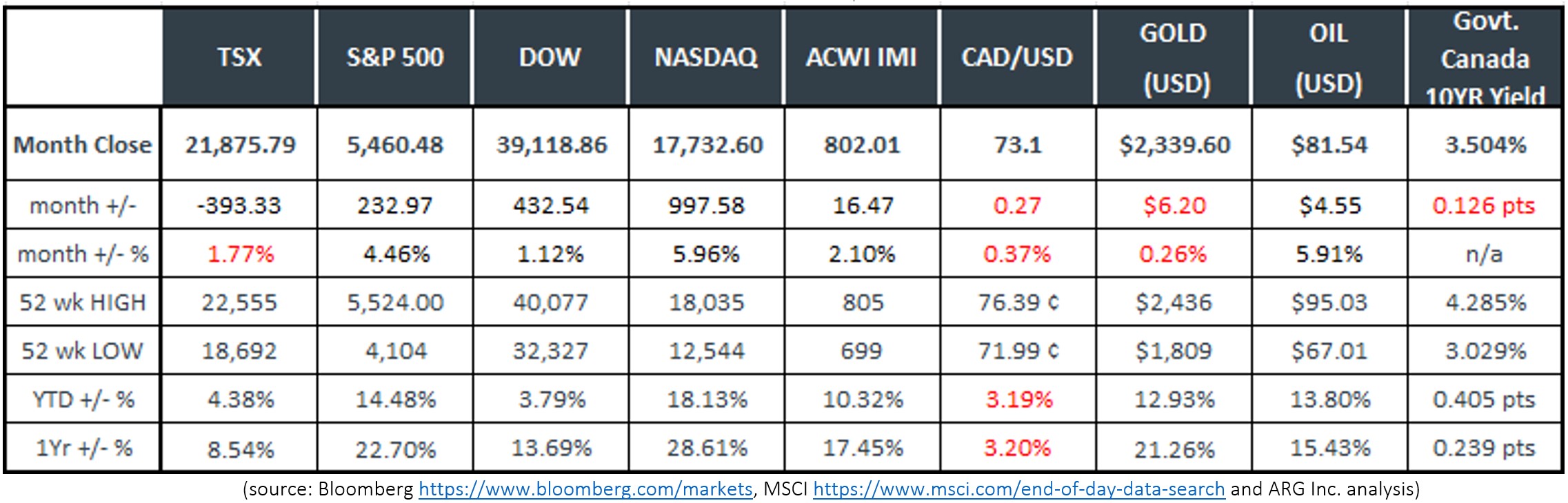
Last Month in the Markets June 3-28

What happened in June?

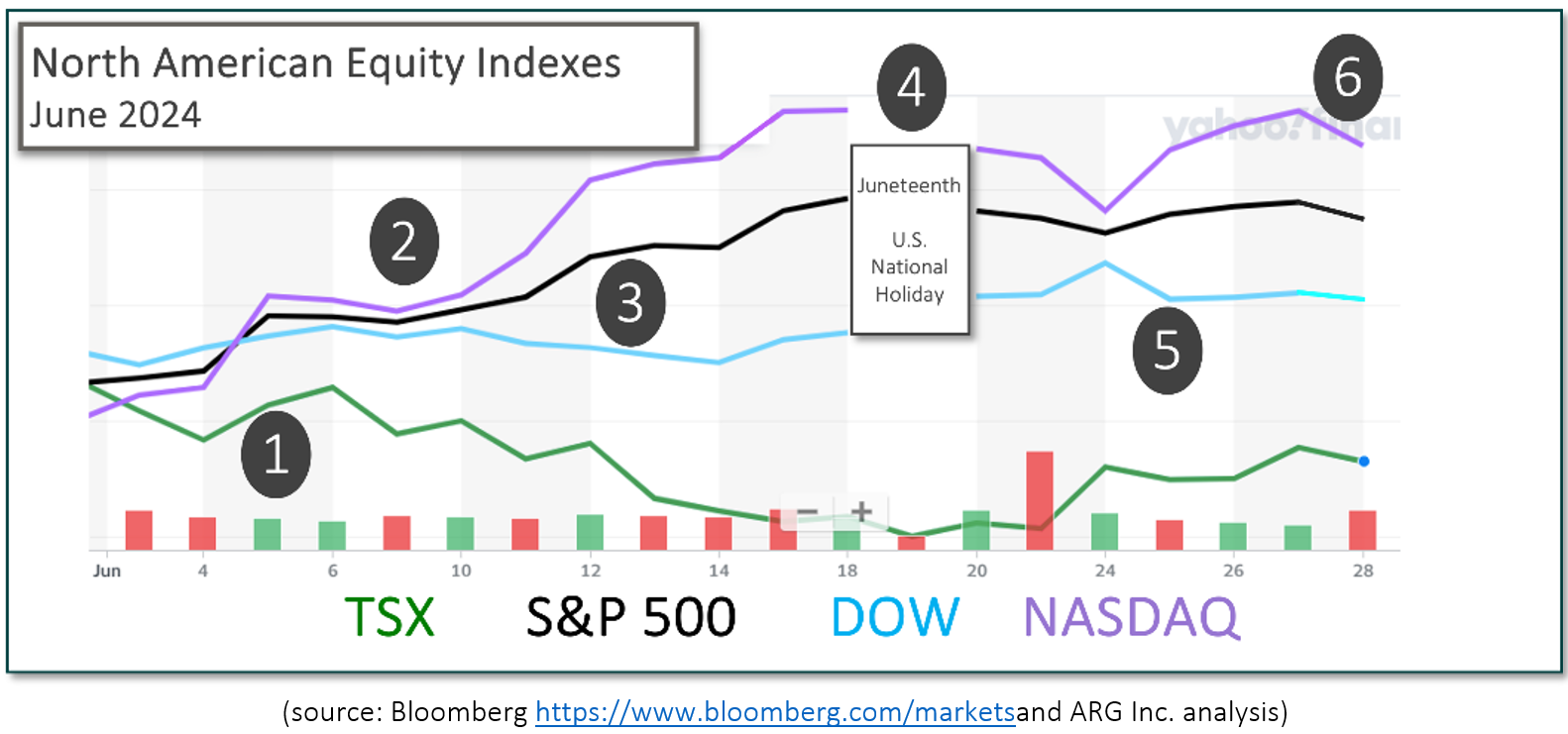
Markets were mixed over the course of last month: the S&P/TSX Composite was the only major North American equity index to lose value, while the U.S. indexes climbed.  The NASDAQ leapt approximately 6%, the S&P 500 rose approximately 4% and the Dow Jones Industrial Average brought a 1% positive gain.

The latest earnings season and forward guidance provided much of the impetus for the rise of U.S. stocks during the first half of June. Inflation and interest rate expectations continued to influence values, while geopolitical events in the Middle East and Ukraine have fallen from focus in the popular press.
North American Equity

Events and announcements triggered positive and negative reactions from equity indexes:

  1. June 5

The Bank of Canada reduced its policy interest rate, the overnight rate, by 25 basis points to 4.75%. The rate had been at 5% since July 2023, and this was the first reduction since March 2022 as our central bank fought against domestic consumer inflation. According to the announced press release “The Bank’s preferred measures of core inflation also slowed and three-month measures suggest continued downward momentum.” It also included, “With continued evidence that underlying inflation is easing, the Governing Council agreed that monetary policy no longer needs to be as restrictive.”  CBC News and BoC

  1. June 7

U.S equities performed well for the week despite Friday’s labour news. In May, the total non-farm payroll employment increased by 272,000 according to the Bureau of Labor Statistics.

The strong jobs market with rising wages, which is a driver of services inflation, is delaying interest rate cuts by the Federal Reserve. After the announcement, the likelihood of a rate-cut in September fell about 12 percentage points to 56% according to CME’s FedWatch tool.  BLS release  CNBC and jobs  CME FedWatch tool

  1. June 12

At 8:30 am Eastern time, the Bureau of Labor Statistics reported that the Consumer Price Index (CPI) was unchanged for the month of May after rising 0.3% in April.  Over the past 12 months, the all-items index increased 3.3%. Core CPI, which excludes food and energy, rose 3.4% on a year-over-year basis, which was lower than expectations.  CNBC and CPI

At 2 pm, the Federal Reserve delivered its interest rate announcement that maintained the federal funds rate at a range of 5% to 5.5%. According to the press release, “Recent indicators suggest that economic activity has continued to expand at a solid pace. Job gains have remained strong, and the unemployment rate has remained low. Inflation has eased over the past year but remains elevated.” The underlying indicators for economic activity, jobs and inflation, made the decision to hold interest rates steady.  CNBC and Fed rates

  1. June 19

U.S. markets were closed for the Juneteenth national holiday.    NY Times and Juneteenth

  1. June 25

StatsCan reported that Canadian CPI rose 0.6% in May and 2.9% on a year-over-year basis, up from 2.7% in April.  Higher prices for services (+4.6%) provided fuel for the increase in the overall rate of inflation. Although goods inflation tempered, grocery prices rose 1.1% in May, and 1.5% on an annual basis in May. The price increase for groceries is seasonal, but it was the first acceleration since June 2023 in the year-over-year inflation for food purchased in stores, which is an unwanted result as is the uptick in the overall rate of inflation.  StatsCan release  CBC and CPI

  1. June 28

Before markets opened, the U.S. Bureau of Economic Analysis delivered the PCE release. On a year-over-year basis, the Personal Consumption Expenditures (PCE) price index decreased 0.1%. Excluding food and energy, the core PCE increased 0.2% in May from April on a year-over-year basis. Core PCE achieved its lowest reading since March 2021, which matched expectations and could lead to future interest rate reductions PCE March 2021

What’s ahead for July and beyond?

Interest rates will continue to heavily influence markets as inflation continues to cool, economies slow and jobs growth declines. The Bank of Canada will release interest rate updates on July 24 and September 4. The Federal Reserve’s next scheduled opportunities to adjust interest rates are July 31 and September 18.

The Federal Reserve tracks PCE more closely than CPI, and Core PCE is the most important inflation measure for the U.S. central bank. CPI computes the increase in the price of a basket of goods and services using a weighted average method, while the PCE utilizes total spending data, which accounts for changes in consumer behaviour.

Based on previous Fed statements, the recent drop in the PCE could facilitate an interest rate cut, but consistency and predictability are the next, necessary conditions.  CNBC and PCE    CPI definition    PCE definition


Recent Posts

Beyond ESG Ratings: How We Evaluate Responsible Investments

Beyond ESG ratings: How we evaluate responsible investments

Understanding our responsible investing process

Responsible investing has become an increasingly important part of the investment landscape. As environmental, social, and governance (ESG) investing has become more widely adopted, many investors are surprised to learn that different ESG research organizations often assign different ratings to the same company.

Rather than viewing these differences as a weakness, we believe they reflect the complexity of evaluating corporate sustainability. No single research provider captures every dimension equally well.

For this reason, we developed a proprietary ESG assessment methodology that combines multiple independent sources of research into one disciplined and consistent investment framework.

Why this matters

Responsible investing is about more than simply selecting companies with favourable ESG ratings. It requires a disciplined investment process that balances sustainability considerations with sound financial analysis.

Our methodology is designed to identify companies that demonstrate responsible corporate behaviour while continuing to meet the financial characteristics we believe are important for long-term investment success.

Our layers of ESG due diligence

Read More »

July 2026 Market Update – Middle East Uncertainty, Central Bank Caution, and Resilient Economic Growth

What happened in July? Geopolitical developments in the Middle East remained an important influence on global markets during July. Renewed military activity involving the United States and Iran contributed to continued uncertainty, while developments surrounding shipping routes and energy infrastructure kept oil markets particularly sensitive to changing events. Oil prices experienced renewed volatility throughout the month, rising following heightened tensions in early July before easing later in the month as markets responded to changing geopolitical developments. Despite the late-month decline, oil prices finished July more than 20 per cent above their levels at the end of February, reflecting the ongoing impact of geopolitical risk on global energy markets. While geopolitical developments remained the primary focus for investors, economic data and central bank decisions continued to shape expectations for inflation and interest rates. The Bank of Canada and the U.S. Federal Reserve both maintained their policy interest rates during July, while inflation data suggested that price pressures remain above central bank targets despite some moderation from recent highs.

Read More »

Summer 2026 Newsletter – The Wagner Investment Management Team

As we move through summer 2026, it’s a great time to take a step back from the headlines and focus on the bigger picture of your financial plan.

Discover how evolving market dynamics are shaping the investing landscape, explore the lessons that Jevons Paradox may offer for energy markets and artificial intelligence, and learn practical ways to support the next generation through homeownership, tax planning, and financial education. Plus, gain valuable estate-planning insights on navigating the transition when children reach adulthood.

Let’s make this summer a season of perspective, preparation, and opportunity – helping you stay focused on your long-term goals while we continue to navigate changing markets together.

Read More »

June 2026 Market Update – Middle East Tensions, Oil Price Swings, and Easing Energy Concerns

Geopolitical tensions in the Middle East remained a key influence on global markets during June. Developments involving the U.S., Iran, Israel, Gaza, and Lebanon contributed to periods of heightened uncertainty, particularly in energy markets. Concerns surrounding shipping through the Strait of Hormuz, a key global oil transit route, led to temporary increases in oil prices during the month. However, as tensions eased, oil prices retreated approximately 30 per cent from their June 3 intraday high, ending the month near where they finished in late February.

Read More »

The information contained herein has been provided for information purposes only. The information has been drawn from sources believed to be reliable. The information does not provide financial, legal, tax or investment advice. Particular investment, tax, or trading strategies should be evaluated relative to each individual’s objectives and risk tolerance. This does not constitute a recommendation or solicitation to buy or sell securities of any kind. Wellington-Altus Private Wealth Inc. (WAPW) does not guarantee the accuracy or completeness of the information contained herein, nor does WAPW assume any liability for any loss that may result from the reliance by any person upon any such information or opinions. Before acting on any of the above, please contact your financial advisor.

© 2024, Wellington-Altus Private Wealth Inc. ALL RIGHTS RESERVED. NO USE OR REPRODUCTION WITHOUT PERMISSION. www.wellington-altus.ca