

Prorogation Purgatory: What Parliament’s Shutdown Means for Proposed Tax Changes

Prorogation Purgatory: What Parliament’s Shutdown Means for Proposed Tax Changes

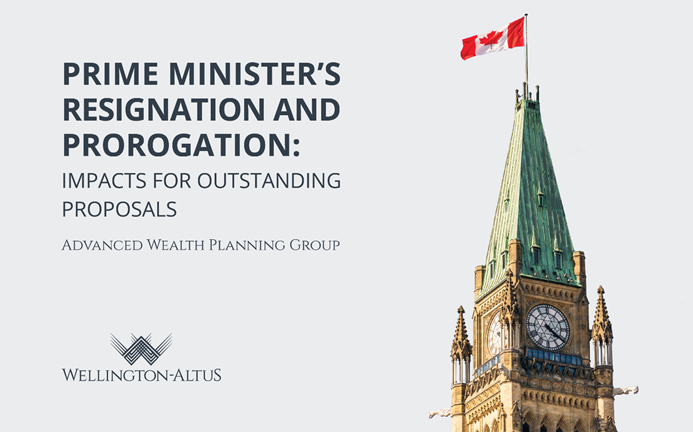
On January 6, 2025, Prime Minister Justin Trudeau resigned, effective upon selection of a new leader of the Liberal Party of Canada, and requested that Parliament be prorogued. The Governor General consented to the request, terminating all parliamentary activities until March 24.


What does this mean for previously announced proposals?

Any bill that hasn’t become law by the time of prorogation is effectively canceled, and would need to be reintroduced when Parliament resumes—unless the House votes to reinstate it.1 Given the government is expected to face a confidence vote soon after Parliament reconvenes, and opposition parties have stated they will vote down the government, there’s uncertainty about whether any new or previously cancelled bills will be introduced before an election is called.

Over the past year, several significant tax proposals have been announced, but not yet been included in a bill. With prorogation and the possibility of a spring election, the fate of these proposals is now unclear.

Here are some key proposed tax measures you may be wondering about:

1. Increase to the capital gains inclusion rate

The 2024 Federal Budget proposed to increase the capital gains inclusion rate from 50 per cent to 66.67 per cent for individuals’ capital gains in excess of $250,000 and for all capital gains of corporations and trusts, starting on June 25, 2024. These proposals would effectively raise the tax rate on capital gains by seven to nine per cent depending on the jurisdiction.

While draft legislation for these changes was included in a September 2024 Notice of Ways and Means Motion (NWMM), and reaffirmed in the December 2024 Fall Economic Statement, it still needs to be passed in a bill. If an election is called before such a bill is enacted, the future of this proposal will depend on the next government.

However, the Canada Revenue Agency’s (CRA) longstanding practice is to administer tax rules introduced in a NWMM even before they are formally enacted.

CRA confirmed it will apply the new inclusion rate to capital gains realized on or after June 25, 2024, even if the rules haven’t, and may never, become law.2

Impacted taxpayers preparing their 2024 tax returns will face a tough decision:

  • File returns and pay taxes based on the proposed 66.67 per cent inclusion rate now, and potentially need to amend those returns down the road to recover overpaid tax if the change doesn’t pass, or
  • Use the current 50 per cent inclusion rate and risk facing additional taxes and interest if the change is eventually enacted.

2. Trust reporting and bare trusts

Starting for the 2023 tax year, new trust reporting rules required many informal “bare trusts” to file tax returns for the first time. Following significant confusion over these rules, CRA exempted bare trusts from these filing requirements for 2023, mere days before the returns were due.3

In August 2024, draft legislative proposals were released to clarify the trust reporting rules, revise the bare trust reporting requirements starting in 2025, and exempt bare trusts from reporting for the 2024 tax year. CRA subsequently announced that it will not require bare trusts to file trust returns for the 2024 tax year, unless a direct request is made.4 CRA confirmed the filing exemption for bare trusts on January 7, post- prorogation.5

Because of the technical nature of these amendments to address prior issues with the trust reporting rules, they are perhaps more likely to proceed (though possibly with further amendments) than the more controversial proposed increase to the capital gains inclusion rate.

3. Extension for 2024 charitable donations

Mere days before prorogation, the government announced plans to allow charitable donations made up to February 28, 2025 to be applied to the 2024 tax year.6 The announcement was intended to address delays caused by a Canada Post mail stoppage.

Because Parliament is now prorogued, there will be no opportunity to introduce legislation to bring these changes into effect before the proposed February 28, 2025 donation deadline or possibly even before the April 30, 2025 personal tax filing deadline. If an election is called before the legislation is enacted, the new government will decide whether to introduce the measure.

What now?

Taxpayers should consult their qualified tax advisors to understand how Parliament’s prorogation may affect their tax filings. Underused Housing Tax reporting in 2022 and the bare trust reporting requirements in 2023, provide recent examples of how early filers were penalized as last-minute extensions and/or exemptions were announced. Whether and when this year’s uncertainties will be clarified further remains to be seen.

Recent Posts

Investment Insight – Summer 2026

One of the recurring challenges in writing our quarterly commentary is that by the time it reaches publication, parts already feel dated. This feels especially pronounced today as the pace of change appears to be accelerating.

After the S&P 500 declined by roughly 10 percent by the end of March, it took just 11 trading sessions to fully recover — among the fastest recoveries on record. As one market observer noted, “for situation monitors, the whiplash is a thing to behold…for everyone else, they may not have even noticed.” More notable was the speed at which the narrative reversed. By late March, many big-tech valuations appeared more fairly valued; by late April, they again appeared stretched.

The increasing frequency of such rapid shifts raises a broader question: Does this reflect a changing market regime?

Part of the explanation may lie in how the investing landscape itself has evolved over recent decades. Information is now disseminated globally in seconds. Combined with trading automation and declining transaction costs, this has contributed to a significant increase in market activity. In the  late 1980s, the New York Stock Exchange averaged around 500 million shares traded daily; by 2020, this figure had doubled to over one billion.1

Participation has also become democratized. Building a diversified portfolio once required meaningful capital. Today, internet access and low-cost, diversified products have lowered barriers to entry. In 1990, equity and investment fund units represented just six percent of Canadian household assets. In 2025, they accounted for over 25 percent.2 This has also influenced investor behaviour. The average holding period for a stock, once
spanning years, is now measured in months.

Read More »

July Market Insights: Trump’s Meta Game, Pax Americana, and the AI Age

In politics and markets, the decisive contest is often the one being played above the visible struggle. Elections, earnings and summit communiqués are the surface game—the real action lies in the metagame, the contest over rules, incentives and narratives that shape outcomes long after today’s skirmishes are forgotten.

Henry Kissinger, American diplomat and political scientist, warned that most statesmen get lost in the “manifestations of events”—daily crises, tactical choices and headlines—and fail to read the deeper “trend of events” that gives those crises meaning. Investors make the same mistake when they trade every move in yields or volatility but never ask which regime those data points are compounding into over a five‑ or ten‑year horizon.

German‑American entrepreneur Peter Thiel’s line that “competition is for losers” captures the business version of the same instinct. The point is not to fight hardest inside the old game, but to see how the game itself is changing and reposition before everyone else.

Read More »

June Market Insights: America at 250

merica reaches its 250th anniversary not as a fallen hegemon, but as the dominant centre of global hard power, monetary power, and frontier innovation. It still sits astride the world’s resource base through energy, agriculture, and continental depth; it still issues the reserve currency at the core of global trade and finance; and it still leads the race to build artificial intelligence (AI) as the next digital platform. Yet precisely because American power remains so large, the visible breakdown of the post–Second World War rules-based order has become impossible to ignore. To anyone who has read German historian and philosopher Oswald Spengler’s The Decline of the West (1918), this is not a surprise but a pattern: history is not a straight line of progress. Instead, it is the record of civilizations that rise as living cultures harden into systems and eventually exhaust the moral energy that made them great in the first place. America did not choose this time, but it has been born into it.

Read More »

May Market Insights: Mastery and the Terror Premium

Mastery of energy, again

Winston Churchill, as first lord of the Admiralty, tied Britain’s fate to Persian oil. United States President Donald Trump’s war in Iran, centred on Operation Epic Fury, could do the same for the West by removing Iran’s nuclear shadow, resetting oil toward US$60, and finally unlocking a modern peace dividend.

“Mastery itself was the prize of the venture.” Winston Churchill’s 1912–13 case for converting the Royal Navy from coal to oil—enshrined in historian Daniel Yergin’s The Prize: The Epic Quest for Oil, Money, and Power captured the brutal clarity of a great power energy strategy: accept dependence to command the seas. That wager framed the last century. In 2026, as Epic Fury grinds through the Gulf and Brent trades above US$100, the question is no longer whether oil confers mastery, but who holds it: a revolutionary theocracy astride the Strait of Hormuz, or a West intent on stripping the terror and nuclear risk now priced into every barrel out of the energy system—finally collecting a long‑deferred peace dividend.

Read More »

Highlights from the 2026 Spring Economic Update

On April 28, 2026, Finance and National Revenue Minister François-Philippe Champagne released the 2026
Spring Economic Update (the Update). This was the first spring economic update after the federal budget was
moved to the fall in 2025. In the absence of a federal budget earlier this year and with the recent shift to a
majority government, Canadians have been awaiting clear direction on the federal government’s policy
focus and anticipated initiatives. Overall, the Update introduces relatively little that had not been previously
announced, while showing an improved fiscal outlook, with the projected deficit declining despite $37.5 billion
in net new spending.

Read More »

The information contained herein has been provided for information purposes only. The information has been drawn from sources believed to be reliable. Graphs, charts and other numbers are used for illustrative purposes only and do not reflect future values or future performance of any investment. The information does not provide financial, legal, tax or investment advice. Particular investment, tax, or trading strategies should be evaluated relative to each individual’s objectives and risk tolerance. This does not constitute a recommendation or solicitation to buy or sell securities of any kind. Market conditions may change which may impact the information contained in this document.  Wellington-Altus Private Wealth Inc. (WAPW) does not guarantee the accuracy or completeness of the information contained herein, nor does WAPW assume any liability for any loss that may result from the reliance by any person upon any such information or opinions.  Before acting on any of the above, please contact your financial advisor.

© 2024, Wellington-Altus Private Wealth Inc. ALL RIGHTS RESERVED. NO USE OR REPRODUCTION WITHOUT PERMISSION.

www.wellington-altus.ca