
The Fall of Communism and Poland’s Economic Reset
In August 1980, a fired electrician scaled a security fence at the Lenin Shipyard in Gdańsk and joined a workers’ strike. Within a year, ten million Poles had signed up. Within a decade, communism in Poland was done.
Nobody saw it coming. Wałęsa himself recalled that not a single world leader he spoke with believed communism could fall before the year 2000. But toppling a political system turned out to be the easy part. Rebuilding an economy—that was the real test.
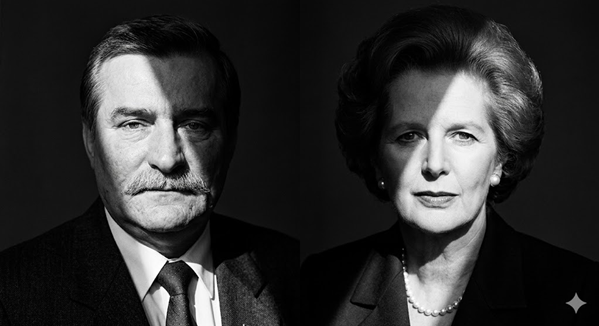
Lech Walesa and Margaret Thatcher—source Gemini
Shock Therapy: The Start of Economic Reform and Growth
When Solidarity took power, Poland was a wreck. Inflation: 50% per month. Over 90% of GDP was state-controlled. Store shelves were bare. The new government had a choice: reform slowly and protect the old guard, or rip the bandage off.
They ripped. On January 1, 1990, Deputy Prime Minister and Finance Minister Leszek Balcerowicz launched “shock therapy”—liberalizing prices overnight, ending subsidies, making the currency convertible, and throwing open the borders to trade. It was brutal. Factories closed. Unemployment surged. A thousand companies lost their creditworthiness in six months.
And then something remarkable happened.
source: Claude
Why Poland’s Economy Outpaced Expectations
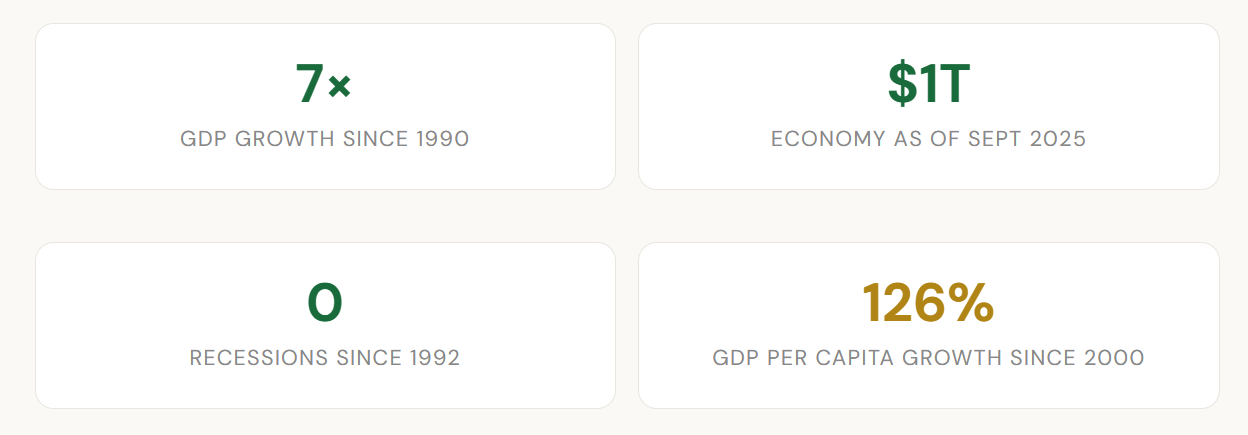
Poland hasn’t had a single year of economic contraction since 1992. It was the only EU country that dodged the 2008 financial crisis entirely. It joined the EU in 2004 and the money poured in—€250 billion in structural funds, $310 billion in foreign direct investment.
At the start of the 1990s, Ukraine was richer than Poland. Today, Poland’s GDP is roughly ten times Ukraine’s. The difference? Ukraine chose gradualism. Poland chose speed.
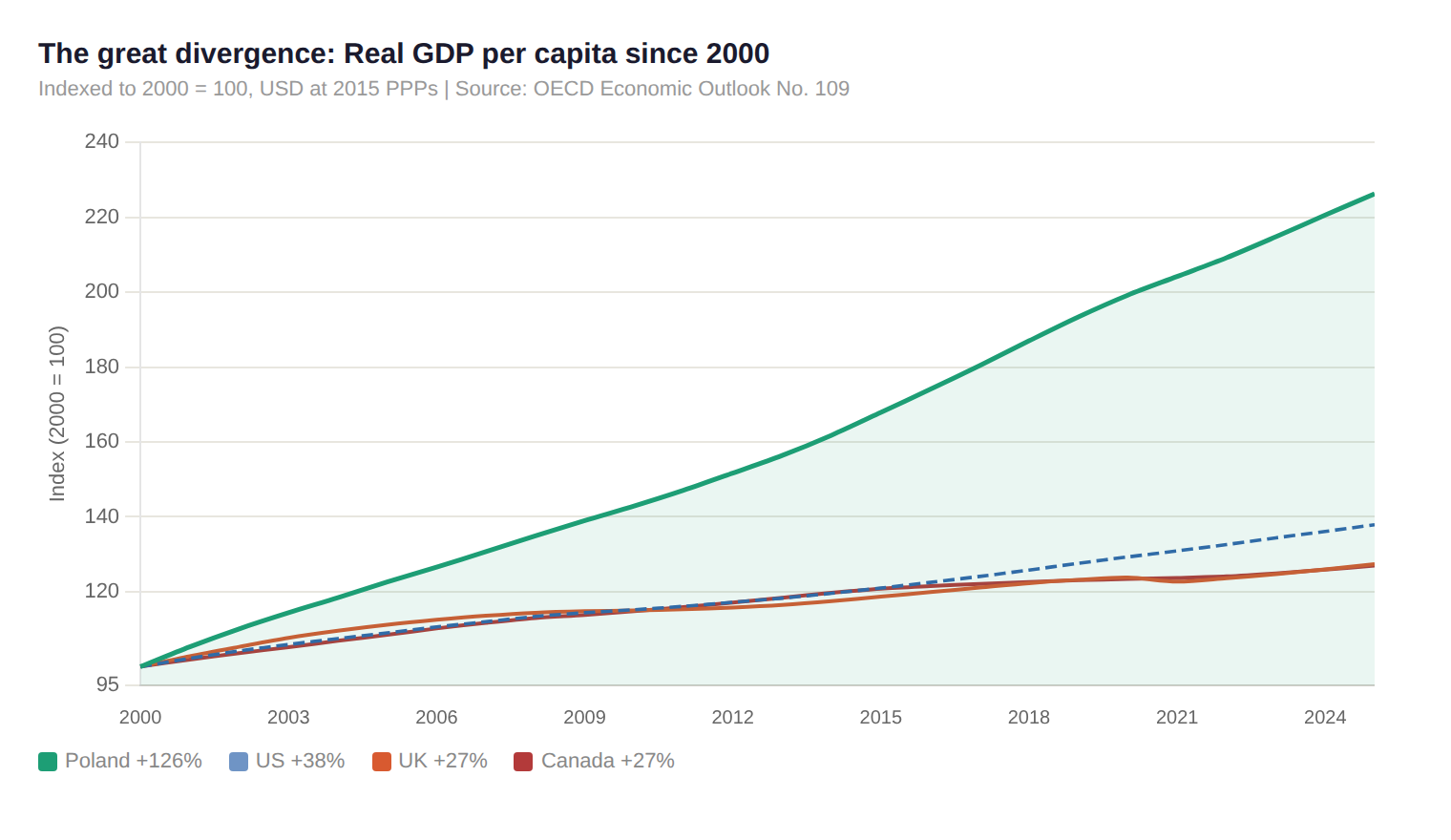
Source as 03/18/26
Now, let’s be honest about that chart. Poland’s stunning growth rate came from a low base—in 2000, its GDP per capita was just $16,150 versus Canada’s $37,692. It’s still in catch-up mode. But that’s actually the point. Poland recently passed Japan in GDP per capita. It’s closing in on the European leaders. Good economic decisions compound—and in less than one generation, they’ve transformed a country from one of Europe’s poorest into its sixth-largest economy.
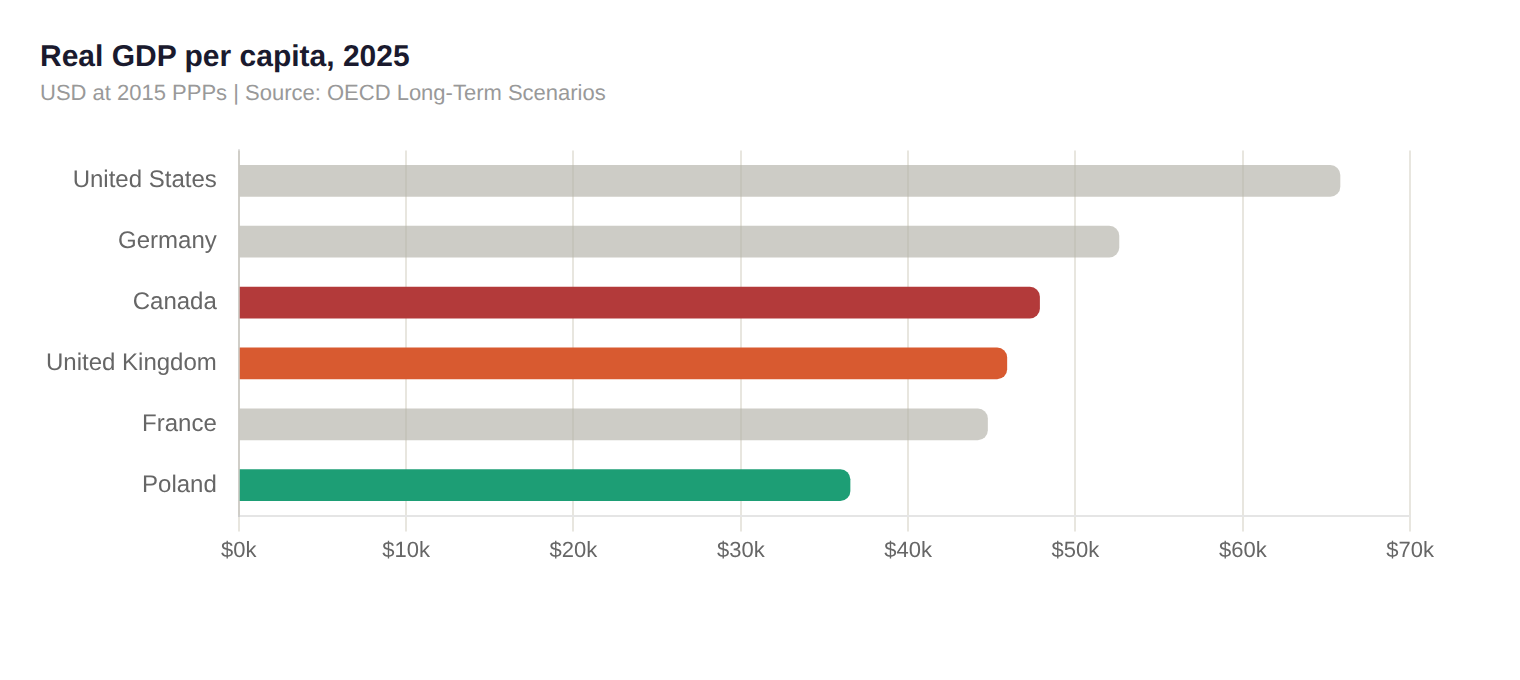
Source as 03/18/26
Britain’s Reform Playbook Under Margaret Thatcher
Here’s the thing: Britain ran this exact experiment a decade earlier. And won. And then forgot the hard-earned lessons.
After World War II, the Attlee government nationalized everything: coal, steel, railways, airlines, gas, electricity, telecoms. By 1979, state-owned industries were 10% of the economy. The result was predictable. Inflation topped 25%. The fiscal deficit hit 10% of GDP. Sterling crashed. In 1976, Britain crawled to the IMF for a $3.9 billion bailout—the largest the Fund had ever issued.
That humiliation produced Margaret Thatcher. She did to Britain what Balcerowicz would later do to Poland: privatized state industries, broke the unions’ stranglehold, deregulated markets, cut subsidies, restructured taxes. GDP per capita nearly tripled during her tenure. Even PM Tony Blair Labour’s most successful post-war PM later called her reforms a matter of “basic fact.”
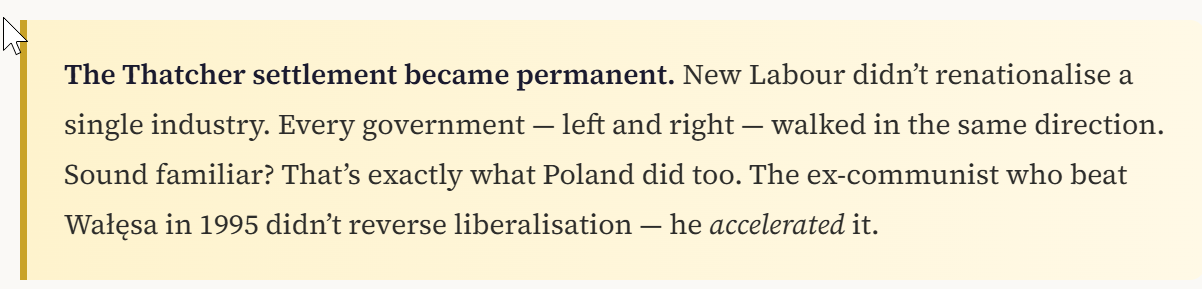
When Economic Reform Slows, Growth Follows
This is where the two stories part company.
Poland kept walking. Every government—left, right, post-communist, post-Solidarity—maintained market reforms. EU accession in 2004 was rocket fuel. Poland now outperforms every European G20 economy on growth. It finished 2025 at 3.6%, accelerating to 4% in Q4.
Britain turned around. The state’s share has crept back up. Productivity has flatlined. Public debt has ballooned. In 2025, economists started drawing explicit comparisons to 1976, the last time Britain needed the IMF.
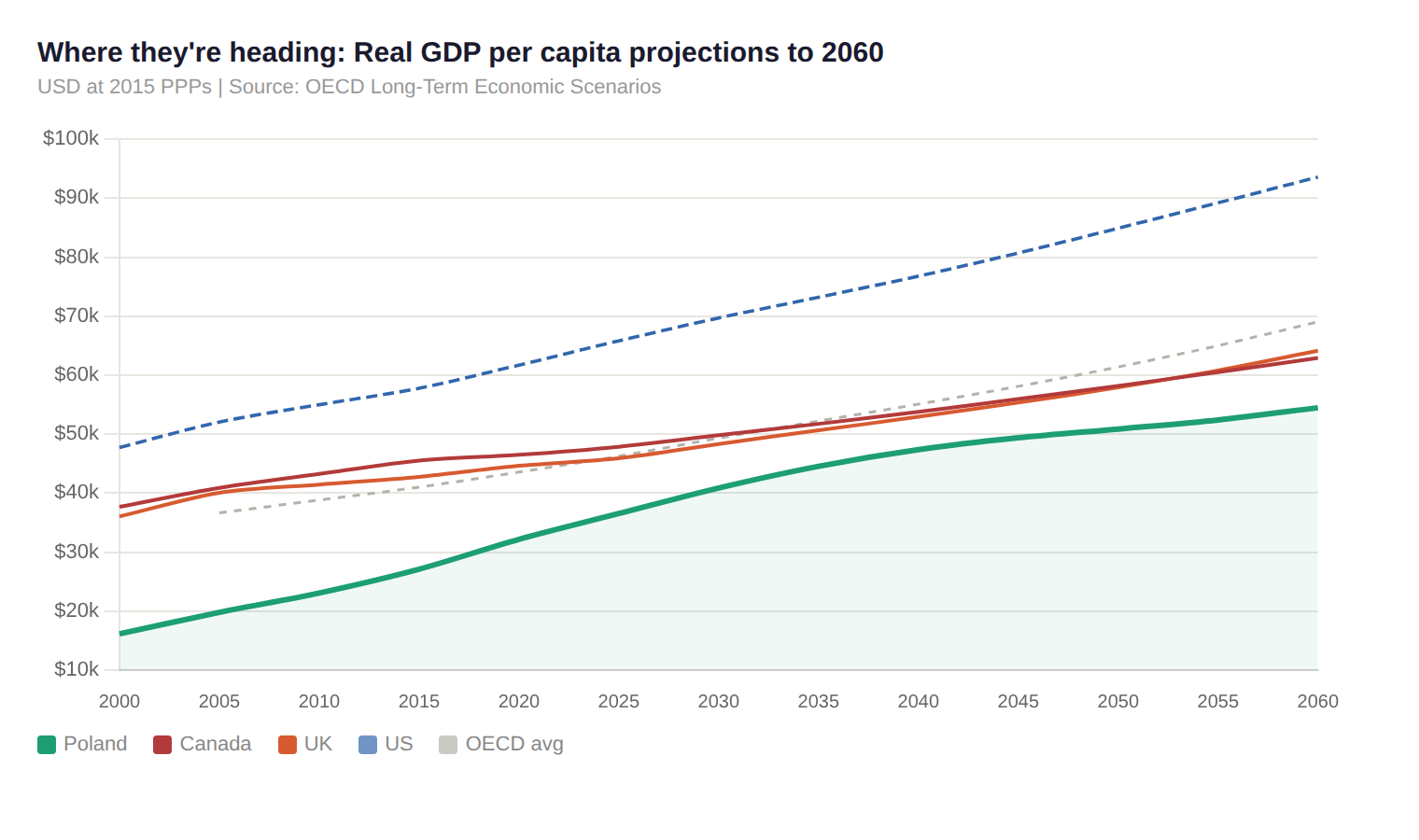
Source as 03/18/26
Poland vs. the World: A Study in Policy Direction
Look at that chart. Poland started at $16,150 per person in 2000. By 2060, the OECD projects it will reach $54,483. Canada? From $37,692 to $62,915 Poland is closing the gap from less than half of Canada’s level to within striking distance. The compounding power of good policy is extraordinary.
Reform is not a one-time event. It’s a direction of travel. Poland kept travelling. Others stopped.
Argentina’s Real-Time Economic Reform Experiment
If this were just one story, you could call it a coincidence. But Argentina is providing real-time confirmation. President Javier Milei introduced shock therapy and Argentina achieved its first budget surplus in 14 years. It saw monthly inflation collapse from 25% to under 2%, and recorded 7.7% year-over-year GDP growth by mid-2025.
The recipe isn’t complicated. Countries that liberalize fast, endure short-term pain, and by letting markets allocate capital they recover and grow. Countries that protect incumbents, direct investment from the centre, and try to reform gradually tend to stagnate. Both in the short term and in the long term:
Short Term
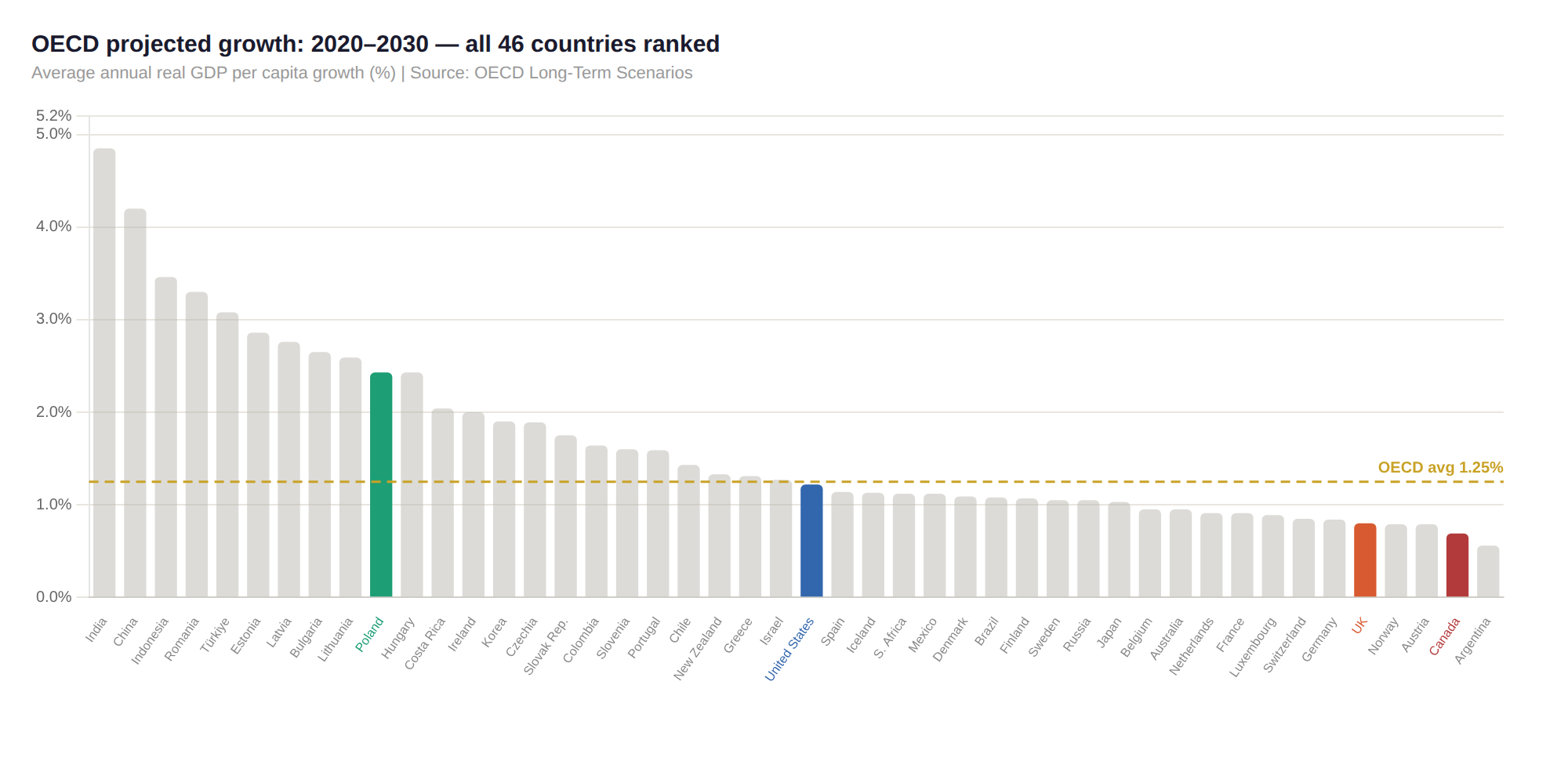
Source as 03/18/26
Long Term
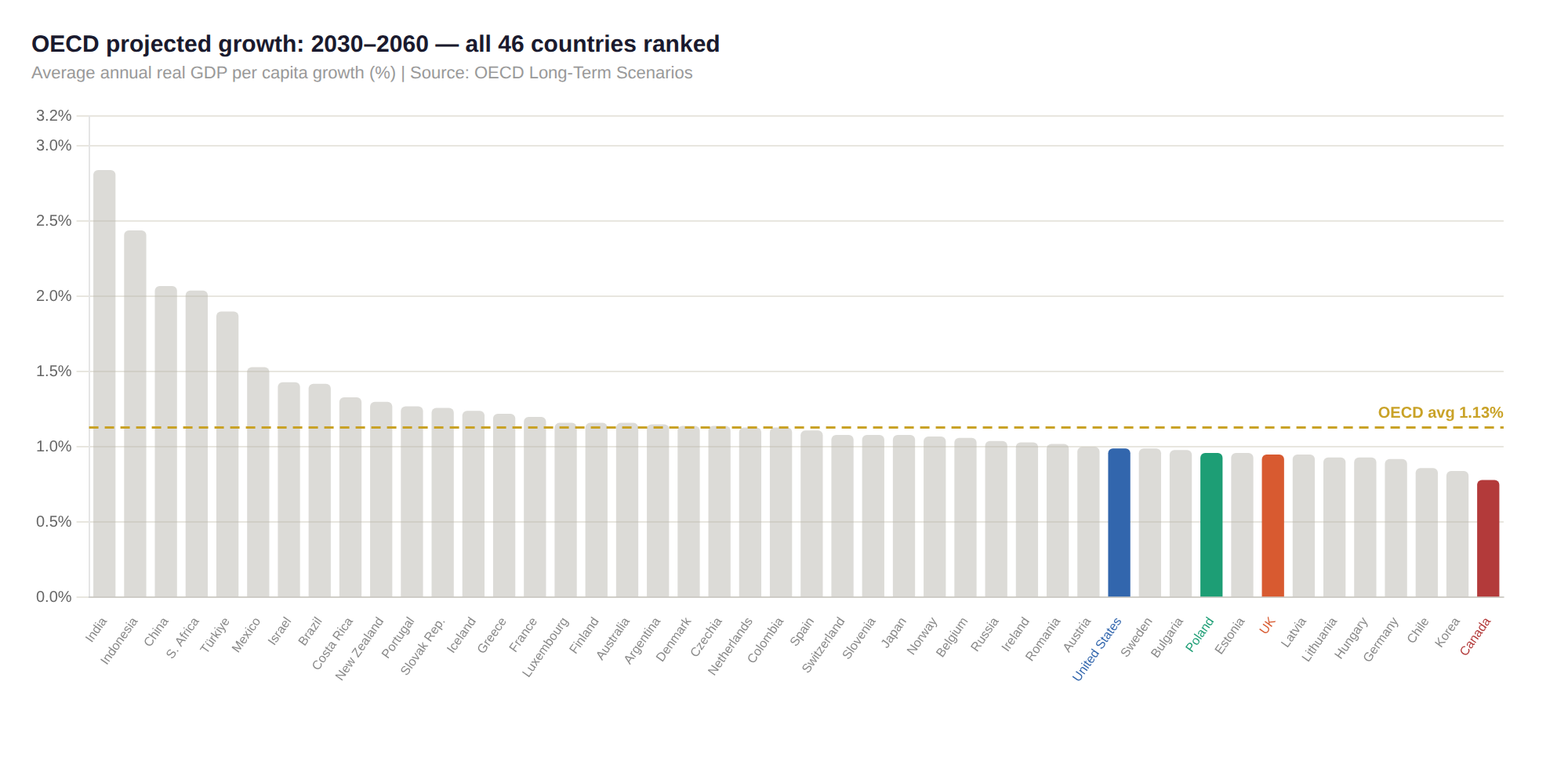
Source as 03/18/26
What Investors Should Watch Next
Poland’s story is, at its core, an optimistic one. We know how to cure economic stagnation. The prescription is well-tested. The results are dramatic and durable. When governments trust markets over ministries, growth follows. This has been reliably, repeatedly demonstrated across cultures and continents.
The question for any portfolio is simple: which countries are walking in Poland’s direction, and which ones have stopped?
Poland reminds us that the cure exists, that good decisions compound remarkably quickly. In less than one generation, an electrician’s revolution built a trillion-dollar economy. The courage to follow that example is the scarce commodity.
Glen