
Gold Seal Monthly Review
2025 Tax season reminder: Final tax slips are not available until April 1. See more information in Mallory’s Memo below.
Geopolitical update: What it means for markets and your portfolio
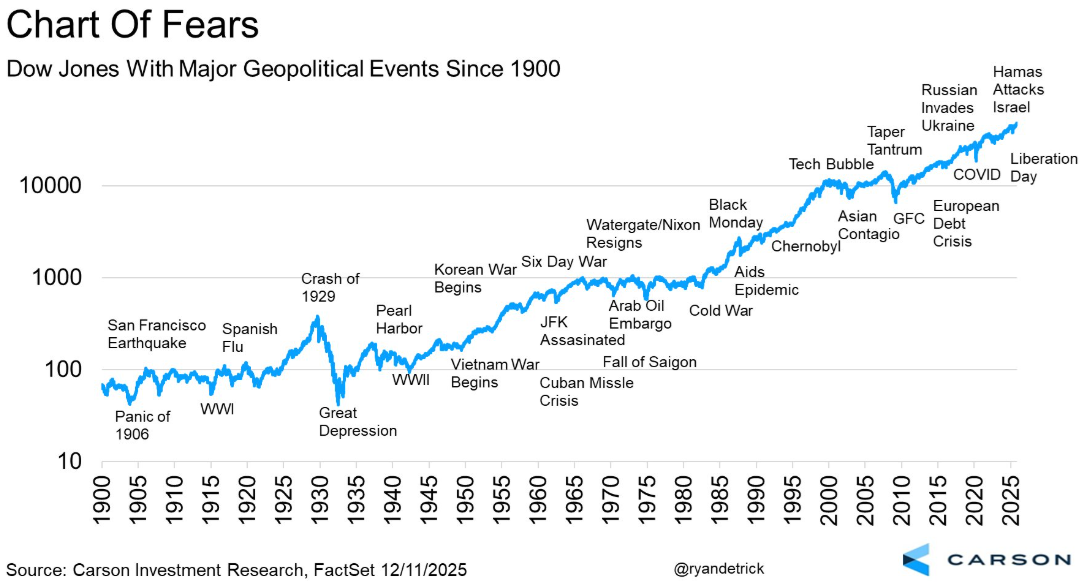
There’s been a noticeable shift in tone coming out of the Middle East over the past week. While headlines remain tense and, at times, escalate quickly, the broader pattern suggests we may be moving through a more dynamic phase rather than a simple, one-directional escalation.
That might seem counterintuitive. Strong language and rapid developments often signal rising risk, but in many cases, this is how complex negotiations unfold in real time. Pressure is applied, reactions follow, and positioning evolves. It’s not always comfortable to watch, but it is a familiar pattern.
What matters more than the headlines is how key players are actually behaving. Countries in the region, particularly those with the most at stake economically, continue to act cautiously and with a clear focus on stability. Investment commitments remain in place, alliances are holding, and there is still a strong incentive across the region to avoid meaningful disruption to energy markets and global trade.
At the same time, this situation is not just about military tension. Financial pressure is playing an equally important role. Energy flows, trade channels, and access to global financial systems are all part of the equation. In many ways, these forces will shape the outcome just as much as anything happening on the ground.
So what does this mean for markets?
When uncertainty rises, markets tend to price in worst-case scenarios. Energy prices can move higher, investors become more defensive, and volatility increases. As we’ve seen recently, those moves can happen quickly in both directions. When conditions stabilize, even modestly, that risk premium can begin to ease, leading to more stable energy pricing, improving confidence, and capital gradually moving back toward growth-oriented investments.
This is exactly the type of environment we prepare for.
Rather than trying to predict how events will unfold, we focus on positioning portfolios so they can navigate a range of outcomes. Over the past several months, that has meant maintaining exposure to areas that tend to benefit from uncertainty, while also ensuring we are ready to participate as conditions improve.
In practical terms, that balance has served clients well. Our Serenity Portfolios have remained resilient through periods of volatility, while still being positioned to capture upside when markets find their footing. It’s not about making big, reactive moves. It’s about making thoughtful adjustments and staying aligned with long-term objectives.
We continue to emphasize diversification across asset classes, regions, and strategies, including allocations designed to provide stability when markets are unsettled. At the same time, we remain attentive to opportunities that can emerge as uncertainty begins to fade.
It’s also worth noting that situations like this rarely resolve in a straight line. There will likely be periods where headlines become more or less concerning. That’s normal. Markets tend to move ahead of the news, not in sync with it, which means recoveries often begin before the headlines fully improve.
Looking forward, the most likely path is not a sudden resolution, but a gradual shift toward a more stable, though still complex, environment. If that continues, we would expect to see less pressure on energy markets, improving investor sentiment, and a broader reallocation of capital toward long-term growth.
For now, the focus remains the same. Stay disciplined, stay diversified, and avoid reacting to short-term noise. Our role is to ensure your portfolio is positioned not just to withstand uncertainty, but to benefit as clarity returns.
The quiet end of one of B.C.’s best retirement hacks
For years, B.C.’s Property Tax Deferral Program was one of the most quietly powerful tools available to retirees. Many financially savvy homeowners used it strategically, not because they couldn’t afford their property taxes, but because the math made sense.
Historically, the program charged simple interest at up to 2% below prime, and importantly, that interest did not compound. In practice, that meant homeowners could defer property taxes at extremely attractive rates. In some periods the cost of borrowing through the program was close to 0.5%–3%, far lower than most credit lines or mortgages.
Many retirees realized something interesting: if your portfolio could reasonably earn more than the borrowing cost, it sometimes made financial sense to defer the taxes and keep your investments working. That strategy may now be coming to an end.
Beginning with 2026 tax deferrals, the province has changed the structure of the program dramatically. Instead of simple interest below prime, the new rules apply interest at prime plus 2%, compounded monthly. That is a very different equation.
Compound interest means you now pay interest on interest, and the rate itself is materially higher than before. In other words, what used to resemble a subsidized government loan now looks much closer to a conventional borrowing rate.
What does this mean in practice?
First, existing deferred balances from prior years will keep their original terms, which is good news for homeowners who have already been using the program. However, new deferrals going forward will accumulate interest much more quickly.
From a planning perspective, the strategy changes:
If you were using the program purely as a financial optimization tool, it may no longer make sense in many cases. The new borrowing cost may be higher than what many retirees are comfortable carrying over long periods.
On the other hand, the program still serves its original purpose well. For homeowners who are cash-flow constrained but equity rich, it can still provide flexibility and allow people to remain in their homes longer without being forced to sell assets or relocate.
The key takeaway is simple: a strategy that used to be an easy “yes” now requires a bit more analysis. As always, when government programs change quietly in the background, it is worth revisiting how they fit into your broader financial plan.
Gold Seal Insights
Mallory’s Memo: Your 2025 tax Package

Tax season is here and your 2025 tax documents are available through our secure client portal. To access your Tax Package visit: MyPortfolio+
First-time user? Click “Start here”; Forgot your password? Click “Forgotten password?”; Don’t know your User ID? Contact the Gold Seal team.
Once logged in: Open the Documents menu> Select Reports to download your Tax Package> Select Tax Slips to download your T-slips
Reminder, our tax slips are being issued up until April 1 2026. Third-party tax slips, such as those from mutual fund companies, are sent to you directly from those institutions. We strongly recommend not submitting your tax return early unless you are confident that all slips have been received. Missing documents can result in reassessments and unnecessary delays.
If you are unsure whether your documents are complete, our team is happy to help.
Tanya’s Tips: A quick security reminder for clients

We were recently made aware of an attempted phone scam targeting investment clients in Canada. In this case, a caller contacted an individual claiming to represent the Canadian Investment Regulatory Organization (CIRO) and asked the client to confirm whether they had accounts at their investment firm.
Fortunately, the client recognized that something didn’t feel right and ended the call. The incident has since been reported to the appropriate regulatory bodies.
It’s a good reminder that financial fraud attempts continue to evolve, and they often rely on creating urgency or using official-sounding names to gain trust.
A few important points to keep in mind:
- Regulators such as CIRO do not call clients to verify whether they hold accounts at an advisory firm.
- If you ever receive a call, email, or text asking you to confirm account information, do not provide any details.
If something feels unusual, the safest step is to hang up and contact our office directly using the phone number you already have for us.
We monitor these types of issues closely and work with our firm’s compliance team to report suspicious activity when it arises. If you ever receive a call that references your investments and you’re unsure whether it is legitimate, please let us know. We would always prefer a quick check-in than have you worry about it.
As always, protecting our clients’ financial security remains a priority.
Noteworthy Links
- Geopolitical tensions and oil prices: What they mean for Canadian investors
- The war is over. Human advisors won.
- Federal government reveals new deficit number
- What does a market bottom look like this time?
- Don’t let the foreign investment numbers fool you
Picture of the month