
Dear Friends and Clients,
September always feels like a season of fresh starts. Summer vacations come to an end and children head back to school.
Back in Prince Edward Island, September is harvest season. Potato fields begin to clear, grain combines are busy from sunrise to sunset, and farmers finally get a chance to see the results of work that started months earlier. Investing often feels the same way. Most of the important work happens long before the results become visible.
We wanted to sit down after this latest earnings season to provide a plain-spoken update on the world, the markets, and the adjustments we have made to your portfolios.
Investment performance
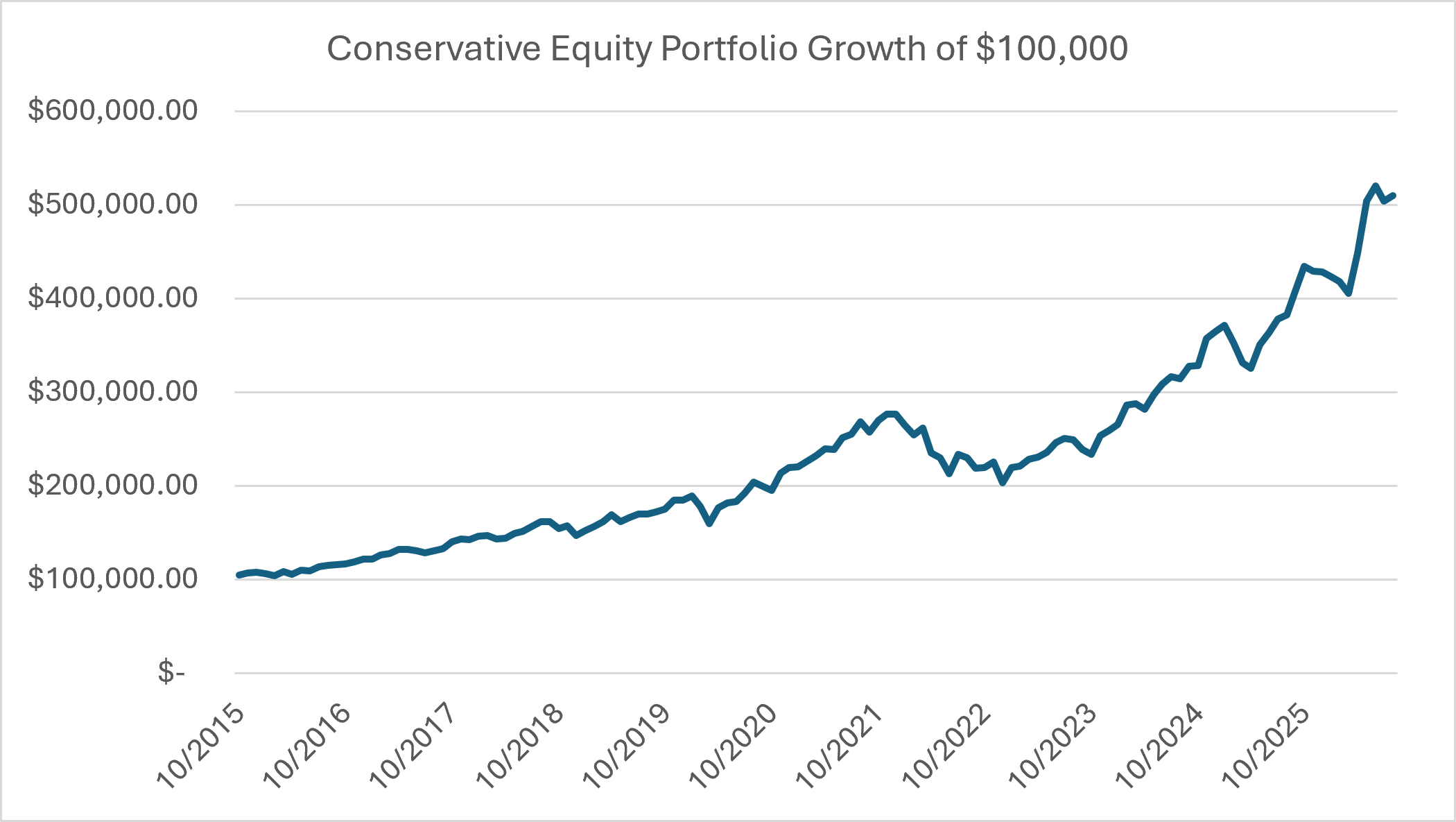
Year to date, our portfolios are compounding nicely, with many of our higher conviction, more concentrated positions doing the heavy lifting.
|
As of August 31, 2026 |
YTD |
1Y |
3Y |
5Y |
SI |
|
CONSERVATIVE EQUITY TOTAL GROSS RETURN (CAD) |
19.1% |
33.4% |
27.0% |
13.7% |
16.1% |
|
Benchmark (50% DJ US Div 100; 45% S&P/TSX 60, 5% S&P Can T-Bill) |
22.0% |
27.8% |
19.2% |
12.0% |
|
|
Morningstar Category (Global Equity) |
10.7% |
17.5% |
16.0% |
9.3% |
|
|
|
|
|
|
|
|
|
DIVERSIFIED INCOME TOTAL GROSS RETURN (CAD) |
6.6% |
13.8% |
16.1% |
8.7% |
11.0% |
|
Benchmark (35% S&P Can Bond; 25% S&P Can Div; 25% DJ US Div 100; 10% MSCI EAFE, 5% S&P Can T-Bill) |
13.5% |
18.4% |
13.5% |
8.1% |
|
|
Morningstar Category (Global Neutral Balanced) |
6.9% |
12.4% |
11.3% |
6.1% |
|
|
|
|
|
|
|
|
|
FOCUSED TOTAL RETURN TOTAL GROSS RETURN (CAD) |
28.8% |
47.6% |
32.0% |
18.9% |
25.1% |
|
Benchmark (40% DJ US Div 100; 35% S&P/TSX 60, 20% S&P Can Bond, 5% S&P Can T-Bill) |
17.6% |
22.4% |
16.0% |
9.5% |
|
|
Morningstar Category (Tactical Balanced) |
6.8% |
12.7% |
10.2% |
5.5% |
|
|
|
|
|
|
|
|
|
S&P 500 (NR USD) – USA |
12.9% |
20.0% |
20.6% |
12.3% |
|
|
S&P TSX 60 (NR CAD) – CANADA |
15.8% |
27.9% |
23.2% |
14.2% |
|
|
MSCI EAFE (GR CAD) – EUROPE |
14.9% |
22.5% |
19.1% |
11.2% |
|
|
S&P CANADA ALL BOND |
0.6% |
2.0% |
4.1% |
0.5% |
|
*Your own returns will vary depending on the amount of fixed income you hold, cash flows in and out, and management fees.
Portfolio changes
Our strategy the last couple of months has been simple: recycle capital from businesses we feel have become fully priced to names at more attractive valuations. Over the last two months, we trimmed our positions in Royal Bank and CN Rail. Royal Bank is currently trading at nearly three times its book value, which is historically expensive for a Canadian bank, and CN Rail recently tagged a 52-week high.
We used that cash to add to our positions in Tesla and Google at lower historical valuations following post-earnings sell-offs. More recently, we took some profits on Microsoft after a sharp rally, reallocating that capital into Micron. In July, a large, highly leveraged artificial intelligence (AI) hedge fund called Situational Awareness blew up and was forced to liquidate its massive Micron position to Citadel. We happily stepped in to buy during that forced selling and volatility.
The AI buildout & the real economy
Three years ago, AI was essentially a chatbot; today, it is becoming a full-time employee. Roughly a third of large companies now have at least one AI agent running in their workflows, and that number is projected to hit 40% of enterprise software by the end of the year.
These digital agents live in physical data centres, and building those centres requires steel, copper, transformers, and electricians. This is creating high-paying, union jobs and expanding the tax base. The U.S. government also permanently restored a 100% first-year write-off for equipment placed in service after January 2025, which acts as a massive invitation for companies to build out their infrastructure.
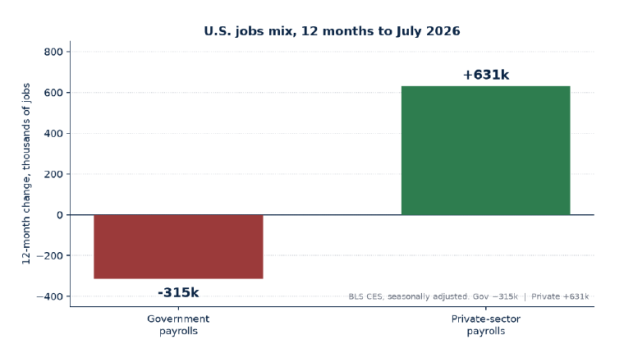
This private investment is reshaping the labour market. Over the last 12 months, U.S. government payrolls fell by roughly 315,000, while the private sector added 631,000 jobs. We will gladly take a shrinking bureaucracy and a growing private sector any day of the week.
Rapid fire: Quarterly earnings
S&P 500 earnings were up an impressive 52% in the second quarter. Even if you strip out the paper gains from Amazon and Alphabet marking up their private investments, earnings still grew by a robust 34%. Here is a quick look at the businesses doing the heavy lifting:
The macro picture: Trade & energy
The ongoing trade dispute between Canada and the United States remains a headwind. After the U.S. opted not to renew the United States-Mexico-Canada Agreement, they threatened 50% tariffs across multiple sectors, bringing both sides to the negotiating table. After weeks of negotiations, Canadian officials walked out of negotiations without a deal, implementing retaliatory tariffs of 50% in response.
The U.S. Secretary of Commerce Howerd Lutnick publicly stated that the Canadians hinted to him that they were purposefully torpedoing the deal for political reasons. On the Canadian side Prime Minister Carney stated that the Americans were at fault because they kept asking for more even after an agreement was reached in principle. Which side is to be believed we are not sure but there could of course be some truth behind both.
For context, the U.S. economy is 13 times larger than Canada’s, and they represent 73% of our total exports, while Canada only represents about 15% of U.S. exports. In a trade marriage like this, you have to ask yourself: would you rather be right, or would you rather be happy? The uncertainty itself acts as a tax, causing businesses to delay building plants and making capital investments.
Markets hate uncertainty, while politicians and news agencies love it. Fortunately, the Canadian economy showed resilience, bouncing back with a 3.3% annualized growth rate in the second quarter, largely aided by strong oil and auto exports which may shorten some of the blow on the short term. For now, the only ones benefiting are politicians in our eyes, with the Canadian Liberal party seeing a boost in popularity for walking out while here in Quebec the provincial election has gone from a major lead for the Parti Quebecois to a closer race with the CAC gaining momentum talking about the threat south of the border.
On the energy side, elevated tensions in the Strait of Hormuz have created a spike in global oil prices which oddly helps the Canadian dollar and Canadian exports. Diesel in particular is spiking even higher as it has also been effected by the war between Russia and Ukraine. This puts pressure on shipping costs further and raises the cost of all goods.
Interest rates and what keeps us awake
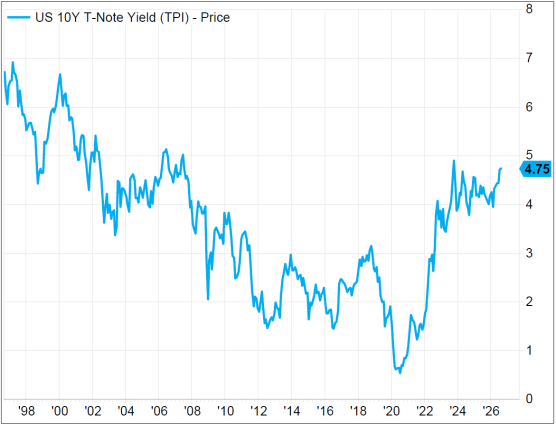
Global interest rates have spiked alongside recent oil prices. The U.S. 10-year bond yield currently sits around 4.84%, while the 30-year is at 5.3%. U.S. Treasury Secretary Scott Bessent attempted to calm the waters by announcing a doubling of the bond buyback program for long-term debt. This temporarily caused yields to drop, but the bond market quickly resumed selling off due to concerns over surging national debt levels.
When interest rates rise significantly, the valuations of high-growth assets are compressed. This is what happened in 2022 when interest rates went up and growth stocks went down.
The second issue we monitor closely is physical infrastructure limits. The memory chip bottleneck is actively being solved by companies like Micron, but securing enough electrical power for the 2027 data-centre fleet is a hurdle we take very seriously. Electricity could restrict economic growth a few years out if not addressed.
A note on progress
To end on an optimistic note, we are witnessing an incredible acceleration in medical science. Moderna recently hit Phase 3 trials for a personalized melanoma vaccine. The science of sequencing a tumor to train the immune system has been around for decades, but AI has drastically increased the speed of this process. Big Pharma sees this writing on the wall; Eli Lilly, a name we added to in July, recently purchased Ajax Therapeutics and signed major deals to take AI-discovered medicines worldwide.
We remain firmly optimistic about the businesses we own and the future they are building. Earnings are doing the heavy lifting. We are maintaining our target of 8,000 for the S&P 500 by year-end, and 15,000 by the year 2030.
Warmly,
Michael & Simon Hale
Senior Wealth Advisors & Portfolio Managers
Hale Investment Group