


Challenging the Artificial Intelligence Job Apocalypse
Is artificial intelligence (AI) coming for your job? According to The Economist, one in three people believe AI will cause widespread job losses, while seven out of 10 believe it will make it harder for people to find work.
Beyond the geopolitical volatility dominating headlines, the “AI job apocalypse” has become a common narrative. It doesn’t help that the unemployment rate has been creeping upward, and that many recent college and university graduates are struggling to find work.
Of course, there’s no doubt that AI improves productivity. A recent paper from Stanford University examined how large language model tools (generative AI systems known as LLMs) are already significantly improving productivity across a range of knowledge based tasks. The results are striking. In every common work task that was studied, generative AI reduced completion time by at least half, and in most cases by around 70 to 75 percent (chart below). The study also found that LLM adoption among U.S. workers rose significantly from 30.1 percent as of December 2024 to 38.3 percent as of December 2025.1
Given the proven capabilities and rapid advancement of AI, it will undoubtedly eliminate some tasks and compress certain roles. There is evidence that this may already be happening.2 However, the notion that AI will imminently create permanent, widespread unemployment might be exaggerated.
How Many Minutes Does AI Save? Select Work Tasks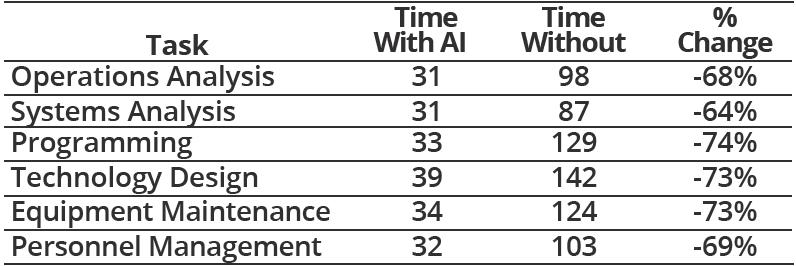
 Historically, productivity gains have often expanded economic activity rather than contracted it, creating new industries, new demand and ultimately new forms of employment. A related dynamic is seen in the Jevons Paradox: efficiency gains lower costs, which tends to increase overall consumption rather than reduce it. William Jevons observed this phenomenon in the 19th century when improvements in efficiency led to greater overall coal consumption, not less.
 We’ve been here before. In 1951, when IBM introduced its electronic calculator, it was promoted as capable of replacing 150 engineers. Yet, 75 years later, engineers remain indispensable. Every major platform shift arrives with the familiar promise and worry: more output, fewer people, instant transformation. In recent decades, similar fears surrounded radiologists, telemarketers and travel agents. In practice, technology augmented these professions rather than eliminating them outright.
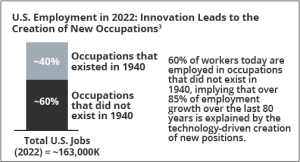
 Then there are the jobs that do not yet exist. One study suggests that technology has facilitated the creation of new occupations that now employ 60 percent of workers today (above). Indeed, the labour market will evolve, as it always has when transformative technologies emerge. But worries of widespread and permanent unemployment may ultimately prove to be a shortsighted view of the world ahead.
1. https://papers.ssrn.com/sol3/papers.cfm?abstract_id=5136877
2. https://fortune.com/2026/04/06/ai-tech-displacement-effect-gen-z-16000-jobs-per-month/
3. https://www.gspublishing.com/content/research/en/reports/2023/03/27/d64e052b-0f6e-45d7-967b-d7be35fabd16.html
 The information contained herein has been provided for information purposes only. The information has been drawn from sources believed to be reliable. Graphs, charts and other numbers are used for illustrative purposes only and do not reflect future values or future performance of any investment. The information does not provide financial, legal, tax or investment advice. Particular investment, tax, or trading strategies should be evaluated relative to each individual’s objectives and risk tolerance. This does not constitute a recommendation or solicitation to buy or sell securities of any kind. Market conditions may change which may impact the information contained in this document. Wellington-Altus Private Wealth Inc. (WAPW) does not guarantee the accuracy or completeness of the information contained herein, nor does WAPW assume any liability for any loss that may result from the reliance by any person upon any such information or opinions. Before acting on any of the above, please contact your financial advisor. Transactions of the type described herein may involve a high degree of risk, and the value of such instruments may be highly volatile. Such risks may include without limitation risk of adverse or unanticipated market developments, risk of issuer default and risk of illiquidity. In certain transactions prospective investors may lose their entire investment or incur an unlimited loss. This brief statement does not disclose all the risks and other significant aspects in connection with transactions of the type described herein, and prospective investors should ensure that they fully understand the terms of the transaction, including the relevant risk factors and any legal, tax, regulatory and accounting considerations applicable to them, prior to transacting. The information contained herein may include the opinions of representatives of third-party companies or organizations and may not necessarily reflect that of Wellington-Altus (WA) or its representatives. All third-party products and services referred to or advertised are sold by the company or organization named. While WA may have referral arrangements with some third-party companies or organizations, WA does not specifically endorse any of these products or services and is not liable for any claims, losses or damages however arising out of any purchase or use of third-party products or services. All insurance products and services are offered by life licensed advisors of Wellington-Altus Insurance Inc. or other insurance companies separate from WAPW.
© 2026, Wellington-Altus Private Wealth Inc. ALL RIGHTS RESERVED. NO USE OR REPRODUCTION WITHOUT PERMISSION. www.wellington-altus.ca
If you no longer wish to receive commercial electronic messages from Wellington-Altus Private Wealth Inc., please send an email to unsubscribe@wellington-altus.ca