
News & Updates​

Understanding the RRSP Deduction Limit Statement

WA-Featured-Image

The Difference Between an RRSP Contribution vs. an RRSP Deduction, and More

Click here to download the PDF.

Every year clients look at the RRSP Deduction Limit Statement on their Notice of Assessment and ask similar questions:

• Is there a difference between a RRSP contribution and a RRSP deduction?

• I have RRSP deduction room and unused contributions — what does this mean?

• My unused contribution room for the year is negative $3,500 — am I in an RRSP overcontribution situation?

Let’s start with fundamentals — the RRSP deduction limit outlines how much an individual can contribute and deduct for personal tax purposes (plus the cumulative $2,000 overcontribution allowance). RRSP contributions are the amounts individuals have deposited into their RRSPs and which may be deducted for income tax purposes. If contributions do not exceed deduction room by over $2,000 there is no cause for concern.

Now let’s look at the RRSP Deduction Limit Statement, which can be found on an individual’s annual Notice of Assessment/Reassessment, CRA’s My Account and MyCRA mobile app.
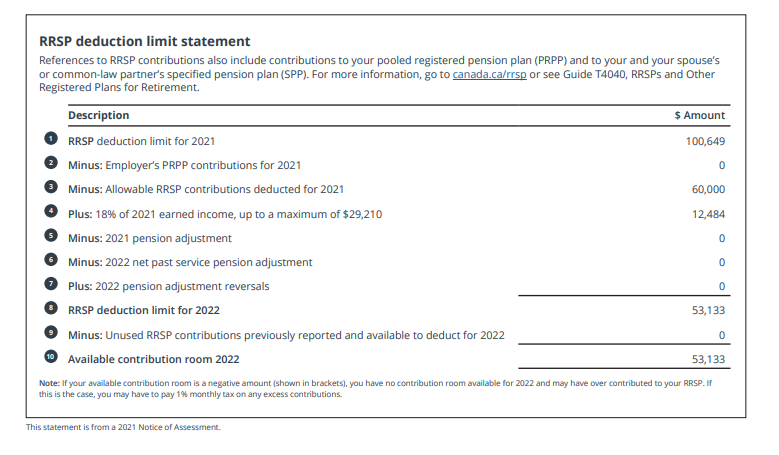
RRSP Deduction Limit Statement Broken Down

Line 1: RRSP deduction limit for 2021 — reflects RRSP carry forward room available from the prior year of $100,649.

Line 2: Reflects any optional employer Pooled Retirement Pension Plan contributions.

Line 3: This RRSP Deduction Limit Statement also reflects 2021 RRSP contributions of $60,000 that were deducted on the individual’s 2021 personal tax return. Line 4: Additional RRSP room generated of $12,484 given their 2021 earned income times 18%, up to the annual limit. 2022’s annual RRSP contribution limit was $29,210, and 2023’s is $30,780.

Lines 5-7: Any adjustments related to Registered Pension Plan (RPP) benefits. Adjustments include registered pension plan contributions, net past service or pension adjustment reversals. Such information would have been reflected on an individual’s 2021 T4 or other pension tax slips. It appears this taxpayer is not enrolled in a pension plan with his/her employer.

Line 8: When all these amounts are combined, the RRSP deduction limit for 2022 is calculated. For this individual it is $53,133. The next two lines can be problematic.

Line 9: Unused RRSP Contributions. This line shows RRSP contributions that have not been deducted for income tax purposes.

Line 10: Available Contribution Room for 2022. This line indicates the maximum RRSP contributions that an individual can deduct in 2022 — the next year. Contributions can be made up to 60 days after the calendar year-end, that is, by March 1, 2023.

Let’s tweak some facts to outline relevant information in Lines 9 and 10:

What if this individual had contributed $100,000 to their RRSP in 2021, but only deducted $60,000 as indicated? The remaining $40,000 would be reflected in Line 9, “Unused RRSP contributions previously reported and available to deduct for 2022.” Given the unused contributions of $40,000 are less than their 2022 RRSP deduction limit of $53,133, the amount on Line 10 would show a positive balance of $13,133 and there is no concern about overcontribution.

Let’s consider a final scenario — let’s say the individual contributed $150,000 to their RRSP in 2021, and again deducted $60,000. The remaining $90,000 is reflected as an unused contribution. Unfortunately, as $90,000 exceeds the individual’s RRSP deduction limit of $53,133 plus the $2,000 the RRSP overcontribution buffer, the individual has overcontributed to their RRSP. Line 10 would show a negative balance of $36,867 and will be subject to the 1% RRSP overcontribution penalty per month.

We hope this explanation of the RRSP Deduction Limit Statement helps in your RRSP planning. Remember, you don’t have to be the expert here — if you have questions, please reach out to your Wellington-Altus advisor.

Recent Posts

August Market Insights: Beyond The AI Bottleneck

A leadership transition is already underway, but much of the market remains anchored to the last trade. Investors are still crowded into semiconductors, memory and artificial intelligence (AI) infrastructure supported by passive flows and a sell-side that continues to extrapolate an era of outsized earnings surprises that has largely run its course. The earnings revision cycle in AI-adjacent infrastructure is maturing. The bottleneck trade is crowded, over-owned and increasingly exhausted at current valuations. Tocqueville’s line belongs here: what is being mistaken for novelty is, in fact, a familiar late-cycle pattern, consensus convergence, narrow leadership and risk concentrated in the assets investors perceived as safest.

Read More »

June Market Insights: America at 250

America reaches its 250th anniversary not as a fallen hegemon, but as the dominant centre of global hard power, monetary power, and frontier innovation. It still sits astride the world’s resource base through energy, agriculture, and continental depth; it still issues the reserve currency at the core of global trade and finance; and it still leads the race to build artificial intelligence (AI) as the next digital platform. Yet precisely because American power remains so large, the visible breakdown of the post–Second World War rules-based order has become impossible to ignore. To anyone who has read German historian and philosopher Oswald Spengler’s The Decline of the West (1918), this is not a surprise but a pattern: history is not a straight line of progress. Instead, it is the record of civilizations that rise as living cultures harden into systems and eventually exhaust the moral energy that made them great in the first place. America did not choose this time, but it has been born into it.

Read More »

May Market Insights: Mastery and the Terror Premium

Winston Churchill, as first lord of the Admiralty, tied Britain’s fate to Persian oil. United States President Donald Trump’s war in Iran, centred on Operation Epic Fury, could do the same for the West by removing Iran’s nuclear shadow, resetting oil toward US$60, and finally unlocking a modern peace dividend.

“Mastery itself was the prize of the venture.” Winston Churchill’s 1912–13 case for converting the Royal Navy from coal to oil—enshrined in historian Daniel Yergin’s The Prize: The Epic Quest for Oil, Money, and Power captured the brutal clarity of a great power energy strategy: accept dependence to command the seas. That wager framed the last century. In 2026, as Epic Fury grinds through the Gulf and Brent trades above US$100, the question is no longer whether oil confers mastery, but who holds it: a revolutionary theocracy astride the Strait of Hormuz, or a West intent on stripping the terror and nuclear risk now priced into every barrel out of the energy system—finally collecting a long‑deferred peace dividend.

Read More »

The information contained herein has been provided for information purposes only. The information has been drawn from sources believed to be reliable. Graphs, charts and other numbers are used for illustrative purposes only and do not reflect future values or future performance of any investment. The information does not provide financial, legal, tax or investment advice. Particular investment, tax, or trading strategies should be evaluated relative to each individual’s objectives and risk tolerance. This does not constitute a recommendation or solicitation to buy or sell securities of any kind. Market conditions may change which may impact the information contained in this document.  Wellington-Altus Private Wealth Inc. (WAPW) does not guarantee the accuracy or completeness of the information contained herein, nor does WAPW assume any liability for any loss that may result from the reliance by any person upon any such information or opinions.  Before acting on any of the above, please contact your financial advisor. Insurance products are provided through Wellington-Altus Insurance Inc.

Lakeview Wealth Management Logo