
News & Updates​

Estate Planning: Getting the Details Right

WA-Featured-Image

When it comes to estate planning, co-ordination of documents and details such as beneficiary designations matter. A lack of planning and out of date or incomplete documentation can result in additional costs, delays and taxes for your estate, or a loss of control over certain aspects, such as the guardianship of minor children and/or how you want your assets to be distributed when you die. Even carefully planned estates can be undone by technical glitches or unnecessary complications.

What is an estate?1

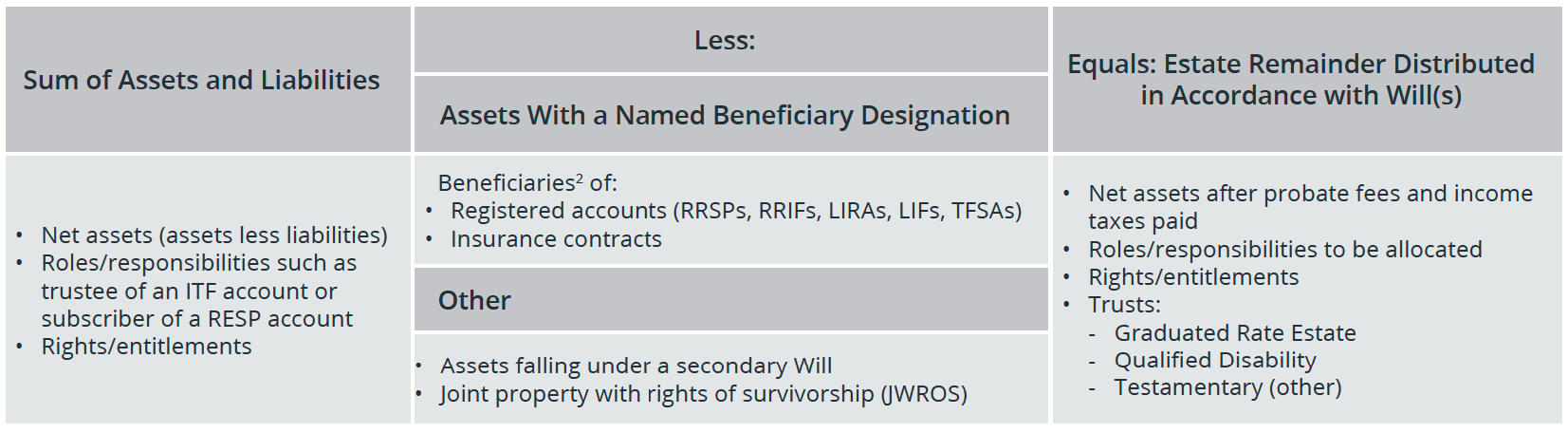
An estate is the net worth of a person, namely: the total value of your assets, including any legal roles, responsibilities, rights, and entitlements you may have, minus assets flowing directly to your beneficiaries and any changes to your legal standing, as outlined in Table 1.

Table 1: The Estate Equation
The Estate Equation

Your Wellington-Altus investment accounts

When you die, the assets in your various Wellington-Altus accounts remain invested until they are transferred to beneficiaries named in the account documents or your executor acts on the instructions you have provided in your Will.

Upon notice of death, purchases in non-managed accounts are restricted, dispositions are allowed and any outstanding or closing fees will be charged. There are no trading restrictions on managed accounts and fees will be charged until assets are transferred and the estate is settled.

To facilitate the transfer of wealth, here are some key estate planning points to consider:
  • Rollover opportunities. Many registered accounts, including RRSPs, RRIFs, LIFs and TFSAs allow for assets to be “rolled over” to a spouse, minor dependent or disabled dependent without tax consequences on the death of the account holder.3 It is possible to opt out of the rollover if desired.
  • Minor and adult beneficiaries who lack capacity. Include the name of a trustee to ensure that they can access funds for the care of dependant beneficiaries.
  • Legal standing. A spouse is typically the legal beneficiary of a locked-in registered account. Ensure that separation or divorce notices, or a waiver to name a different beneficiary, are on file as required.
  • Jurisdictional wrinkles. Legislation related to naming a beneficiary and the rights and entitlements of spouses and common-law partners can vary significantly across different provinces and territories. In Quebec, registered accounts do not allow beneficiary designations. Common-law partners do not have the same rights as spouses in all jurisdictions and may have no rights at all to the estate. As well, in the absence of a Will – an individual’s estate is intestate – spouses and children may not automatically inherit all assets.
  • Joint ownership. Holding property and accounts jointly with rights of survivorship is a popular tool to bypass probate, particularly in jurisdictions with high probate fees. There are many potential traps with this sort of planning, and it should only be undertaken with the advice of an estate planning professional.


Note that with JWROS, tax and succession law do not always align. If one owner dies, for example, assets will transfer to the surviving owner, but the deceased is still considered to have disposed of the assets and their estate may be taxed depending upon who the surviving joint owner is. For JWROS accounts where the owners are not spouses or common-law partners, as in the case of an adult child being added to a parent’s investment account, it’s important to document the intention of this arrangement to avoid legal issues when settling the estate, as it may be used to transfer assets or simply for administrative purposes.

Estate Planning in Practice: A Case Study

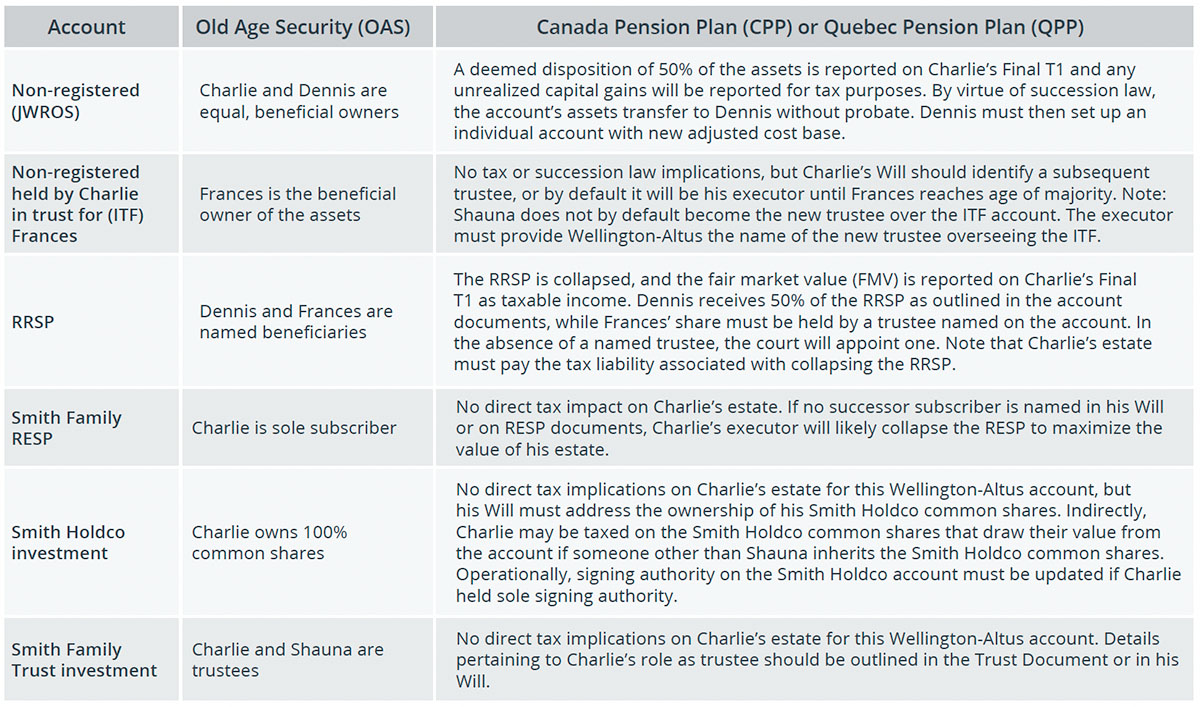
Charlie and Shauna Smith are married with two children, Dennis, age 20 and Frances, 16 and live in Saskatchewan. What would happen to Charlie’s Wellington-Altus accounts if he dies?

Wellington-Altus accounts CPP and QPP if passing away

The Power of 5

It’s wise to revisit your estate plan at least every five years and when one of the following life events occurs:

  1. A change in your relationship status. A new common-law partner or spouse, a relationship breakdown or the death of a common-law partner or spouse.
  2. The purchase of real property.
  3. A new beneficiary or new beneficiary need. The addition of a child, grandchild or other dependent, or when a beneficiary has additional needs to be addressed.
  4. A change in residency. When moving to a different province/territory or country.
  5. A significant change in your health, financial or other economic circumstances.

Your advisor can help

There is no better time to begin the process of estate planning than today. Reach out to your Wellington-Altus advisor for assitance to begin the process.

1 Under Quebec’s civil law, this is known as a person’s patrimony or succession.


2 Beneficiaries may be named at the account level or in the will. Beneficiaries cannot be named on registered accounts in Quebec.


3 Beneficiaries to registered accounts cannot be named in Quebec. This intention must be included in the Will.

Recent Posts

August Market Insights: Beyond The AI Bottleneck

A leadership transition is already underway, but much of the market remains anchored to the last trade. Investors are still crowded into semiconductors, memory and artificial intelligence (AI) infrastructure supported by passive flows and a sell-side that continues to extrapolate an era of outsized earnings surprises that has largely run its course. The earnings revision cycle in AI-adjacent infrastructure is maturing. The bottleneck trade is crowded, over-owned and increasingly exhausted at current valuations. Tocqueville’s line belongs here: what is being mistaken for novelty is, in fact, a familiar late-cycle pattern, consensus convergence, narrow leadership and risk concentrated in the assets investors perceived as safest.

Read More »

June Market Insights: America at 250

America reaches its 250th anniversary not as a fallen hegemon, but as the dominant centre of global hard power, monetary power, and frontier innovation. It still sits astride the world’s resource base through energy, agriculture, and continental depth; it still issues the reserve currency at the core of global trade and finance; and it still leads the race to build artificial intelligence (AI) as the next digital platform. Yet precisely because American power remains so large, the visible breakdown of the post–Second World War rules-based order has become impossible to ignore. To anyone who has read German historian and philosopher Oswald Spengler’s The Decline of the West (1918), this is not a surprise but a pattern: history is not a straight line of progress. Instead, it is the record of civilizations that rise as living cultures harden into systems and eventually exhaust the moral energy that made them great in the first place. America did not choose this time, but it has been born into it.

Read More »

May Market Insights: Mastery and the Terror Premium

Winston Churchill, as first lord of the Admiralty, tied Britain’s fate to Persian oil. United States President Donald Trump’s war in Iran, centred on Operation Epic Fury, could do the same for the West by removing Iran’s nuclear shadow, resetting oil toward US$60, and finally unlocking a modern peace dividend.

“Mastery itself was the prize of the venture.” Winston Churchill’s 1912–13 case for converting the Royal Navy from coal to oil—enshrined in historian Daniel Yergin’s The Prize: The Epic Quest for Oil, Money, and Power captured the brutal clarity of a great power energy strategy: accept dependence to command the seas. That wager framed the last century. In 2026, as Epic Fury grinds through the Gulf and Brent trades above US$100, the question is no longer whether oil confers mastery, but who holds it: a revolutionary theocracy astride the Strait of Hormuz, or a West intent on stripping the terror and nuclear risk now priced into every barrel out of the energy system—finally collecting a long‑deferred peace dividend.

Read More »

The information contained herein has been provided for information purposes only. The information has been drawn from sources believed to be reliable. Graphs, charts and other numbers are used for illustrative purposes only and do not reflect future values or future performance of any investment. The information does not provide financial, legal, tax or investment advice. Particular investment, tax, or trading strategies should be evaluated relative to each individual’s objectives and risk tolerance. This does not constitute a recommendation or solicitation to buy or sell securities of any kind. Market conditions may change which may impact the information contained in this document.  Wellington-Altus Private Wealth Inc. (WAPW) does not guarantee the accuracy or completeness of the information contained herein, nor does WAPW assume any liability for any loss that may result from the reliance by any person upon any such information or opinions.  Before acting on any of the above, please contact your financial advisor. Insurance products are provided through Wellington-Altus Insurance Inc.

Lakeview Wealth Management Logo