
Resilience Tested
Thank you for continuing to follow our insights and market commentary as we begin a new chapter as Lauer Brothers Private Wealth at Wellington-Altus Private Wealth Inc. We appreciate your interest and look forward to sharing our perspectives in the months ahead.
Canadian equities have generally remained competitive with their U.S. counterparts this year, as the chart below illustrates, but sustaining that resilience will depend on earnings, interest rates and how businesses adapt to changing trade conditions. Tariffs, trade-policy uncertainty and inflation remain potential obstacles, with uneven consequences across companies and sectors.
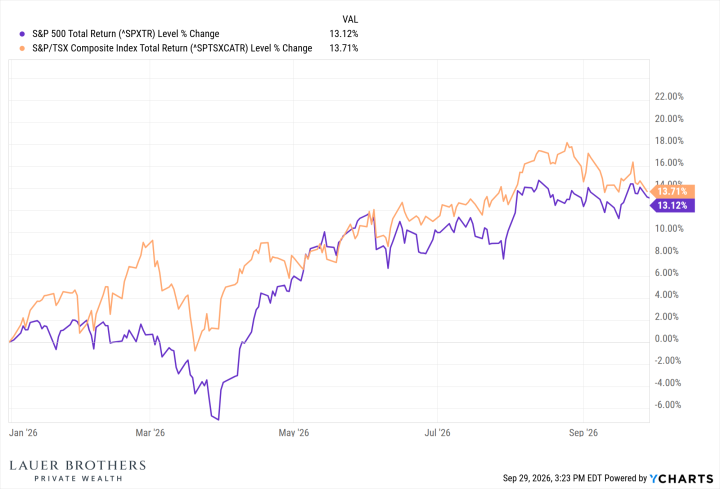
Total returns are normalized to a common starting value at the beginning of the year and shown in each index’s local currency: USD for the S&P 500 and CAD for the S&P/TSX Composite. Currency movements are not reflected; returns measured in a common currency may differ. Past performance is not indicative of future results.
Looking beyond the chart, this month’s three readings explore the decisions that will shape what comes next: how businesses adapt to a changing trading environment, who finances the investment that adaptation requires, and how families translate business success into lasting wealth.
Adapting to Change
Canadian businesses are responding to trade barriers by seeking new customers and suppliers. The Bank of Canada explains why that adjustment takes time—and why greater resilience can initially come with higher costs. It offers a useful perspective on the outlook: businesses can adapt, but the transition may put pressure on profitability before delivering benefits.
Financing the Future
Adapting to a changing economy requires capital. The AI buildout illustrates the scale: McKinsey estimates that data centres could require nearly US$7 trillion in investment by 2030, spanning computing equipment, buildings and power infrastructure. Its analysis explores who will provide that investment and the uncertainty surrounding future demand. For investors, the opportunity depends on whether the money committed today earns an adequate return tomorrow.
Beyond the Business
For families, allocating capital takes on a different meaning after selling a business. UBS explores the shift from managing a company to managing wealth intended to support spending, long-term growth and future generations. The central lesson: preserving the proceeds requires a deliberate balance between stability and growth, guided by what the family wants its wealth to accomplish.