The risk you can see isn’t always the risk that matters.
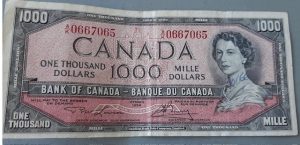
A 1954 Canadian $1,000 note—a useful reminder that preserving the number is not the same as preserving its purchasing power.
A 1954 Canadian $1,000 bill recently caught my attention. These notes are no longer in circulation, which makes them unusual—but what interested me most was not their collector value. It was the number printed on the front.
The fun part of investment management is the return. Bull markets can be a lot of fun, until they’re not. Returns and market volatility get the headlines, but the most important part of investment management is often the risk management part, and risk is not always obvious or easy to quantify.
Every client discussion lately seems to touch on the next crash or the next bubble. That matters. We want to be prepared because we do not know when the next major decline will happen. But when I tell clients that one of the riskiest assets they own may be the money sitting in their wallet, they sometimes look at me as if I am from another planet.
Therein lies one of investing’s great paradoxes:
“What feels safe can be risky, while what feels risky, can be safe”
The $1,000 bill survived, its purchasing power didn’t
The number printed on the bill has never changed. One thousand dollars in 1954 is still one thousand dollars today.
Imagine being extraordinarily risk-averse in 1954 and putting that bill under your mattress. You would have avoided every stock-market crash, recession and bear market of the past seven decades.
You also would have lost roughly 92% of its purchasing power.
Using Canadian CPI data, the basket of goods and services that cost about $1,000 in 1954 would cost roughly $12,000 today. Turn the comparison around, $1,000 in 1954 is worth about $83 today. It’s rare so the note may have collector value of around $1,500, even that doesn’t compare to the $12,000 needed to keep up with inflation.
You don’t have to go back 72 years to experience this.
The change since January 2020 is striking enough. Canada’s all-items CPI rose from 136.8 in January 2020 to 169.8 in August 2026. That means $1,000 held as cash over that period retained only about $806 of its January 2020 purchasing power.
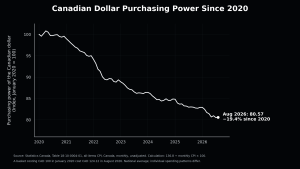
To keep pace with consumer prices, that $1,000 needed to grow to about $1,241—roughly 3.3% per year, before taxes and fees, simply to stand still.
How does the money in your wallet lose value?
Think in terms of abundance, and scarcity. Money printing is a big part of the story; inflation happens when too much money chases too few goods. Fiscal policy, productivity, supply constraints, energy costs, wages, expectations and the velocity of money all matter.
The result for a saver is simpler than the economics behind it: if the return on your cash does not keep pace with inflation after tax, purchasing power erodes little by little. You are losing money, even though it may not be obvious.
Why I watch the bond market
Interest rates are like oxygen to the economy. When rates rise, financing becomes more expensive for households, businesses and governments. If rates rise far enough, they can slow economic activity dramatically.
Most people watch the stock market every day. I also watch the bond market, especially the yield on the ten-year U.S. Treasury. That yield is set continuously by investors around the world and reflects, among other things, expectations for inflation, economic growth, future short-term rates and the return investors demand for lending for a decade.
On October 1, 2026, the U.S. 10-year Treasury yield briefly reached about 5.34%, its highest level since 2002. Long-term government bond yields have also been under pressure in other major markets all over the world.
Central banks set short-term policy rates. They influence longer-term borrowing costs, but they do not dictate them. Sometimes the bond market has already moved well before a central bank changes its overnight rate. In those moments, the policy announcement can look less like the beginning of a change and more like the central bank catching up to what markets have already been pricing.
Why we moved to zero bonds
Bonds make money when interest rates drop. Bonds lose money when interest rates go up. That distinction shaped our decision to move to a zero-bond allocation in 2022. With yields near historic lows and inflation pressure building, we saw very little reason to own bonds. Conventional thinking says bonds are safe, in 2022 interest rates were near 0%, bonds were anything but safe. Or, as I said to clients, in this environment, bonds are an all risk no return proposition.
A government bond can have very low default risk and still expose an investor to interest-rate risk, inflation risk and purchasing-power risk.
The dilemma for indebted governments
Highly indebted governments face an uncomfortable trade-off. Higher rates can restrain inflation, but they also increase debt-service costs and weigh on economic activity. Allow inflation to remain elevated, however, and the purchasing power of money continues to erode.
That is one reason the bond market matters so much. Rising long-term yields increase the cost of mortgages, corporate borrowing and government financing which is like a wet blanket on the economy. Money goes where it is treated best. If interest rates go high enough, investors will sell stocks and buy bonds.
What ‘safe’ should mean
For our clients, there was a time that I loved bonds, there will be a time that I will love bonds again, but not right now. What’s working now, and what has worked historically are productive businesses with strong balance sheets, durable cash flows that fund a regular, predictable, growing cash income in the form of dividends. Dividends are not guaranteed and share prices fluctuate. That volatility is visible, and not a bug, but a feature of a well-constructed portfolio. A portfolio designed to increase both income and principal faster than inflation.
Retirement years can last longer than working years. History has taught us, and I hope this essay conveyed this, that the objective is not simply to preserve the number printed on the statement. It is to preserve, and ideally grow, what that money can buy.
We don’t predict. We prepare.