

In Brief: What Is the “K-Shaped” Economy?
The eleventh letter of the alphabet has taken on new meaning. The letter “K” is now used to describe the bifurcation in today’s economy. Different consumer segments and the businesses that serve them are growing at different rates. Indeed, there’s a divergence: The upward-slanting arm of the “K” represents higher-income households with strong consumer spending, fuelled by healthy income growth and rising wealth. In contrast, the downward-slanting arm represents low- and middle-income households facing rising living costs, stagnant wages and higher debt burdens.
Since consumer spending drives more than two-thirds of total U.S. GDP, this divide carries implications. Higher-income households are now responsible for a disproportionate share of economic activity. In Q2 2025, the top 10 percent of income earners accounted for nearly half of all U.S. consumer spending. This imbalance underscores how economic resilience has become concentrated among wealthier consumers—those benefiting most from asset price appreciation. As a result, the softer labour-market figures observed in 2025 that largely impacted lower-income households attracted less attention as they didn’t materially affect overall consumption.
 Where are economies and markets headed in 2026? In 2025, artificial intelligence (AI) was a key driver of market enthusiasm. If AI capital investments deliver productivity gains, markets may look past ongoing labour-market weakness, effectively shrugging off the lower part of the K—although expectations may already be partly reflected in valuations. At the same time, monetary stimulus from interest rate cuts in Canada and the U.S., tariff renegotiations and potential U.S. tax refunds could strengthen labour markets and support more exposed sectors. Yet some argue the same stimulus has exacerbated wealth inequality.
As advisors, we continue to navigate the evolving landscape. The “K-shaped” economy reinforces the value of time-tested principles—diversification, a focus on quality and ongoing risk management—as key to successful long-term wealth management in an increasingly uneven economic environment.
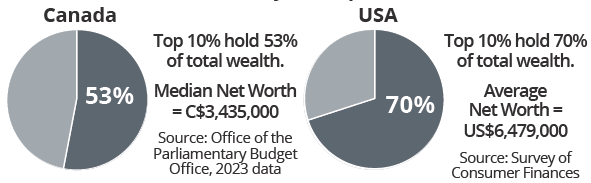
Share of Total Wealth Held By the Top 10% (2023 Data)
The information contained herein has been provided for information purposes only. The information has been drawn from sources believed to be reliable. Graphs, charts and other numbers are used for illustrative purposes only and do not reflect future values or future performance of any investment. The information does not provide financial, legal, tax or investment advice. Particular investment, tax, or trading strategies should be evaluated relative to each individual’s objectives and risk tolerance. This does not constitute a recommendation or solicitation to buy or sell securities of any kind. Market conditions may change which may impact the information contained in this document. Wellington-Altus Private Wealth Inc. (WAPW) does not guarantee the accuracy or completeness of the information contained herein, nor does WAPW assume any liability for any loss that may result from the reliance by any person upon any such information or opinions. Before acting on any of the above, please contact your financial advisor. Transactions of the type described herein may involve a high degree of risk, and the value of such instruments may be highly volatile. Such risks may include without limitation risk of adverse or unanticipated market developments, risk of issuer default and risk of illiquidity. In certain transactions prospective investors may lose their entire investment or incur an unlimited loss. This brief statement does not disclose all the risks and other significant aspects in connection with transactions of the type described herein, and prospective investors should ensure that they fully understand the terms of the transaction, including the relevant risk factors and any legal, tax, regulatory and accounting considerations applicable to them, prior to transacting. The information contained herein may include the opinions of representatives of third-party companies or organizations and may not necessarily reflect that of Wellington-Altus (WA) or its representatives. All third-party products and services referred to or advertised are sold by the company or organization named. While WA may have referral arrangements with some third-party companies or organizations, WA does not specifically endorse any of these products or services and is not liable for any claims, losses or damages however arising out of any purchase or use of third-party products or services. All insurance products and services are offered by life licensed advisors of Wellington-Altus Insurance Inc. or other insurance companies separate from WAPW.
© 2026, Wellington-Altus Private Wealth Inc. ALL RIGHTS RESERVED. NO USE OR REPRODUCTION WITHOUT PERMISSION. www.wellington-altus.ca
If you no longer wish to receive commercial electronic messages from Wellington-Altus Private Wealth Inc., please send an email to unsubscribe@wellington-altus.ca