


Are the Bond Markets Sending a Signal?
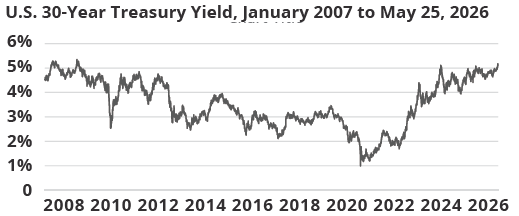
Many market observers have recently turned their attention to the fixed-income markets, as long-term government bond yields have risen to levels not observed in more than two decades. By the end of May, 10-year and 30-year U.S. Treasury yields had risen to levels last seen before the 2008 crisis. Japan’s long-end bond yields also surged to multi-decade highs. Even in Canada, government bond yields hit multi-year highs.
What has driven these moves? Concerns over rising inflation, fuelled by elevated oil prices, and geopolitical uncertainty stemming from the conflict in the Middle East, have prompted a sell-off in global bond markets, helping to push yields higher.
The value of a bond at maturity is fixed when the government issues it. However, inflation reduces the real value of those future payments, making existing bonds less attractive. Because bonds trade in secondary markets, falling prices translate into higher yields. As a result, when governments issue new bonds, they must offer higher yields, which pushes yields up across the curve.
But it is not just renewed inflationary pressure that has weighed on bond markets. Here are three other drivers:
Persistently large government deficits — Government debt in developed economies continues to rise, with limited signs of stabilization. To finance their deficits, governments must issue more bonds. This is particularly notable in the U.S., where borrowing needs remain elevated and defence spending increased amid recent geopolitical tensions. Japan’s debt burden has also risen substantially due to sustained government spending, reaching roughly 248 percent of GDP, the highest globally by this measure.1
Central bank balance sheets — Many central bank balance sheets expanded significantly through quantitative easing to support economies after the Global Financial Crisis of 2008- 09. Central banks are no longer large-scale marginal buyers of government bonds and, in some cases, are actively reducing holdings through quantitative tightening. This represents a structural shift from the period when central bank purchases helped suppress yields and support liquidity conditions.
Investor premiums — Investors are demanding higher term and inflation-risk premiums amid ongoing geopolitical uncertainty. Higher U.S. yields can also attract global capital, putting upward pressure on yields elsewhere and weighing on bond prices globally.
What Does This Mean?
Higher long-term yields have historically weighed on equities through higher discount rates, though that relationship has been less consistent in recent years. So far, equity markets have largely shrugged off the bond market repricing.
Because bond markets anchor borrowing costs, higher yields are pushing consumer lending rates higher. The U.S. 30-year fixed-rate mortgage rate, the key barometer for housing finance, recently surpassed 6.5 percent. In Canada, the five-year yield, which forms the basis for five-year fixed mortgage rates, rose above 3.3 percent, its highest since July 2024. Typical five-year fixed mortgage rates now hover around 4.5 percent, which may feed into the ongoing slowdown in housing activity.

which forms the basis for five-year fixed mortgage rates, rose above 3.3 percent, its highest since July 2024. Typical five-year fixed mortgage rates now hover around 4.5 percent, which may feed into the ongoing slowdown in housing activity.
Complicating matters, elevated inflation has led to concerns that central banks will need to keep interest rates higher for longer, or raise them further, a sharp contrast to earlier in the year when inflation appeared under control and markets had largely priced in rate cuts. This comes on top of a meaningful erosion in purchasing power following years of aggressive fiscal and monetary stimulus, which has further widened the disparities between asset owners and wage earners.
The other problem, of course, is that higher interest rates increase government debt-servicing costs, further expanding deficits and contributing to higher debt levels over time.
What Can Investors Do?
Within a diversified portfolio, having some exposure to assets that behave more resiliently in this environment is important. This may include real assets, businesses with pricing power and companies that generate steady cash flows regardless of inflationary conditions. By contrast, areas of the market reliant on low discount rates face greater pressure, such as high-growth equities, long-duration assets and highly leveraged business models more sensitive to higher interest rates.
One lesson we’ve learned from our experience in the industry is that bond markets tend to send signals before they are widely acknowledged. When those signals strengthen, it is usually worth paying attention.
1. https://tradingeconomics.com/japan/government-debt-to-gdp
The information contained herein has been provided for information purposes only. The information has been drawn from sources believed to be reliable. Graphs, charts and other numbers are used for illustrative purposes only and do not reflect future values or future performance of any investment. The information does not provide financial, legal, tax or investment advice. Particular investment, tax, or trading strategies should be evaluated relative to each individual’s objectives and risk tolerance. This does not constitute a recommendation or solicitation to buy or sell securities of any kind. Market conditions may change which may impact the information contained in this document. Wellington-Altus Private Wealth Inc. (WAPW) does not guarantee the accuracy or completeness of the information contained herein, nor does WAPW assume any liability for any loss that may result from the reliance by any person upon any such information or opinions. Before acting on any of the above, please contact your financial advisor. Transactions of the type described herein may involve a high degree of risk, and the value of such instruments may be highly volatile. Such risks may include without limitation risk of adverse or unanticipated market developments, risk of issuer default and risk of illiquidity. In certain transactions prospective investors may lose their entire investment or incur an unlimited loss. This brief statement does not disclose all the risks and other significant aspects in connection with transactions of the type described herein, and prospective investors should ensure that they fully understand the terms of the transaction, including the relevant risk factors and any legal, tax, regulatory and accounting considerations applicable to them, prior to transacting. The information contained herein may include the opinions of representatives of third-party companies or organizations and may not necessarily reflect that of Wellington-Altus (WA) or its representatives. All third-party products and services referred to or advertised are sold by the company or organization named. While WA may have referral arrangements with some third-party companies or organizations, WA does not specifically endorse any of these products or services and is not liable for any claims, losses or damages however arising out of any purchase or use of third-party products or services. All insurance products and services are offered by life licensed advisors of Wellington-Altus Insurance Inc. or other insurance companies separate from WAPW.
© 2026, Wellington-Altus Private Wealth Inc. ALL RIGHTS RESERVED. NO USE OR REPRODUCTION WITHOUT PERMISSION. www.wellington-altus.ca
If you no longer wish to receive commercial electronic messages from Wellington-Altus Private Wealth Inc., please send an email to unsubscribe@wellington-altus.ca