


Tower Wealth Advisory Logo

Newswire

DEBUNKING THE MYTHS

TW-WA ARTICLE

Investing After Periods of Strong Market Returns

“The strongest of all warriors are these two: Time and Patience.”
— Leo Tolstoy

Following the notable gains in both Canadian and U.S. equity markets in 2024, some investors may feel hesitant about the prospect of continuing to put money to work. Here are a few myths, debunked, about investing after periods of strong market performance:

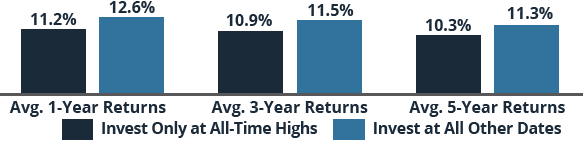
Myth: Investing at all-time highs means substantially lower returns. While investing benefits from the practice of buying low and selling high, sometimes perceived highs still allow for growth .Consider the situation to start 2024 — many were asking if U.S. markets had peaked. Yet, investing only at market highs may not be as unfavorable as many believe. Since 1950, the returns from investing in the S&P 500 only at all-time highs wouldn’t be far from the average index when investing at all other dates for one-, three- and five-year periods.

Invest at All-Time Highs vs. Other Times, S&P 500, 1950 to 20241
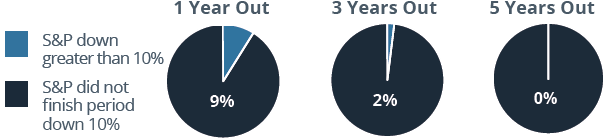
Myth: Market corrections often follow market highs. In reality, corrections are not common after markets reach all-time highs. The chart (top) shows just how often the S&P 500 has finished down more than 10 percent (often defined as a market correction) over various periods, following any of the over 1,250+ all-time highs since1 950.

Myth: High U.S. market concentration will lead to a prolonged bear market. While strong performance driven by the tech sector has led some market pundits to warn of a

How Frequent Are Market Corrections After All-Time Highs?1
potential “lost decade” for U.S. stocks, historical analysis suggests otherwise. An interesting study of over 200 years of U.S. stock market history concluded that significant increases in market concentration did not typically lead to dramatic bear markets; instead, bull markets often continued following periods of rising concentration associated with the onset of a bull market. Certain sectors, reflecting the prevailing innovation at the time, such as technology today, were responsible for high concentration and this dominance often persisted for extended periods — in many cases multiple decades.2 Another analysis of the S&P 500 over 90 years shows that rolling 10-year returns below 3 percent are rare, largely occurring in the worst economic periods in history: the Great Depression, the stagflation of the 1970s and the Great Financial Crisis.3

This isn’t to suggest that recent rapid gains are expected to continue at a similar pace. Indeed, we may find ourselves in a period where strategic security selection is even more important — and this is where our work as advisors shines through. These perspectives are intended to provide a more balanced view of market concentration and high valuations. Enjoy the gains we’ve recently seen, but don’t overlook the importance of time and patience in building wealth for the future.

1. https://www.rbcgam.com/en/ca/learn-plan/investment-basics/investing-at-all-time-highs/
detail; 2. https://globalfinancialdata.com/200-years-of-market-concentration;
3. https://awealthofcommonsense.com/2024/10/3-stock-market-returns-for-the-next-decade/

Recent Posts

August Market Insights: Beyond The AI Bottleneck

A leadership transition is already underway, but much of the market remains anchored to the last trade. Investors are still crowded into semiconductors, memory and artificial intelligence (AI) infrastructure supported by passive flows and a sell-side that continues to extrapolate an era of outsized earnings surprises that has largely run its course.

Read More »

Our Continuing Dependence on Oil: Will the Energy Landscape Shift?

The conflict with Iran served as an abrupt reminder of energy’s central role in global order. In the spring, the Strait of Hormuz exposed the risks of routing roughly 20 percent of global supply through a single chokepoint. The resulting disruptions not only drove fossil fuel prices sharply higher but also reinforced a consequence that extends well beyond economics: energy security is inseparable from national security.

Read More »

What Jevons Paradox Tells Us About the World Around Us

In 1865, British economist William Jevons observed a seeming paradox with the rise of the steam engine and its effect on coal consumption. As coal use became more efficient, he expected total coal consumption to decline. Instead, it surged. This observation remains relevant to the world around us.

Read More »

Are the Bond Markets Sending a Signal?

Many market observers have recently turned their attention to the fixed-income markets, as long-term government bond yields have risen to levels not observed in more than two decades. By the end of May, 10-year and 30-year U.S. Treasury yields had risen to levels last seen before the 2008 crisis. Japan’s long-end bond yields also surged to multi-decade highs. Even in Canada, government bond yields hit multi-year highs.

Read More »

The opinions contained herein are the opinions of the author and readers should not assume they reflect the opinions or recommendations of Wellington-Altus Private Wealth. Assumptions, opinions and information constitute the author’s judgement as of the date this material and subject to change without notice. We do not warrant the completeness or accuracy of this material, and it should not be relied upon as such. Before acting on any recommendation, you should consider whether it is suitable for your particular circumstances and, if necessary, seek professional advice. Graphs and charts are used for illustrative purposes only and do not reflect future values or future performance of any investment. The information does not provide financial, legal, tax or investment advice. Particular investment, tax, or trading strategies should be evaluated relative to each individual’s objectives and risk tolerance. All third party products and services referred to or advertised in this presentation are sold by the company or organization named. While these products or services may serve as valuable aids to the independent investor, WAPW does not specifically endorse any of these products or services. The third party products and services referred to, or advertised in this presentation, are available as a convenience to its customers only, and WAPW is not liable for any claims, losses or damages however arising out of any purchase or use of third party products or services. All insurance products and services are offered by life licensed advisors of Wellington-Altus.