
From Tehran to treasury yields
The Iran conflict is increasingly becoming a capital markets story rather than simply an energy story. As Middle Eastern nations redirect capital towards domestic priorities and security needs, less money is available to fund Western growth initiatives, including the artificial intelligence (AI) boom. At the same time, trillion-dollar AI spending plans and massive U.S. Treasury refinancing needs are creating intense competition for capital, putting upward pressure on bond yields and government borrowing costs.
Trade wars, policy mistakes and stagflation
Markets are pricing in additional rate hikes, but today’s inflation appears to be driven more by supply shocks, trade disruptions, and energy costs than excessive consumer demand. History suggests that using higher interest rates to combat supply-driven inflation can weaken growth without solving the underlying problem. If policymakers continue down that path, the risk is a return to stagflation: slower growth, persistent inflation, and weaker returns for both stocks and bonds.
Staying rational in an irrational world
Periods of market fear often create attractive investment opportunities for disciplined investors. Rather than moving heavily into cash during tariff, recession, and geopolitical scares, we focused on tax-loss harvesting, portfolio repositioning, and structured strategies that improved upside participation while reducing downside risk. After a strong year of performance, we have become more defensive by increasing cash, principal-protected investments, and exposure to real assets while remaining positioned for future opportunities.
Building a stronger Canada
Canada’s economic future depends on becoming more valuable to a world increasingly focused on energy security, critical minerals, supply chains, and strategic partnerships. Recent regulatory changes suggest Ottawa may be moving towards a more pragmatic approach that supports investment and infrastructure development. By attracting capital, building projects, and expanding export capacity, Canada can strengthen both its economic resilience and its position as a trusted global partner in a rapidly changing world.
Please reach out to any of our team members should you have any comments or questions about markets, your portfolio or just wanting to catch up
Your TriVest Team
September 2026
From Tehran to treasury yields
For much of this year, investors have been fixated on AI and the resilience of North American equity markets. Meanwhile, bond markets have been flashing warning signals about concerns over sovereign debt, higher borrowing costs and growing geopolitical uncertainty.
The most significant development behind these trends is the ongoing conflict involving Iran. While it appears that many investors continue to view the situation primarily through the lens of oil prices, the implications are much more than this, as it is increasingly influencing government finances, global capital flows, investment decisions, and even trade relationships.
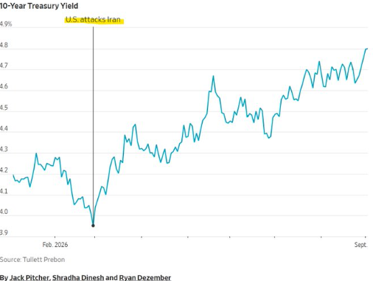
For the past several years, investors have largely assumed the United States AI buildout would have access to virtually unlimited funding. For decades, Middle Eastern nations recycled energy revenues into global financial markets through sovereign wealth funds, infrastructure investments, private equity, venture capital, and real estate. These pools of capital became important funding sources for Western economies, including many of the growth initiatives currently driving U.S. equity markets.
However, what happens when the countries that traditionally supplied this capital begin consuming it themselves as a direct consequence of the U.S.-Iran conflict?
Governments across the Gulf have ambitious domestic spending programs, economic diversification strategies, and infrastructure projects that must now compete with rising geopolitical and security costs. As a result, capital that once flowed into global markets is increasingly being redirected towards domestic priorities.
Take Saudi Arabia, for example. Despite elevated oil prices, the kingdom is in a large fiscal deficit position as rising costs associated with regional instability, trade disruptions, and domestic investment commitments place increasing pressure on public finances. It is reportedly exploring about US$8 billion in additional borrowing.
This comes at a time when many of the technology companies leading the AI revolution are spending at unprecedented levels—so much so that they simply don’t have enough cash flow to fund their buildout and have to turn to bond markets, especially since capital sourcing regions such as the Middle East are no longer available.
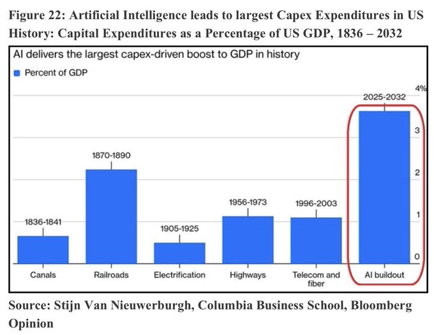
AI-related corporate borrowing already makes up roughly 14 to 15 per cent of the total U.S. investment-grade bond market, which is significant and concerning, but it’s about to get a lot worse. JPMorgan Chase & Co. recently raised its cumulative global AI capital expenditure outlook to US$5.5 trillion by 2030. Out of the total anticipated spending, about US$4.1 trillion is projected to come directly from debt markets, including investment-grade and leveraged finance.
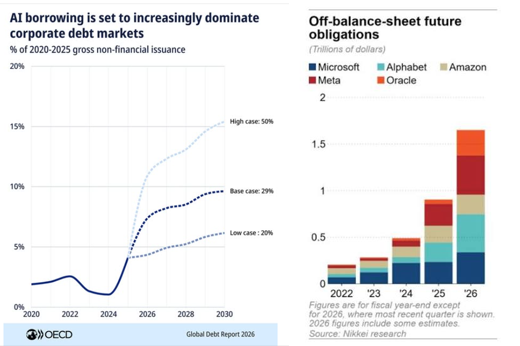
This is happening while bond investors are demanding higher yields as a flood of new issuance is only beginning to hit the market. Making matters worse is that it’s not only AI companies at the trough. The U.S. government itself is having to refinance about US$9 trillion in treasuries, representing more than 25 per cent of its gross domestic product, that are maturing in less than one year.
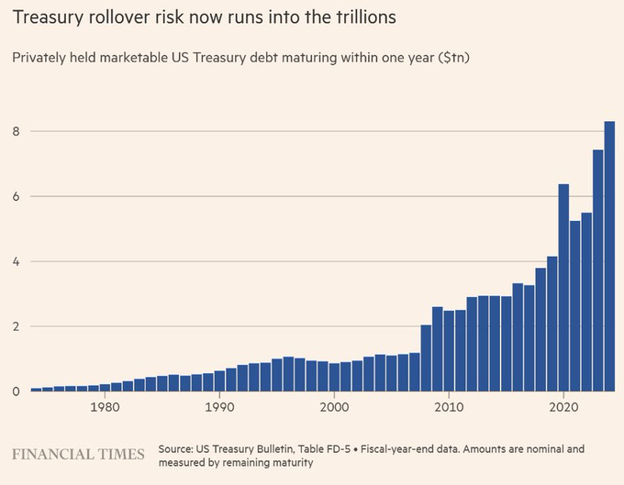
This dynamic may help explain why U.S. Treasury Secretary Scott Bessent has appeared increasingly concerned in recent weeks. He recently delivered some of Washington’s strongest comments to date regarding Iran, signalling a willingness to aggressively pursue sanctions enforcement against individuals, companies, and financial networks perceived to be supporting the regime.Investors may dismiss such remarks as political rhetoric, but sanctions, financial restrictions, and geopolitical realignment can influence capital flows every bit as much as central bank policy.
Trade wars, policy mistakes and stagflation
“With the U.S. dollar hitting 3-month purchasing power lows, some Americans might need that $5,000 just to cover what the $1 trillion that printed it cost them at the grocery store.” – Hedgeye CEO Keith McCullough.
Bond traders are now pricing in two to three quarter-point rate hikes over the next 12 months. The two-year Treasury yield, which closely tracks expectations for future U.S. Federal Reserve policy, has risen well above the current federal funds rate. The message from the bond market is clear: investors appear convinced that the U.S. Federal Reserve Chair Kevin Warsh is prepared to lean harder against inflation following his recent hawkish remarks at Jackson Hole.
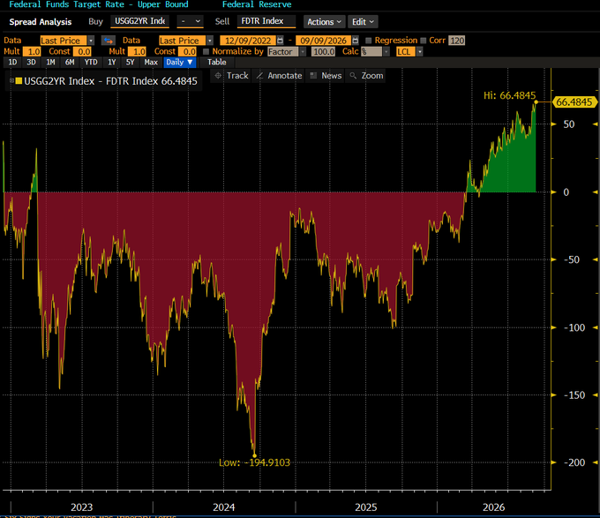
The problem many investors are missing is that the inflation we’re seeing today isn’t being driven by excessive consumer demand, an overheated housing market, or a wage-price spiral. In fact, the wage data suggest the exact opposite.
Growth in average hourly earnings has slowed steadily from nearly 6 per cent in early 2022 to approximately 3.1 per cent as of August 2026. At the same time, real wages have turned negative again, meaning inflation is once again rising faster than paycheques. This comes after years of excessive fiscal and monetary stimulus that have significantly eroded the purchasing power of the dollar. Households are now being squeezed further by rising energy, transportation, food, and housing costs.
So please explain how higher borrowing costs are going to improve their situation. How exactly do higher interest rates produce more barrels of oil, more natural gas, or more refined petroleum products?
Treasury Secretary Scott Bessent recently highlighted this issue, arguing that the current inflation backdrop increasingly resembles a supply shock rather than a traditional demand-driven inflation cycle. Yet markets continue to price additional tightening.
The problem as history suggests is that when policymakers attempt to fight supply-driven inflation with demand-destroying tools, the economy can drift towards a much uglier outcome: stagflation. For those who lived through the 1970s, it was an economic nightmare. Economic growth slowed, unemployment rose, consumer confidence deteriorated, yet inflation remained stubbornly high because energy shortages continued pushing costs upward.
The origins of that crisis were relatively straightforward, and in many ways resemble the pressures we’re facing today. The 1973 OPEC oil embargo and the Iranian Revolution later in the decade sharply reduced global energy supplies. Oil prices surged, transportation costs increased, manufacturing costs climbed, and food prices followed.
Central banks responded with repeated rounds of monetary tightening that compounded the economic damage already being inflicted by the supply shock. At least there was a rationale. Wage growth accelerated, labour unions had greater bargaining power, and policymakers were increasingly concerned about a wage-price spiral becoming embedded in the economy.
Today, the situation is very different.
Wage growth is slowing, not accelerating. Labour markets are more flexible, inflation expectations remain better anchored, and workers are largely absorbing higher prices rather than successfully passing them on through higher wages. If wages are not driving inflation, investors should be asking a simple question: why is the market so convinced that higher interest rates will solve it?
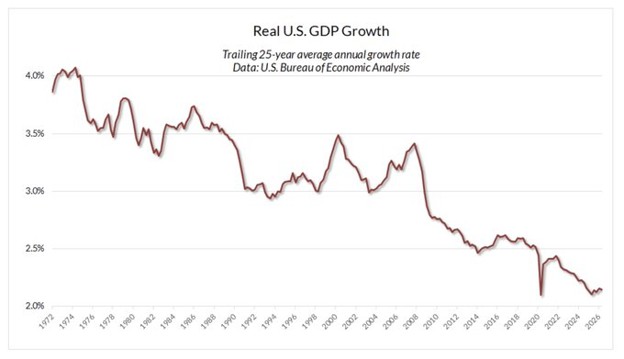
The bond market itself appears to be warning that all is not well. Yet many economists and market commentators somehow believe this round of rate hikes will be different and will magically push bond yields lower. That argument makes little sense. If supply constraints remain the primary driver of inflation, tighter monetary policy risks weakening growth without solving the underlying problem. Unfortunately, there is no monetary solution to an energy shortage.
The real solution lies in increasing production, expanding infrastructure, encouraging investment, and removing barriers to supply growth. Ending the conflict with Iran and reopening the Strait of Hormuz would likely do far more to reduce inflationary pressures than another quarter-point rate hike. This, in addition to ending the costly trade wars being imposed upon its trading partners like Mexico and Canada. But these are levers controlled by the White House, not the Federal Reserve.
For investors, that distinction matters enormously.
The 1970s should serve as a warning as to what is to come. Bond investors were hit hard by rising yields and inflation-eroded real returns, while equity investors faced weaker growth, margin pressure, and valuation compression. The S&P 500 lost roughly 50 per cent of its value during the 1973-74 bear market, and real equity returns remained disappointing for much of the decade.
I am still waiting for someone to explain to me why tighter monetary policy can suddenly succeed where it could not address the underlying problem decades ago? With this as context, I think the greatest risk may not be that the Federal Reserve does too little but that it does exactly what the market expects.
Staying rational in an irrational world
Global trade wars, geopolitical turmoil, sovereign credit yields exploding higher, the return of inflation from global supply disruptions, and equity markets holding their own–few had this on their bingo cards, as we certainly didn’t.
The problem is that we are constantly being bombarded with negative news in order to grab our attention. The problem is if we give into this emotionally, we can miss out on some excellent opportunities to make money.
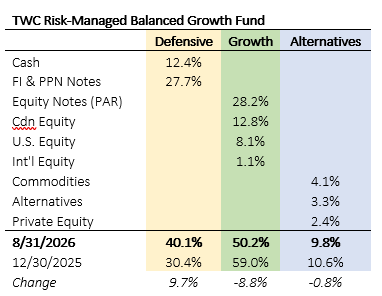
TWC Risk-Managed Balanced Growth Fund

We’ve had a busy two months trading and adjusting portfolios and positioning. In particular, we implemented some tax-loss harvesting that so far has worked out very well.
We sold our Agnico Eagle (AEM) for those clients down on the position as gold prices corrected on the rise in real rates, which we believed to be short-lived. We then switched into Wheaton Precious Metals (WPM), and when gold prices recovered, WPM fully participated in it. For those with AEM in their registered accounts, we sold it and implemented a twin-win structured note (RBC16236), adding in some downside protection without giving away the upside. It has a 1x tracking to a basket of gold producers over a three-year period, but if down zero to 30 per cent we make a positive zero to 30 per cent.
We also did a tax-loss sell on our WSP Global position and switched into Stantec. Both stocks were hit by algo selling on worries over their businesses getting disrupted by AI. We think they are incorrectly being viewed as a SaaS when, in fact, their engineering and procurement processes will be improved and streamlined by AI, while their services will continue to be very much in demand due to legal requirements by industry and government.
We tax-loss sold our position in Cameco (CCO) and bought the Global X Uranium ETF. It not only generated a capital loss, but also tracked the recovery in the space with a decent gain on the new position.
The telecommunications space has been our worst trade for our clients, as we underestimated the drop in immigration paired with increased competition among the few companies in the space. For those with Telus, we reduced the position partially or completely and bought two structured notes providing exposure to the Solactive Canada Telecommunications 145 AR Index through different payoff structures.
The first note (JHN22621) is a seven-year autocallable note paying a 15.0 per cent annual coupon with yearly observation dates and featuring 100 per cent principal protection at maturity as long as the index does not fall more than 30 per cent. In addition to the coupon, investors receive a 240 per cent participation in any upside of the underlying index, creating significant growth potential if Canadian telecommunications stocks perform well. The second note (JHN22619) is a seven-year Buffered Twin Win note maturing on the same date, offering a 3.15x leveraged return over the term rather than periodic coupons. It also provides a 30 per cent downside buffer, but unlike a traditional growth note, it generates positive returns when the index declines between 0 per cent and 30 per cent, effectively allowing investors to profit from modest market weakness while maintaining leveraged upside participation if the index rises. Together, the two notes complement each other: the first emphasizes high income plus amplified upside participation, while the second is designed for leveraged capital appreciation with protection against moderate declines and the ability to benefit from a flat-to-modestly negative market environment.
We also tax-loss sold our BMO TLT Autocall Note (JHN18421). The proceeds were reinvested into the BMO Accelerator TLT (JHN22485), maintaining exposure to the same underlying asset, the iShares 20+ Year Treasury Bond ETF (TLT), while replacing the autocall structure with a simpler growth-oriented payoff. The replacement note is a three-year term investment providing 1.78x leveraged participation in any positive performance of TLT, with only 1:1 downside participation. While we are still bearish on U.S. Treasury over the longer-term, we think this could be a good near-term trade on a recovery to long-dated bonds as there is tremendous pressure on the Treasury to stabilize its lending, and the Trump administration to end the war in Iran, both of which would be supportive to this trade.
Tying it all together, by achieving well ahead of our yearly target, it afforded us the ability to strategically position more defensively than we started the year. As you can see, we have boosted our cash position and are making more use of principal protected notes. We also have increased our weighting to real assets, including commodities and commodity producers.
Building a stronger Canada – by Martin Pelletier

For Canadians, the risk is that we are completely missing the bigger picture and what is truly at stake. The larger question is whether Canada’s policy decisions match the level of urgency and economic impact from the ongoing trade escalation with the Americans. We also need to keep in mind that Washington has become increasingly focused on national security, supply chains, sanctions enforcement, and strategic alignment. The uncomfortable reality is that Canada cannot control how the U.S. views Iran, China, or global trade. What we can control is whether we position ourselves as an indispensable partner or an increasingly unreliable one, not just to the Americans but to the world.
For years, Canada has struggled to attract investment into the very industries that strengthen both our economic security and our strategic relevance. We’ve allowed foreign sponsored environmental groups to heavily influence policy. As a result, Canada has often tied itself in regulatory knots, making it unnecessarily difficult to build major projects despite possessing some of the world’s most abundant natural resources. Meanwhile, the U.S., our largest customer and competitor, has aggressively pursued energy independence, domestic manufacturing, and critical mineral supply chains.
That is why the recent changes to the federal Impact Assessment Act framework may be more significant than many Canadians realize and couldn’t come at a better time.
Recent changes that remove certain projects such as in situ oil sands developments and natural gas-fired power generation from automatic federal assessments represent an important shift in thinking. By allowing provinces or the Canada Energy Regulator to lead reviews where appropriate, Ottawa is embracing a principle industry it has advocated for years: one project, one review.
This is about much more than reducing paperwork. In a world increasingly defined by geopolitical competition, energy has become a strategic asset. So have critical minerals, electricity infrastructure, LNG export capacity, and secure supply chains. Every project that is delayed, cancelled, or diverted elsewhere weakens Canada’s economic resilience while strengthening competing jurisdictions.
That makes Energy Minister Tim Hodgson’s recent remarks particularly noteworthy. Rather than speaking about an idealized future, Hodgson acknowledged a reality that many policymakers have been reluctant to confront: the world must be managed as it exists, not as we wish it to be. His argument that Canada can be both a clean energy superpower and a conventional energy superpower reflects a growing recognition that prosperity, security, and environmental progress are not mutually exclusive objectives. In fact, they are increasingly interconnected.
The same allies seeking reliable military partnerships are seeking reliable energy suppliers. The same countries looking to reduce dependence on China are searching for trusted sources of critical minerals. The same governments concerned about geopolitical instability are looking for secure LNG supplies, dependable electricity grids and resilient transportation infrastructure.
Canada should be uniquely positioned to meet those needs.
We possess vast oil and natural gas reserves, abundant critical minerals, enormous hydroelectric capacity, and some of the strongest environmental and governance standards in the world. These are not liabilities but core strategic advantages. Now we just need to get them to global markets, and Ottawa is trying to do exactly that. Canada recently announced plans to show some of the world’s biggest investors a pitchbook laying out tens of billions of dollars worth of projects spanning data centres, advanced manufacturing, liquefied natural gas, ports, and dozens of mines.
Viewed through that lens, the challenge facing Canada becomes clearer. The issue is not simply whether Ottawa’s engagement with China or Iran creates awkward political optics. The issue is whether Canada is strengthening or weakening its position within an increasingly fragmented global economy where strategic relationships matter more than ever.
If Canada wishes to reduce tensions with Washington, improve investor confidence, and strengthen long-term economic growth, the answer is shovels in the ground and becoming more valuable to the world, a place open for business. That means building pipelines, LNG facilities, power generation, transmission infrastructure, mines, and export capacity. It means attracting capital rather than exporting it. And it means recognizing that economic security and national security are becoming increasingly difficult to separate.
The recent policy changes suggest Ottawa may finally be recognizing that reality. The question now is whether they represent the beginning of a broader course correction or simply an isolated adjustment. In a world where geopolitical alignment increasingly influences capital flows, investment decisions, and trade relationships, Canada’s greatest risk may not be choosing the wrong side. It may be failing to recognize that the world has changed and that our economic strengths are the very tools that can secure our place within it.
Research, in-the-media, reads of the month
Go Canada!: Canada plans to show some of the world’s biggest investors a pitchbook laying out tens of billions of dollars worth of projects spanning data centres, advanced manufacturing, liquefied natural gas, ports, and dozens of mines (Bloomberg Paywall). Read Here
A masterclass of an interview on the Canada-U.S. trade war: Mark Warner, one of Canada’s best trade lawyers—and a friend—dismantles, one by one, every argument used to defend Canada’s current negotiating strategy with the United States. Watch Here
Martin Pelletier: ‘Canada’s economy is leaving too many people behind‘: Canada can post strong economic growth numbers while many people feel poorer, more insecure, and increasingly shut out of opportunity. Read Here
The bottom line: this is a crisis not only caused by the Strait of Hormuz: Chokepoints from the Red Sea to the Black Sea grain corridor, the Rhine River, the Russian interior, the Panama Canal—weather, war, and policymaking—have combined to create a crisis that has no easy way out. The energy crisis is here: it has arrived, and it’s showing in the product prices, not in crude. Watch Here
The Iran war just broke the petrodollar: The attack on Iran may go down in history as the greatest geopolitical mistake in U.S. history. Read Here
The U.S. Federal Reserve is in a real pickle: If the Fed hikes, they’re going to lose the long end. If the Fed cuts, they’re going to lose the long end. Watch Here
Powering the AI race: The average price of electricity per Kilowatt-hour in the United States. See here: As of September 9, all three of Japan’s major automakers have released their August new-car sales figures for China. Toyota, Nissan, and Honda all recorded double-digit year-over-year declines in sales, at 22.8 per cent, 51.9 per cent, and 49.9 per cent, respectively. Read here: The number of nuclear reactors under construction. See here: 26 U.S. data centre projects were blocked in Q1 2026. That is nearly as many as the 31 blocked in all of last year. See Here: Paul Kedrosky on the money flooding into data centres: “You have this incredible flow of money purchasing things that’s increasingly divorced from what’s going on inside the data centers.” “This moment is the first one that sits at the intersection of all of the forces that created the largest bubbles in U.S. history.” Watch here
Inflation paired with a deceleration in wage growth: Bottom line: They broke the model in 2008, and we have never really recovered. And arguably the first break occurred in 1971. See here and this and this and this.
Women accounted for almost all of job gains in August. Here’s why: Women were hired in 158,000 (97.5%) of the 162,000 jobs that were created during the month of August. Read here
Markets don’t always go up, there are lost decades: Dollar-cost-averaging into the market is fine for younger investors, but if you’ve taken years to build your wealth, the risk is too great of simply passive indexing it because getting the timing wrong could be very costly. See here “We’re 252% of stock market cap to GDP. In 1929 we were 65%. In 1987 we got to ~85-90%. In 2000, 170%. – Paul Tudor Jones. Read here
On the Positive
“Everybody wants to save the Earth; nobody wants to help Mom do the dishes.” ― P.J. O’Rourke
The President of Mongolia has proper form: Ever see a leader of a country bench press 90kg? I haven’t until now. Impressive. Watch here
“Don’t take it personal, it’s just business”: Good business is personal and the whole point of doing it is with people you trust. Watch here
Poor me, blame them, what am I going to do about it?: Blaming is a way to discharge uncomfortable and strong emotions like pain and anger. Essentially an angry person lashing out with blame is often dealing with internal fragmentation and trying to unload pent-up feelings. Or perhaps Brené Brown says it best that blame has an inverse relationship with accountability. Read here
Rich Dad, levered dad: Rich Dad Poor Dad’ self-help author Robert Kiyosaki is $1.2 billion in debt. Read here
The world will miss you Dolly: The doctor who delivered Dolly Parton in a one-room Tennessee cabin in 1946 was paid with a sack of cornmeal. Her father farmed other people’s land and could not read or write. Eighty years later, the reading program she built in his name has mailed more than 300 million books. Read here
Send this to your best EU employees when they’re back in mid-September. Watch here
The wolf meets the well-fed dog: Self-earned money is freedom. Received money from family is a collar. You have a choice. Be full and chained up, or occasionally hungry and free. Watch here
To find out more about the TriVest team and how we manage wealth, follow us on Twitter, or LinkedIn. Please email us if you want to find out more about our services.

Trivest Wealth is a trade name of Wellington-Altus Private Counsel Inc. (WAPC). WAPC is a Portfolio Manager and Investment Fund Manager registered with the Manitoba Securities Commission as its primary regulator. The advisors associated with Trivest Wealth are registered with WAPC. WAPC is a subsidiary of Wellington-Altus Financial Inc. The information contained herein has been provided for information purposes only. The information has been drawn from sources believed to be reliable. Graphs, charts and other numbers are used for illustrative purposes only and do not reflect future values or future performance of any investment. The information does not provide financial, legal, tax or investment advice. Particular investment, tax, or trading strategies should be evaluated relative to each individual’s objectives and risk tolerance. This does not constitute a recommendation or solicitation to buy or sell securities of any kind. Market conditions may change which may impact the information contained in this document.
Transactions of the type described herein may involve a high degree of risk, and the value of such instruments may be highly volatile. Such risks may include without limitation risk of adverse or unanticipated market developments, risk of issuer default and risk of illiquidity. In certain transactions counterparties may lose their entire investment or incur an unlimited loss. This brief statement does not disclose all the risks and other significant aspects in connection with transactions of the type described herein, and counterparties should ensure that they fully understand the terms of the transaction, including the relevant risk factors and any legal, tax, regulatory and accounting considerations applicable to them, prior to transacting. This report may contain links to third-party websites. WAPC is not responsible for the content of any third-party website or any linked content contained in a third-party website. The inclusion of a link in this report does not imply any endorsement by or any affiliation with WAPC.
Structured Notes are not suitable for all investors. The notes do not pay dividends, and any dividends paid on the underlying constituent’s may not factor into the return calculation that determines your return. The protection and potential augmented returns on these notes are only available when
Wellington-Altus Private Counsel Inc. (WAPC) does not guarantee the accuracy or completeness of the information contained herein, nor does WAPC assume any liability for any loss that may result from the reliance by any person upon any such information or opinions. Before acting on any of the above, please contact your financial advisor.
Wellington-Altus Private Counsel is registered as a Portfolio Manager in Alberta, British Columbia, Manitoba, New Brunswick, Newfoundland & Labrador, Nova Scotia, Northwest Territories, Nunavut, Ontario, PEI, Quebec, Saskatchewan, Yukon and an Investment Fund Manager in Alberta, Manitoba, Ontario, and Quebec.
All trademarks are the property of their respective owners.
© 2026, Wellington-Altus Private Counsel Inc. ALL RIGHTS RESERVED.
NO USE OR REPRODUCTION WITHOUT PERMISSION.
www.wellington-altus.ca