
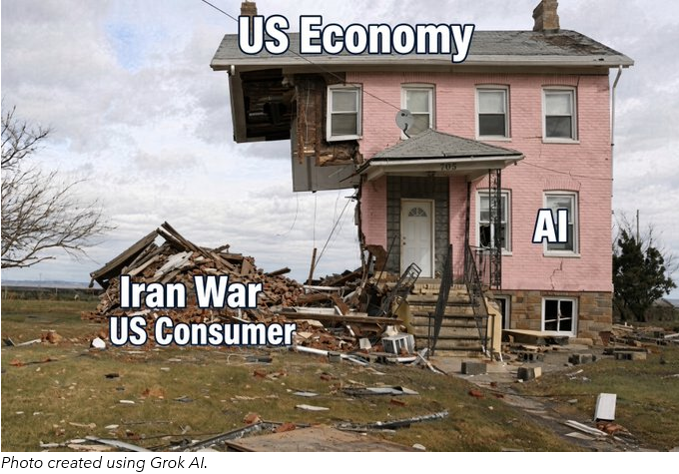
Looking for opportunities in a highly concentrated market
Although the S&P 500 remains near record highs, the underlying market is far weaker than the headlines suggest. Most stocks have experienced significant declines, market breadth has deteriorated to levels last seen during the 1973-74 bear market and the dot-com bubble, and performance has become increasingly concentrated in a small group of AI-related mega-cap companies. This concentration creates vulnerability because the same companies driving market gains also require enormous amounts of capital to fund data centres, semiconductors, and power infrastructure. At the same time, rising Treasury issuance and higher bond yields are competing for that capital, increasing financing costs and creating risks that equity investors appear to be largely ignoring. History shows that when bond markets and stock markets send conflicting signals, the adjustment can eventually be painful for investors who disregard the warning.
Iran, The Art of War and the U.S. consumer
The conflict with Iran is not simply an oil story but a financial-market story occurring at a time when governments are carrying record debt burdens. Higher energy prices threaten to reignite inflation, push bond yields higher, and increase financing costs for heavily indebted governments, particularly the United States. Drawing on Sun Tzu’s principle of attacking an opponent’s strategy rather than its military strength, Iran may be exploiting the vulnerabilities of a debt-laden financial system by extending uncertainty and creating pressure in Treasury markets. Rising yields, market volatility, and tighter financial conditions are already affecting broad segments of the economy and equity markets. The longer the conflict persists, the greater the risk that a geopolitical event evolves into a broader financial event, with the most important signals appearing not on the battlefield but in bond markets.
Market strategy and positioning
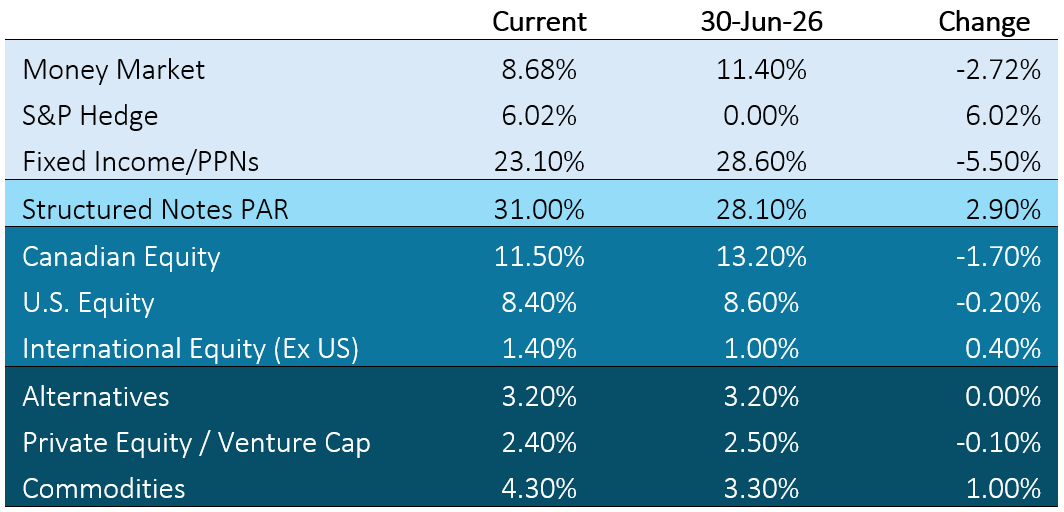
Despite a challenging quarter that saw the Fund decline modestly, the investment team remains focused on balancing risk management with participation in long-term opportunities. Rather than becoming excessively defensive during periods of uncertainty, the Fund has continued to use structured notes, option-based strategies, and downside-protected investments to maintain exposure while controlling risk. As market leadership narrows and weakness spreads beneath the surface, the team has been actively repositioning portfolios, harvesting tax losses, and identifying opportunities in overlooked areas of the market. Recent actions include implementing a zero-cost equity hedge covering approximately 7.5 per cent of the Fund and increasing exposure to strategies designed to provide resilience should market conditions deteriorate, while still allowing investors to participate if the current bull market continues.
Please reach out to any of our team members should you have any comments or questions about markets, your portfolio, or just want to catch up.

October 2026
Looking for opportunities in a heavily concentrated market
One of the most dangerous signals in investing is when market indexes tell a very different story from the underlying data.
Today, the S&P 500 sits near record highs, suggesting investors remain optimistic about economic growth, corporate profits, and the future. Yet beneath the surface, the average stock is struggling. Market leadership has narrowed dramatically, participation is deteriorating, and an increasing number of companies are already in bear market territory.
For some further perspective, since June 1, in the broader Russell 3000 Index (which covers roughly 96% of the investable U.S. equity market):
• 89% of stocks are down more than 10%
• 54% are down more than 20%
• 29% are down more than 30%
• 7% are down more than 50%
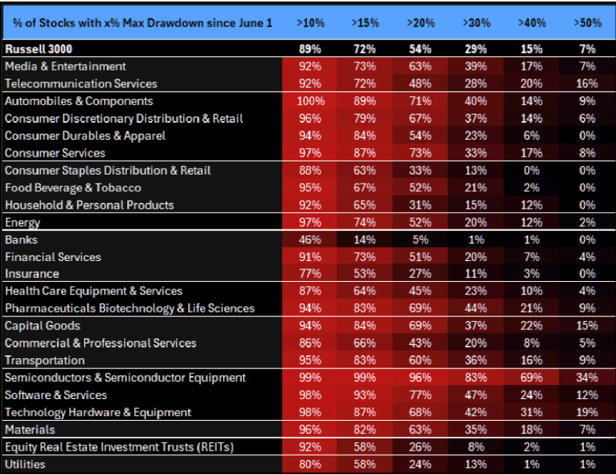
Roughly 60 per cent of S&P 500 constituents are down more than 20 per cent from their individual highs. Market breadth has been this weak only twice before: during the 1973–74 bear market and at the peak of the technology bubble in 1999–2000. The same divergence is evident when comparing the equal-weighted S&P 500 with its traditional capitalization-weighted counterpart. The ratio between the two has fallen to one of its lowest levels since 2003. Driven almost entirely by the growing concentration of mega-cap technology and artificial intelligence stocks, the ratio is on track for a fourth consecutive annual decline, a pattern not seen since the final stages of the dot-com boom.
In many ways, this is no longer a broad-based bull market. It is a market being carried by a remarkably small group of companies tied to a single narrative: artificial intelligence (AI). This market is so dangerously concentrated right now that even JP Morgan provided some scary statistics:
“A basket of 42 AI stocks accounts for 60%-80% of all S&P earnings growth, price returns and capital spending since Jan 2024. At the same time, 60% of S&P 500 stocks are down 20% or more from their all-time highs despite the market being close to all-time highs. Only 30% of stocks are outperforming the S&P 500, one of the lowest figures since 1991.”
“AI is primarily benefitting AI supply chain companies rather than the companies adopting it. The technology share of GDP growth has risen from almost zero in 2022 to ~33%. Only 20% of US states are growing faster than the national average, almost the lowest figure since 1979.”
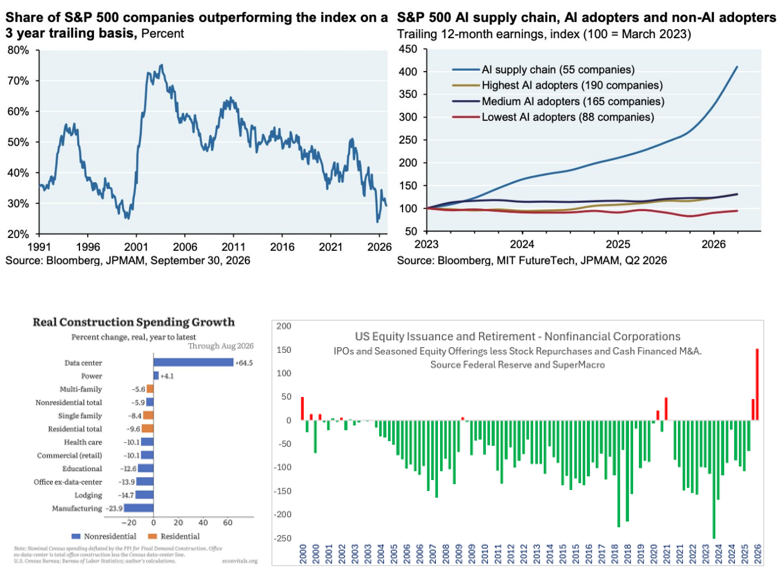
Source: US Equity Issuance chart from Johnny Matthews
As you can see, the problem is that the sector carrying the market is also one of the largest consumers of capital. Building the AI infrastructure of the future requires enormous investment in data centres, semiconductor manufacturing, power generation, and transmission networks. According to a recent Brookings Institution study, financing the AI buildout could exceed US$10 trillion between 2025 and 2032.
The challenge is that this spending does not occur in isolation. The same pool of capital required to finance AI infrastructure must also absorb massive amounts of new U.S. Treasury issuance as Washington continues to run large fiscal deficits.
This is where the bond market enters the story.
While equity investors remain focused on AI growth projections, bond markets appear increasingly focused on a different question: Who will finance both the AI buildout and Washington’s borrowing needs?
Rising term premiums suggest investors are demanding greater compensation for holding long-dated bonds, pushing yields higher even as many market participants continue to expect interest-rate relief. In effect, the bond market may be signalling that the supply of debt is beginning to overwhelm demand.
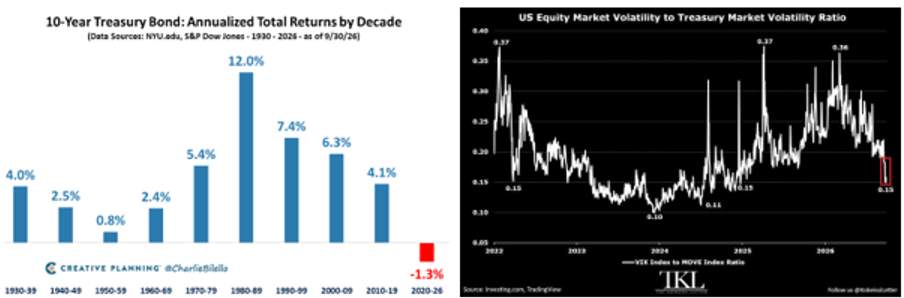
Historically, investors have paid a price for ignoring similar warnings.
During the late stages of the dot-com boom between 1998 and 2000, bond market volatility began rising as the U.S. Federal Reserve tightened policy and liquidity conditions deteriorated. Equity investors largely ignored the warning, with technology stocks continuing to surge for many months before the bubble burst and the S&P 500 ultimately lost roughly half its value.
A similar divergence emerged in 2007. Treasury and credit markets began flashing warning signs well before equities peaked. Bond market stress increased throughout the summer while the S&P 500 continued climbing to new highs into October. Within a year, investors found themselves in one of the worst bear markets in modern history.
More recently, bond volatility surged in 2018 as the Federal Reserve tightened policy and 10-year Treasury yields approached 3.25 per cent. Equities initially shrugged off the move before suffering a near 20 per cent correction during the fourth quarter. In 2022, bond markets again led the warning as inflation and aggressive rate hikes triggered a sharp rise in fixed-income volatility. The S&P 500 eventually followed, falling roughly 25 per cent peak to trough.
To be clear, rising bond market volatility does not automatically signal an imminent bear market. In each of these episodes, stocks continued advancing for weeks, months, and in some cases, more than a year after fixed-income investors first became concerned. The lesson is not that bond investors are always right about timing. It is that when bond markets and equity markets disagree, one of them is eventually forced to adjust.
Today, with market breadth near historic lows, leadership concentrated in a handful of AI-related stocks and bond market volatility rising sharply, investors would be wise to pay attention to what fixed-income markets may be signalling.
Higher yields create a challenge not only for governments but also for the very companies leading the AI boom. As borrowing costs rise, financing massive infrastructure projects becomes more expensive. What has been the market’s strongest tailwind could eventually become a significant headwind if capital costs continue moving higher.
Ironically, much of this pressure could have been avoided. Geopolitical developments earlier this year contributed to higher energy prices and renewed inflation concerns at precisely the wrong moment for an economy that was already showing signs of slowing outside of AI-related spending.
Today, what appears to be a healthy economy is becoming increasingly dependent on a narrow slice of activity tied to AI, while many parts of the broader economy continue to soften. Consumer confidence, housing activity, and portions of the manufacturing sector remain far less robust than headline market returns would suggest.
For Canadian investors, the implications are significant. A combination of higher U.S. bond yields and a stronger U.S. dollar continues to place pressure on the Canadian dollar. This leaves the Bank of Canada facing a difficult balancing act: maintain lower interest rates to support domestic growth and risk further currency weakness or tighten policy to support the currency at the expense of economic activity. Not surprisingly, interest-rate-sensitive sectors such as utilities, infrastructure, and telecommunications have struggled.
The lesson is simple: when markets become dependent on a single narrative, investors should pay close attention to what is happening beneath the surface. Narrow leadership can persist far longer than many expect, but history suggests it rarely endures indefinitely. Eventually, fundamentals reassert themselves.
And when they do, the bond market often proves to have been telling the more important story all along.
Iran, The Art of War and the U.S. consumer
During Martin’s summer holidays in the southern United States, he visited a bar that had been converted from an old church. Covering the ceiling was the entirety of Sun Tzu’s The Art of War. Looking at the situation in Iran today, I can’t help but think they have read the same text.
When investors think about the war involving Iran, they instinctively focus on oil. That’s understandable because every conflict in the Middle East immediately raises questions about crude supply, tanker routes, and energy prices. What makes this episode different from past geopolitical crises is that the global economy is carrying record levels of sovereign debt and governments can no longer absorb inflation shocks the way they once could.
Therefore, every dollar increase in the price of oil and refined products such as gasoline and diesel feeds inflation expectations, pushes bond yields higher, and increases the cost of financing already massive fiscal deficits. While investors and commentators continue debating whether higher interest rates will solve the problem, the reality is that monetary policy cannot produce more oil or reopen disrupted supply chains. As long as the conflict continues, inflationary pressure remains embedded in the system and will continue to wreak havoc on both bond and equity markets.
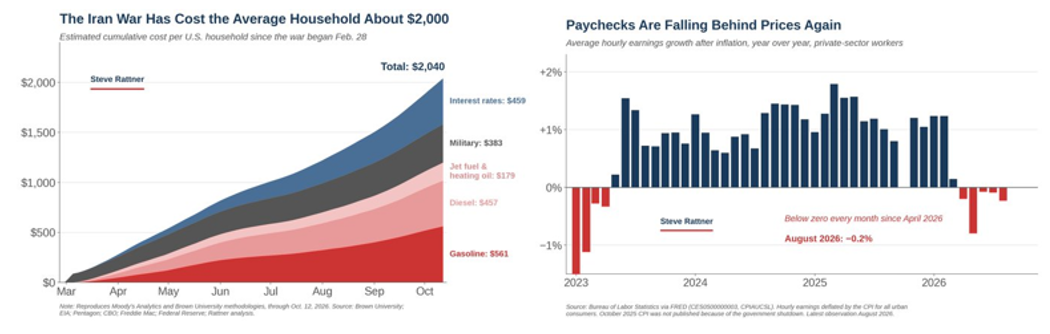
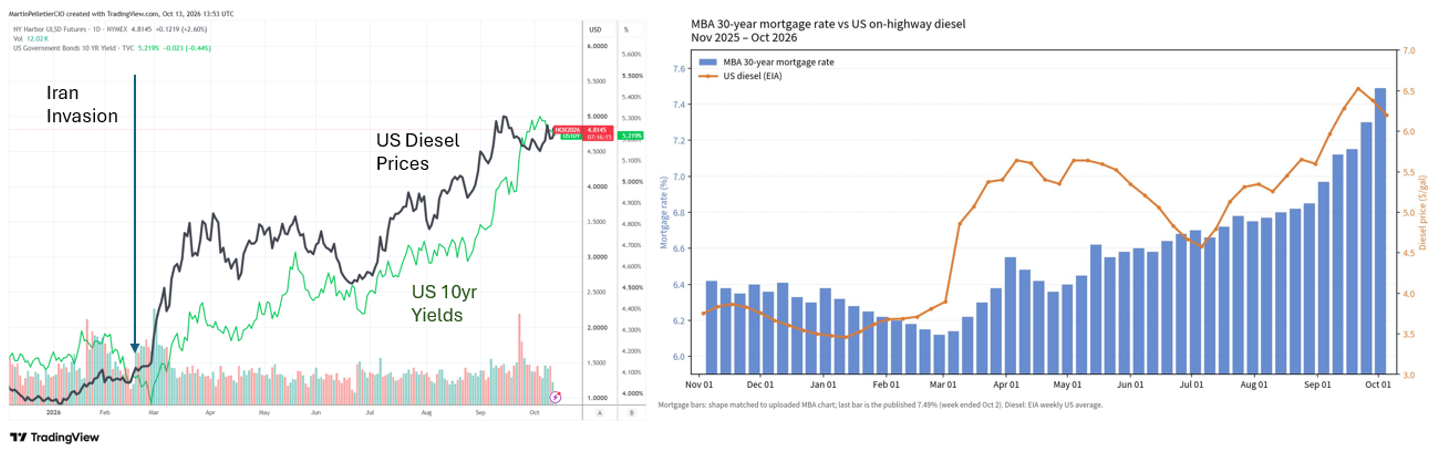
The Iranians understand this. In a world burdened by excessive debt, the critical battlefield is no longer confined to oil fields or shipping lanes. It extends directly into the U.S. Treasury market. If they have indeed studied The Art of War, they would know that Sun Tzu argued the highest form of generalship is to thwart an opponent’s strategy rather than confront its forces directly.
While the United States possesses overwhelming military superiority, financial markets do not respond to military power alone. They respond to risk, uncertainty, inflation expectations, fiscal deficits, and investor confidence. In today’s case, by refusing to capitulate to U.S. demands and prolonging the conflict, Iran may be exploiting the vulnerabilities of an already indebted global financial system, increasing pressure until it ultimately gains leverage at the negotiating table.
We’re already seeing this in the relentless rise in Treasury yields at a time when the U.S. government is carrying record debt levels and facing enormous refinancing requirements. A market once considered the world’s ultimate safe haven has become a source of extraordinary volatility.
What makes this dynamic particularly dangerous is its self-reinforcing nature. Modern markets are dominated by systematic investors, leveraged hedge funds, commodity trading advisors, volatility-targeting strategies, and algorithms that respond almost instantly to price trends. Rising yields trigger risk reduction, risk reduction creates selling pressure, additional selling pressure pushes yields even higher. In effect, Iran is taking full advantage of these market participants to amplify the pressure throughout the entire financial system.
We are, as a result, witnessing economic warfare in a modern form. You no longer need to confront an aircraft carrier directly when you can trigger reactions inside global capital markets that rapidly tighten financial conditions, pressure asset prices, and increase borrowing costs.
While bond markets are responding, don’t kid yourself: equity markets are as well. While the headlines suggest the S&P 500 remains relatively resilient, the underlying market tells a very different story. September exposed just how narrow this bull market has become. Utilities, real estate investment trusts, and other interest-rate-sensitive sectors have been hit hard as investors suddenly found themselves able to earn more than five per cent with virtually no credit risk. Large segments of the market have slipped into correction territory even as the major indexes remain near their highs.
Investors have responded by crowding into a small handful of mega-cap technology companies tied to the AI boom. The extraordinary concentration in these names has masked much of the damage taking place beneath the surface. However, even these companies are not immune if this conflict continues.
This is because we are still at the front end of one of the largest capital spending cycles in modern history. Trillions of dollars will be required to build the data centres, power infrastructure, semiconductor facilities, and networks needed to support the AI revolution. At precisely the moment investors are grappling with rising yields, elevated valuations, fiscal concerns, and geopolitical uncertainty, they are also being asked to absorb an enormous wave of debt and new equity issuance to fund that growth.
Perhaps this is exactly the type of strategy Sun Tzu had in mind more than 2,500 years ago. In a heavily indebted world, financial markets have become the soft underbelly of U.S. economic power. The big question is whether the Trump administration is smart enough to offer the Iranians a golden bridge—a metaphor attributed to Sun Tzu—a way out for a very desperate and dangerous enemy that is feeling cornered.
If not, the danger is that this cycle becomes self-reinforcing. The longer the conflict continues, the greater the risk that what began as a geopolitical event evolves into a full-blown financial event. Investors may be focused on missiles, drones, and oil tankers, but the market’s verdict is being delivered elsewhere. Right now, it is being written every day on the Treasury yield curve.
Market strategy and positioning

Overall, September was a challenging month for the Fund. Several of our equity positions declined amid the continuation of the Iran conflict and rising real interest rates, although gains in Alphabet and Microsoft provided a partial offset. As a result, the TWC Risk-Managed Balanced Growth Fund posted a modest third-quarter loss of 1.1%, reducing our gains for the year.
If there is one lesson from 2026 so far, it is that markets have remained remarkably resilient in the face of developments that would normally undermine investor confidence. Trade disputes, geopolitical conflict, rising sovereign bond yields, renewed inflation pressures, and persistent concerns about government deficits have all dominated headlines. Yet a handful of AI-related companies have continued to drive broader market indices higher, masking many of the challenges occurring beneath the surface.
One of the biggest challenges investors face is distinguishing between genuine risks and the constant flow of alarming headlines competing for attention. When uncertainty rises, the emotional temptation is often to become overly defensive. Earlier this year, concerns surrounding tariffs, recession risks, and geopolitical tensions created a compelling case for significantly raising cash levels. Had we followed that path, however, we would have missed many of the opportunities that subsequently emerged.
Instead, we chose to lean into volatility where the risk-reward profile was attractive. Through the continued use of structured notes, option-based strategies, and investments with built-in downside protection, we were able to maintain meaningful market exposure while managing overall portfolio risk. These strategies provided the confidence to remain invested during periods of heightened uncertainty, and ultimately contributed positively to client outcomes.
Today, the investment challenge is somewhat different. While the major indices remain near their highs, weakness has spread across much of the broader equity market. One of the lessons we have learned over the years is that markets often appear strongest just as participation begins to narrow. Rising index levels can disguise deteriorating market breadth, creating the false impression that risk has disappeared. Investors naturally gravitate toward what is working, and today that means a relatively small group of market leaders. Disciplined investors, however, pay close attention to what is being overlooked. Some of the most attractive opportunities emerge in areas where sentiment is weakest and few investors are willing to look.
This dynamic has created an active environment for portfolio repositioning and tax-loss harvesting. Underperforming stocks often experience additional downward pressure in November and December as investors realize losses for tax purposes. As a result, this is typically one of our busiest periods for portfolio management activity. With markets becoming increasingly selective and valuation dispersion widening across sectors, we have used recent volatility to improve portfolio efficiency while maintaining exposure to our highest-conviction investment themes.
Finally, we also recently implemented a zero-cost equity hedge covering approximately 7.5 per cent of the Balanced Growth Fund. This strategy provides a measure of downside protection while preserving meaningful upside participation should markets continue to advance. The combination of selective repositioning, disciplined risk management, and targeted hedging reflects our ongoing objective of protecting capital while remaining positioned to capitalize on opportunities that emerge when market sentiment becomes overly one-sided.
Research, in-the-media, reads of the month
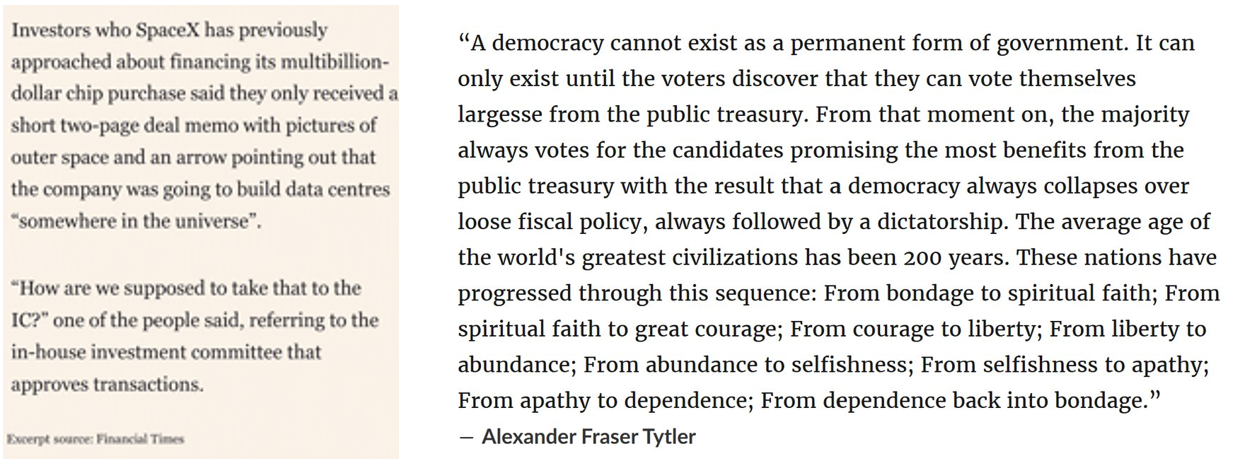
Late in a cycle, investors stop evaluating assets and start validating each other. Suddenly what you own matters only when it matters to everyone else. Dissent means exclusion and a rejection of self and therefore will be defended at all cost. This is not only a very dangerous way of investing but a dangerous way of living. Just because a storm hasn’t hit for a while doesn’t mean it never will simply because your people tell you it won’t. — Martin Pelletier
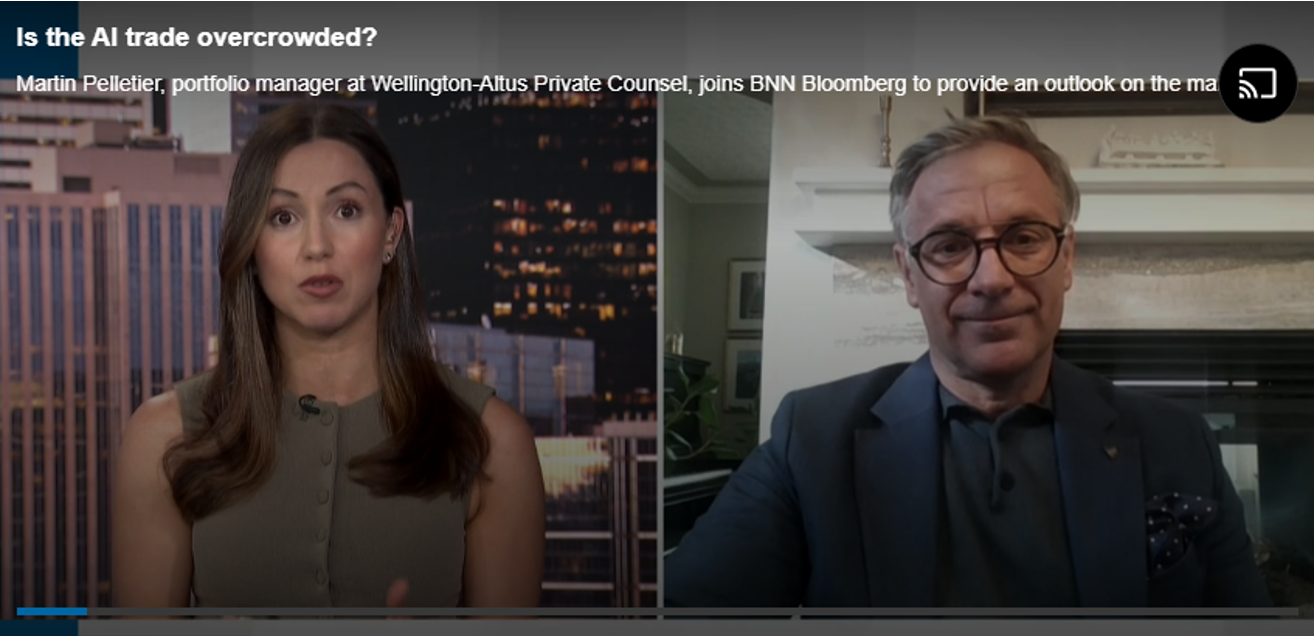
The biggest bet in financial history
The AI investment boom is increasingly becoming a race against extraordinarily high expectations. According to Steve Hsu’s analysis on the Manifold podcast, the hundreds of billions of dollars being poured into AI infrastructure, models, and data centres will only be justified if AI revenues grow more than tenfold and reach the trillions of dollars annually within the next few years, rivalling or exceeding today’s entire global software industry. The challenge is that even if the overall market reaches that scale, the economics for leading AI labs such as OpenAI and Anthropic are far from guaranteed. Intense competition among U.S. and Chinese developers could compress pricing and margins, meaning that massive industry growth does not necessarily translate into attractive returns for investors. In other words, the AI thesis may prove correct while many of the companies at the centre of today’s enthusiasm still struggle to earn returns that justify their valuations. Watch Here
AI expansion and the end of equity scarcity
For most of the last 20 years, U.S. equities benefited from a simple but powerful tailwind: public companies were shrinking their share counts through buybacks faster than new shares were being created, making stocks scarcer and helping support valuations. That dynamic is now reversing, with net equity issuance turning positive and reaching a record US$152 billion in Q2 alone. As giant private companies such as Anthropic, SB Energy, and Inspire Brands potentially come to market, hundreds of billions of dollars of new equity will compete for investor capital. While this doesn’t end the bull market, it does mark a significant shift: investors are moving from an era of shrinking supply that boosted multiples to one where an expanding supply of shares could require stronger earnings growth and fundamentals to drive future returns. See Here
The AI buildout is reshaping global credit markets
The AI infrastructure race is reshaping global capital markets in ways few investors appreciate. Hyperscalers have raised $48 billion in euro, sterling, and Swiss franc bonds this year, more than triple the amount raised in all of 2025, as they seek to fund massive investments in data centres, semiconductors, and power infrastructure. Their growing presence now accounts for 10 per cent of sterling investment-grade issuance and an astonishing 22 per cent of Swiss franc investment-grade issuance, highlighting how a handful of technology giants are becoming dominant borrowers not just in U.S. markets, but across global credit markets. Read Here
“Banks are now trying to offload the AI data center debt they just underwrote”
The rush to finance AI infrastructure is now hitting an important reality check. Banks led by JPMorgan and MUFG underwrote roughly $38 billion of construction debt tied to Oracle-leased data centres in Texas and Wisconsin, expecting strong investor demand for the loans. Instead, they have reportedly spent months trying to distribute the debt, highlighting growing concerns about valuation, execution risk, power constraints, and the sheer scale of capital required to build the AI ecosystem. While investors remain enthusiastic about AI’s long-term potential, the difficulty in syndicating these loans suggests that capital markets may be becoming more selective, marking one of the first signs that the financing behind the AI boom is no longer being absorbed without question. Read Here
The emergence of negative beta
About 45 per cent of the S&P 500 now has a negative beta, which means that when the market goes up, half goes down now. That has never happened before. Zero. Never. A good interview with Harris Kupperman, founder and chief investment officer of Praetorian Capital, on equity and bond markets and well worth a listen—when rates move, things start to break. Watch Here
Finding opportunities in today’s broken equity market
In this excellent interview with Bill Ackman, founder and CEO of Pershing Square Capital Management, he argues that market structure has fundamentally changed. With passive giants like Vanguard, State Street, and Northern Trust locking up a large share of public-company ownership, the tradable float has shrunk, leaving prices increasingly driven by a small group of leveraged, short-term investors such as Citadel and Millennium. As a result, even large, stable companies can now fall 20 to 25 per cent in a single day over a disappointing quarter, something that was far less common earlier in his career. The opportunity for long-term investors is that many of today’s dominant market participants are structurally unable to look past short-term setbacks, creating periodic mispricings in otherwise sound businesses. Watch Here
That’s gold
Central banks continue to send a powerful signal about the changing global monetary landscape. They purchased 39 tonnes of gold in August, marking the fifth consecutive month of net buying and bringing total purchases for 2026 to 170 tonnes. China remains the dominant buyer, adding 20 tonnes in August alone and increasing its gold reserves to a record 2,387 tonnes, while Poland has nearly matched that pace with 98 tonnes of purchases year to date. The steady accumulation suggests that many central banks continue to view gold as a strategic reserve asset, diversifying away from traditional foreign exchange holdings and preparing for a more uncertain geopolitical and financial environment. See Here Even retail investors are still buying alongside central banks. See Here
Zooming out on debasement
Every fiat currency has lost significant purchasing power since 1971. The “best” performer, the Swiss franc, is still down 66 per cent. The U.S. dollar has lost 87 per cent. Most are down 99 per cent or more. See Here
On the Positive

“Once the storm is over, you won’t remember how you made it through, how you managed to survive. You won’t even be sure, whether the storm is really over. But one thing is certain. When you come out of the storm, you won’t be the same person who walked in. That’s what this storm’s all about.” — Haruki Murakami
Martin’s latest reads of the month
In Losing Ourselves: Learning to Live without a Self, Jay Garfield argues that much of human suffering stems from the belief that we are separate, independent selves standing apart from the world. Once we identify with this imagined boundary between “me” and “everything else,” we begin to see life through the lens of division, attachment, fear, and competition. The book suggests that recognizing our fundamentally interconnected nature does not diminish individuality; rather, it frees us from isolation and opens the door to greater compassion, meaning, and peace. Read Here
In Finding Meaning in the Second Half of Life: How to Finally, Really Grow Up, James Hollis argues that many of us spend the first half of our lives living according to expectations we inherit from family, culture, and society, often losing touch with who we truly are. The inevitable challenges, disappointments, and transitions of midlife are not signs of failure but invitations to examine the life we have constructed and to reclaim a deeper sense of purpose. Hollis suggests that meaning is found not through achievement, status, or certainty, but through the courage to confront ourselves honestly, take responsibility for our choices, and live in greater alignment with our authentic nature. Read Here
The loneliness epidemic
A recent report on Men, Women and Social Connections by the Pew Research Center challenges the common assumption that loneliness is primarily a problem among seniors. Instead, the survey found that younger adults report feeling lonely far more often, with roughly one-quarter of Americans under 30 saying they feel lonely all or most of the time, compared with only a small minority of those over 65. The findings suggest that despite being the most digitally connected generation in history, younger people may be struggling with weaker social bonds, greater social isolation, and the pressures of modern life. This serves as a reminder that some of today’s biggest societal challenges may not be entirely economic in nature, but stem from a growing disconnect between technological connectivity and meaningful human connection. Read Here
AI riches and generational struggles
On The Compound and Friends podcast, Josh Brown, Michael Batnick, and Ed Elson explored how AI is rapidly reshaping both markets and society. The discussion examined whether the enormous wave of AI-related spending reflects a transformative technological shift or the early stages of a speculative bubble, as companies like OpenAI and Anthropic race for dominance amid soaring private-market valuations. Beyond technology, the conversation broadened into the economic and social challenges facing younger generations, including housing affordability, growing wealth inequality, the rise of sports betting and financial nihilism, and America’s mounting US$40 trillion debt burden. The hosts argued that while AI could unlock significant productivity gains and new opportunities, policymakers and business leaders must also address the structural barriers preventing Gen Z from building wealth and participating fully in future economic growth. Watch Here
Lessons from Bill Gates — Success reveals character. So does the pursuit of it.
Microsoft co-founder Paul Allen once claimed that Bill Gates tried to dramatically reduce his ownership stake in the company while Allen was undergoing cancer treatment. In the video below, Allen recounts walking past Gates’s office after a radiation therapy session and overhearing a conversation between Gates and Microsoft executive Steve Ballmer. “They were basically talking about how they were planning to dilute my share down to almost nothing,” Allen recalled. Allen walked in and confronted them on the spot. Later that evening, Ballmer came to Allen’s house to apologize. Gates did not.
Allen left Microsoft soon afterward but refused to surrender his shares. It proved to be one of the most valuable decisions of his life. Over time, those shares grew to be worth roughly US$40 billion. Success often reveals character, but so does the pursuit of it. One founder spent years trying to protect what was his. The other spent years trying to take more than he already had. Watch Here
Steve Jobs and the Atari $5,000 bonus
In 1975, Steve Jobs told Steve Wozniak that Atari had paid them $700 for a game they built together. He handed Woz a cheque for $350. Atari had actually paid Jobs about $5,000. Jobs was working the night shift at Atari when the company offered a bonus to redesign a new arcade game, Breakout, using as few chips as possible. Jobs couldn’t build it. Woz could.
Although Woz already had a full-time job at Hewlett-Packard, he agreed to help after Jobs told him they had just four days. Woz worked virtually without sleep, reducing the design to just 45 chips while Atari’s own engineers were using more than 150. The effort left both men sick with mono. Woz happily accepted his $350 share. Jobs kept the rest and used the money to buy into a farm in Oregon.
A decade later, Woz learned the true payment amount while reading a book about Atari. By then, Apple had already made him a multimillionaire. His reaction was telling: if Jobs had simply said he needed the money, Woz said he would have replied, “Take it all.” What bothered him wasn’t the money. It was the dishonesty.
As Woz later put it: “Who cares about money? Well, you do care about friendship and honesty.”
The contrast between the two men surfaced again before Apple’s 1980 IPO. Jobs refused to grant stock options to Daniel Kottke, a close friend who had helped build the first Apple computers. Woz responded differently. He sold some of his own shares at deeply discounted prices to Kottke and other early employees who had been left out.
One friend kept almost all of a $5,000 bonus. The other gave away millions. Sometimes character is revealed not by how much money people make, but by what they do when they have it. Watch Here
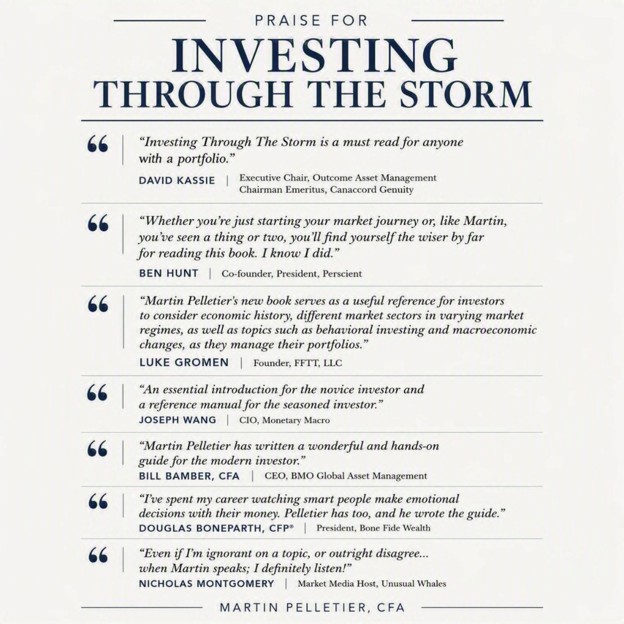
PREORDER your copy here: https://lnk.to/investingthroughthestorm
To find out more about the TriVest team and how we manage wealth, follow us on Twitter, or LinkedIn. Please email us if you want to find out more about our services.

Trivest Wealth is a trade name of Wellington-Altus Private Counsel Inc. (WAPC). WAPC is a Portfolio Manager and Investment Fund Manager registered with the Manitoba Securities Commission as its primary regulator. The advisors associated with Trivest Wealth are registered with WAPC. WAPC is a subsidiary of Wellington-Altus Financial Inc. The information contained herein has been provided for information purposes only. The information has been drawn from sources believed to be reliable. Graphs, charts and other numbers are used for illustrative purposes only and do not reflect future values or future performance of any investment. The information does not provide financial, legal, tax or investment advice. Particular investment, tax, or trading strategies should be evaluated relative to each individual’s objectives and risk tolerance. This does not constitute a recommendation or solicitation to buy or sell securities of any kind. Market conditions may change which may impact the information contained in this document.
Transactions of the type described herein may involve a high degree of risk, and the value of such instruments may be highly volatile. Such risks may include without limitation risk of adverse or unanticipated market developments, risk of issuer default and risk of illiquidity. In certain transactions counterparties may lose their entire investment or incur an unlimited loss. This brief statement does not disclose all the risks and other significant aspects in connection with transactions of the type described herein, and counterparties should ensure that they fully understand the terms of the transaction, including the relevant risk factors and any legal, tax, regulatory and accounting considerations applicable to them, prior to transacting. This report may contain links to third-party websites. WAPC is not responsible for the content of any third-party website or any linked content contained in a third-party website. The inclusion of a link in this report does not imply any endorsement by or any affiliation with WAPC.
Structured Notes are not suitable for all investors. The notes do not pay dividends, and any dividends paid on the underlying constituent’s may not factor into the return calculation that determines your return. The protection and potential augmented returns on these notes are only available when
Wellington-Altus Private Counsel Inc. (WAPC) does not guarantee the accuracy or completeness of the information contained herein, nor does WAPC assume any liability for any loss that may result from the reliance by any person upon any such information or opinions. Before acting on any of the above, please contact your financial advisor.
Wellington-Altus Private Counsel is registered as a Portfolio Manager in Alberta, British Columbia, Manitoba, New Brunswick, Newfoundland & Labrador, Nova Scotia, Northwest Territories, Nunavut, Ontario, PEI, Quebec, Saskatchewan, Yukon and an Investment Fund Manager in Alberta, Manitoba, Ontario, and Quebec.
All trademarks are the property of their respective owners.
© 2026, Wellington-Altus Private Counsel Inc. ALL RIGHTS RESERVED.
NO USE OR REPRODUCTION WITHOUT PERMISSION.
www.wellington-altus.ca