

On April 28, 2026, Finance and National Revenue Minister François-Philippe Champagne released the 2026 Spring Economic Update (the Update). This was the first spring economic update after the federal budget was moved to the fall in 2025. In the absence of a federal budget earlier this year and with the recent shift to a majority government, Canadians have been awaiting clear direction on the federal government’s policy focus and anticipated initiatives. Overall, the Update introduces relatively little that had not been previously announced, while showing an improved fiscal outlook, with the projected deficit declining despite $37.5 billion in net new spending.
Update on the Canadian economy
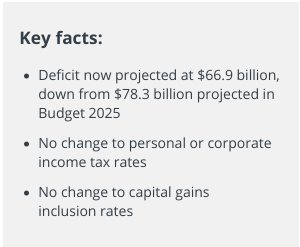
The Update projects a deficit of $66.9 billion for the 2025–26 fiscal year, compared with the $78.3 billion figure published in Budget 2025. For 2026–27, the deficit is projected at $65.3 billion, and by 2030–31 it is expected to decline to $53.2 billion.
The updated deficit for 2025–26 is $11.4 billion lower than the projection in Budget 2025, reflecting stronger than expected revenues and higher personal and corporate income tax receipts. The Update also incorporates $37.5 billion in net new measures over six years, largely focused on affordability and cost-of-living supports.
Federal debt is estimated at $1.33 trillion for the last fiscal year and is projected to rise to $1.63 trillion by the end of the decade. The debt-to-GDP ratio is projected at 41.5 per cent in 2026–27, remaining broadly stable through 2030–31.
While the projected deficits and debt ratios remain elevated relative to Budget 2025, the deficit-to-GDP ratio is expected to continue declining over the forecast horizon to 2030-31.
Tax measures
Reduced CPP contributions
The Update announces a plan to reduce the base CPP contribution rate from 9.9 percent to 9.5 percent starting on January 1, 2027. Both employees and employers will see lower CPP contribution costs as a result of the reduced rate. The Update estimates an employee earning $70,000 and their employer would each save $133 annually with this change. For incorporated business owners, these changes may also factor into their ongoing dividend versus salary analysis beginning in 2027, although the impact will be modest.
Employee ownership trust tax exemption
An employee ownership trust (EOT) is a vehicle for employees to indirectly own shares of the business in which they work. Introduced in 2021, EOTs provide business owners with an additional option in their succession and exit planning. To incentivize use of EOTs, the 2023 Fall Economic Statement announced a temporary exemption from tax on $10 million of capital gains for individuals selling qualifying shares to an EOT. The exemption was set to expire at the end of 2026. The Update proposes to make that exemption permanent.
Home Buyers’ Plan repayment extension
The government acknowledged the ongoing affordability challenges facing new and prospective first-time home buyers. The Update proposes to extend the Home Buyers’ Plan (HBP) repayment grace period from two years to five years for individuals making their first withdrawal between January 1, 2026, and December 31, 2028. This proposal is consistent with the extended grace period already available for withdrawals made from 2022 to 2025. If this proposal is enacted into law, the measure would provide potential annual cash-flow relief of up to $4,000 per individual over the additional three years in which repayment to an RRSP is not required.
Enhanced access to the Disability Tax Credit
For people with disabilities, the Disability Tax Credit (DTC) provides tax relief and access to key disability related benefits. The Update proposes several measures to improve access to the DTC. The Update outlines plans to streamline applications for individuals with certain long-lasting medical conditions, expand the range of medical practitioners who can certify eligibility, and allow provincial and territorial public guardians and trustees to certify on behalf of adults in their care. These changes are expected to increase access to the DTC and related federal benefits, providing an estimated $345 million in additional support over six years.
Previously announced measures
The Update also reconfirms the government’s commitment to an extensive list of previously announced measures that will impact Canadians. A selection of the most relevant previously announced measures is noted below.
Fuel excise tax holiday
Temporary reduction of federal excise tax rates on gasoline, diesel, and aviation fuels to $0.00 from April 20 to September 7, 2026, providing short-term relief from elevated fuel prices.
Alcohol excise duty relief
Two-year extension of the 2 percent cap on inflation adjustments to beer, wine, and spirits excise duties, plus continued reduced rates on the first 15,000 hectolitres for Canadian brewers, supporting producers and modestly limiting price pressures for consumers.
Registered plans and qualified investments
Ongoing work on rules for qualified investments in registered plans and related technical amendments, relevant for portfolio construction within RRSPs, TFSAs, RRIFs, and other registered accounts.
Clean economy and business investment incentives
Confirmation of measures such as immediate expensing for certain manufacturing, processing, and greenhouse buildings, and expanded eligibility for clean hydrogen investment tax credits, which may influence business investment decisions and sectoral opportunities.
Miscellaneous
Canada Strong Fund
The Update introduces the Canada Strong Fund, a new sovereign wealth fund intended to serve as a long-term anchor for strategic investment in the Canadian economy. Operating on a commercial basis, the fund will deploy capital into Canadian projects and companies that advance national priorities, including clean growth, critical minerals, advanced manufacturing, and economic security. Its structure is designed to attract large-scale private-sector co-investment while also providing Canadians with an opportunity to participate directly. Through this mandate, the Canada Strong Fund aims to support the development of high-value industries and generate durable financial returns for the country.
Strategic economic initiatives
Beyond the establishment of the Canada Strong Fund, the Update outlines a broader suite of initiatives intended to reinforce Canada’s long-term economic capacity. These include major nation-building projects, expanded defence sector modernization, and measures to accelerate clean economy investment, strengthen supply chain resilience, and advance critical trade and energy corridors. Collectively, these initiatives are designed to channel private-sector capital into sectors viewed as essential to Canada’s future competitiveness and economic security, reflecting a co-ordinated approach to supporting sustained, long-term growth.