
Stunned by the horror and wonder of his own creation, J. Robert Oppenheimer watched the mushroom cloud rise over the New Mexico desert and quoted the Bhagavad Gita: “Now I am become Death, the destroyer of worlds.” It was a moment of supreme scientific accomplishment paired with deep moral horror. The breakthrough that ended the Second World War ushered in the nuclear age.
 Robert Oppenheimer, image Gemini
The Oppenheimer Moment for Artificial Intelligence
1500 kilometers west of the Trinity Blast site, sits Anthropic’s labs in San Francisco. Their newest model, Claude Mythos, is so powerful and expensive that they aren’t releasing it to the public. Instead, they’re using it to hunt for, and patch vulnerabilities in critical software and infrastructure by teaming up with about 40 other tech companies in Project Glasswing. Like Oppenheimer, Anthropic’s CEO Dario Amodei has realized that his new creation is so dangerously powerful it cannot be released. Or so they say…
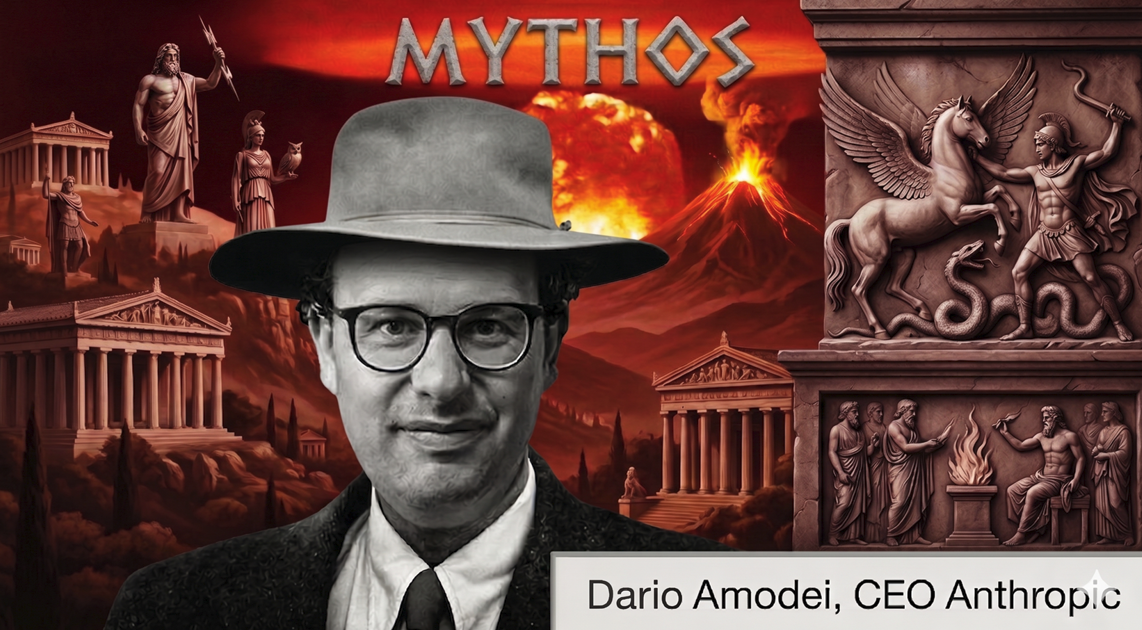
Dario Amodei, image Gemini
Why Advanced AI Models are Raising Both Opportunity and Risk
Some observers in the AI community question whether Anthropic’s initiative is purely altruistic. They note that tools like Mythos are highly compute-intensive, which may limit their viability for broad commercial deployment. They also questioned the model’s magnitude of improvement. At the same time, Anthropic is navigating an ongoing dispute with the U.S. Department of War, which has characterized the company as a potential “supply chain risk.” In that context, initiatives such as Glasswing can also be viewed as part of a broader effort to demonstrate alignment with national security and critical infrastructure priorities.
To give you a sense of just how capable Mythos actually is, consider what it’s already doing in those closed-door audits. In just a few minutes, it discovered serious security holes in software that billions of devices use every day. For example, it found a dangerous flaw in a popular graphics program that had been hiding there since 1995—nearly 31 years. It also spotted major problems deep inside Windows that had gone unnoticed for more than 23 years. Skilled human experts had been staring at that same code for decades and never caught these issues. Let’s be honest, this is both exciting and terrifying.
I’ve described the build out of AI as the new Manhattan Project. I’m hugely bullish about the societal benefits this kind of intelligence can bring: abundant energy, life extension, disease eradication, and productivity gains. The list is endless. So too are the risks. Hence the caution.
The Fast Takeoff: Are We Ahead of the AGI Timeline?
Let’s take a moment to orient ourselves on our current position along the expected path to artificial general intelligence (AGI) and by implication artificial super intelligence (ASI). In 2024, a researcher named Leopold Aschenbrenner shocked the world with his forecast for a “fast take-off” of AGI. His time frame was 2027. Many detractors mocked his forecast. I took the liberty of placing Mythos on his chart—we’re running ahead of schedule!
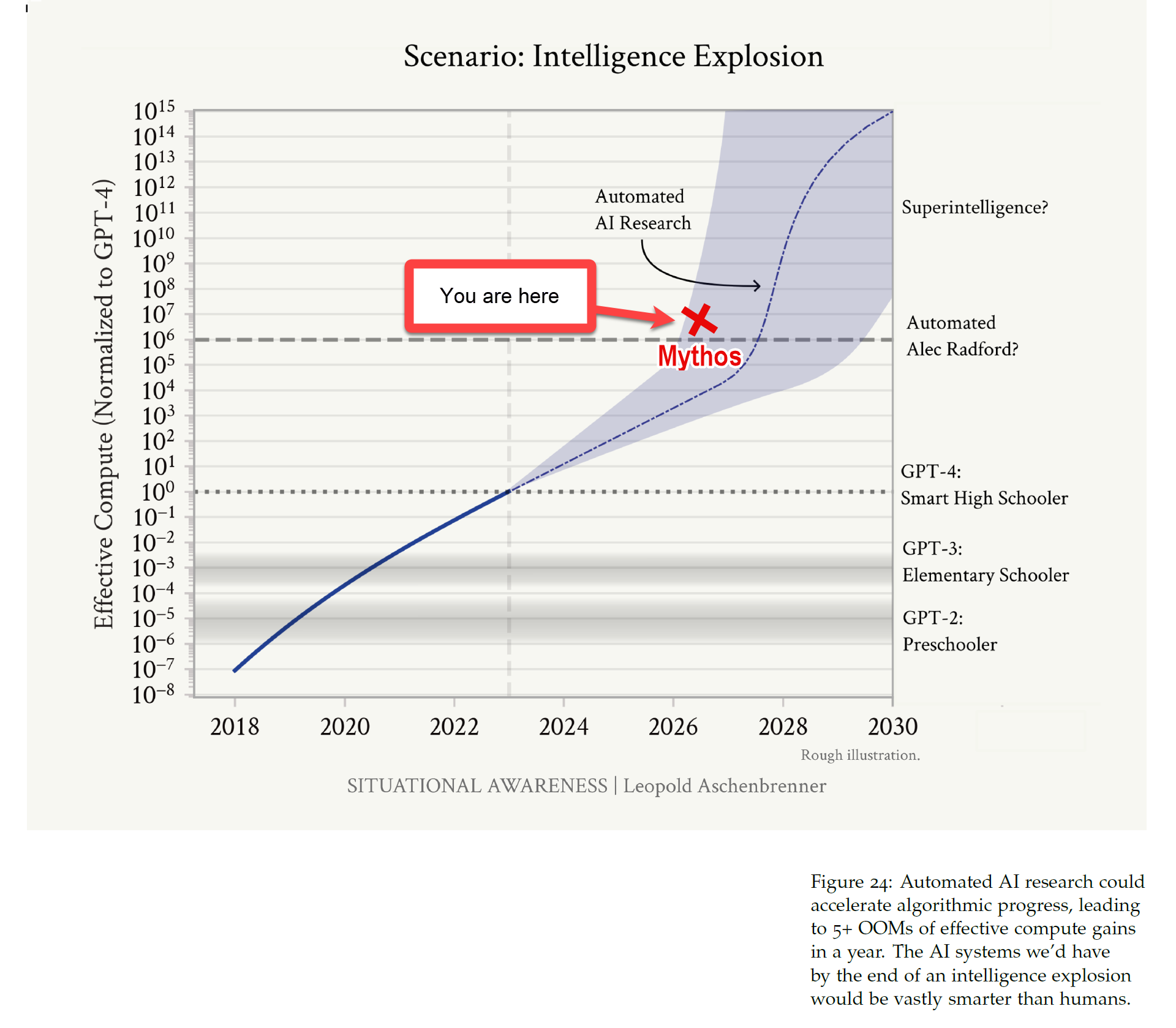
source: Situational Awareness, by Leopold Aschenbrenner
This moment confirms what a lot of AI researchers have been calling the “fast takeoff” narrative. Progress doesn’t happen in nice, steady steps; it suddenly vaults forward once certain thresholds are crossed. Mythos is proof. It’s a strange mix of technical achievement accompanied by genuine excitement and fear.
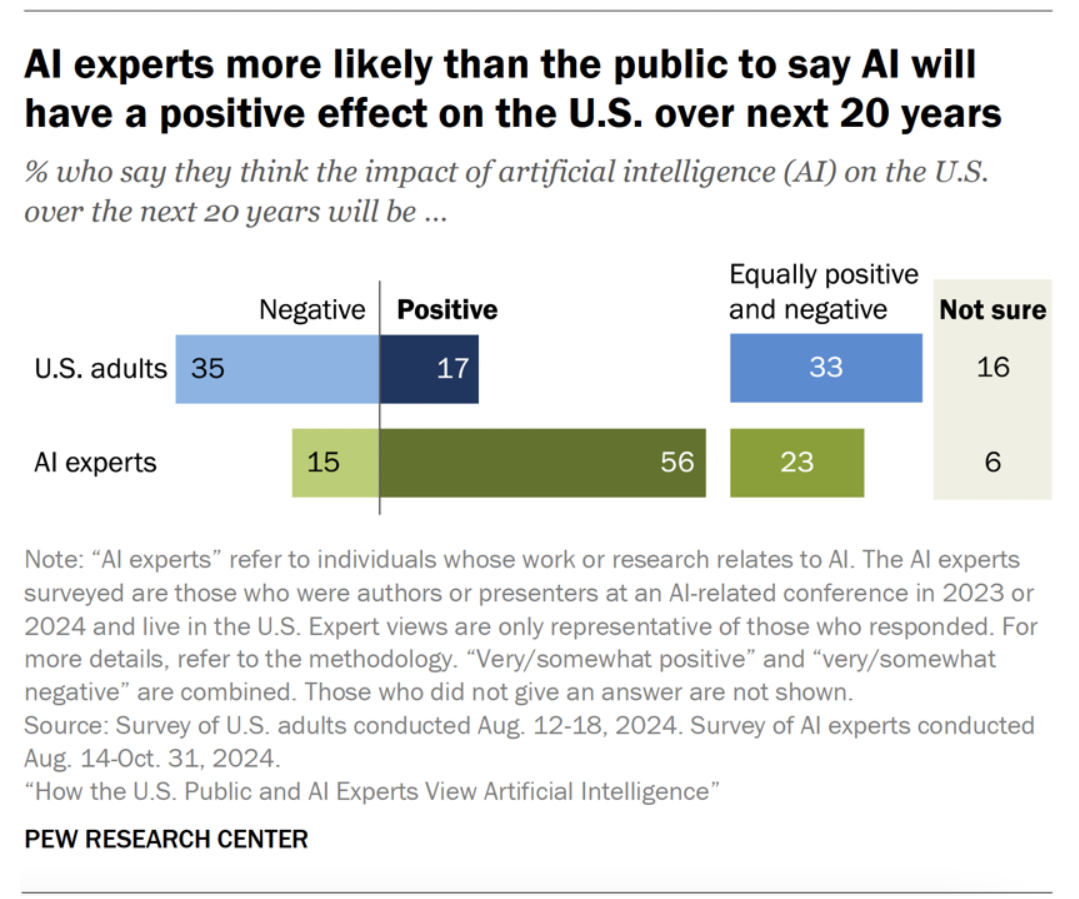
Does this make you anxious? A little fearful? You’re not alone. AI is very unpopular with Americans. Pew Research reported that 35% of U.S. adults believe AI will have a negative impact over the next 20 years, whereas 56% of AI Experts think it will have a positive impact. The industry has a huge communications problem: people don’t trust the “tech bros”.
For the record, I’m on the side of the optimists. Every technology revolution has been met with distrust, cynicism and fear. That’s normal human behaviour. So it isn’t surprising that I’ve been reading reports about AI being all hype and a bubble for almost a year now. Friends, Mythos is yet another datapoint in the exact opposite direction. We are firmly in the “Fast Take-off” scenario for AGI.
The Global AI Race: Why the U.S. Still Leads
Whatever your view about AI, consider this: would you rather have this technology owned by the West or by China? Would Beijing use Mythos purely to defend its own systems—or to quietly map out and attack vulnerabilities in the West’s critical infrastructure? Given China’s extensive history of hacking I think we know the answer to that question. That’s the real risk we face. America is still in the lead. Mythos underscores the importance of securing the technology and winning this race.
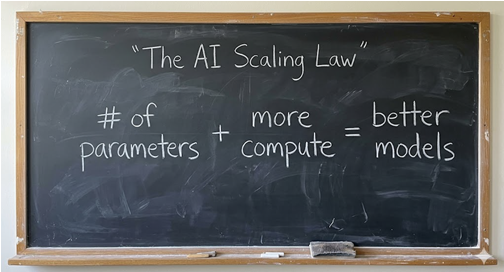
It’s worth asking what has changed recently that made these models so much stronger; a substantial part of that appears to be the compute available to train them. For readers who are interested in the details, Anthropic’s Mythos is trained on 10 trillion parameters—the largest ever—at a reported cost of $10 billion dollars. The technology enabling this is Nvidia’s new Blackwell GPUs. So far “bigger is better” in AI.
The Infrastructure Behind AI Growth: Chips, Energy, and Data
So long as the AI scaling laws hold, America’s lead is likely to grow rather than narrow. U.S. hyperscalers like Google and Microsoft dominate global AI chip ownership as the chart below shows. Oracle has almost as many chips as China. If scaling laws hold, China simply can’t keep up. The rest of the world never really even ran in this race.
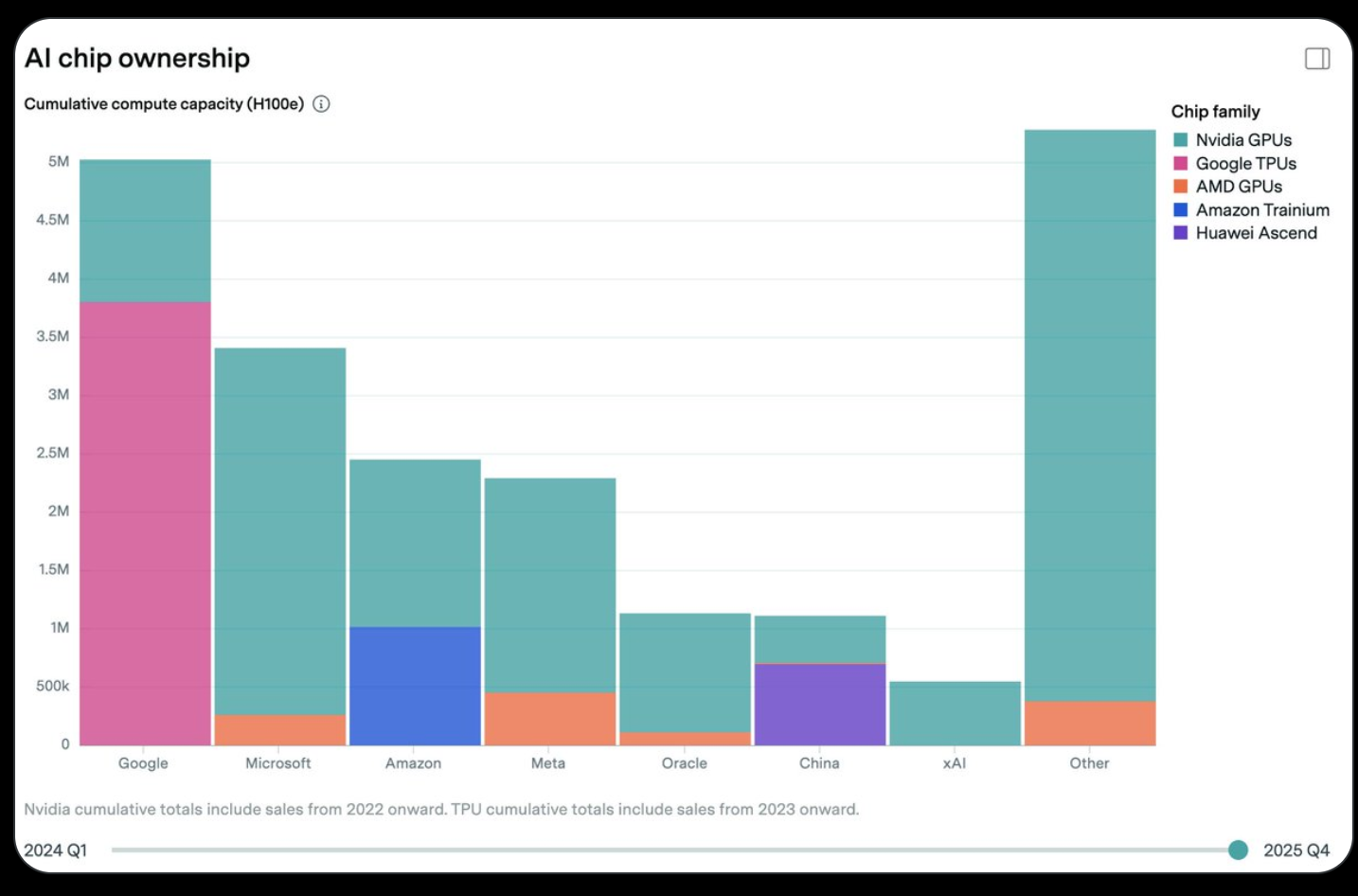
source: Epoch AI
What an AI Investing Strategy Looks Like Today
The honest truth is that this technology is moving forward whether we like it or not. That creates real demand for semiconductors, data-center operators, power utilities, and cybersecurity specialists. The infrastructure-hardening work Mythos is already doing is part of a multi-trillion-dollar global need. Energy demand alone is huge—training and running these models requires electricity on a scale that’s forcing utilities and renewable developers to rethink their long-term plans. As Canadian investors, we’re actually in a strong position here: our hydro capacity, critical minerals, and resource base give us natural exposure to the physical side of the AI economy.
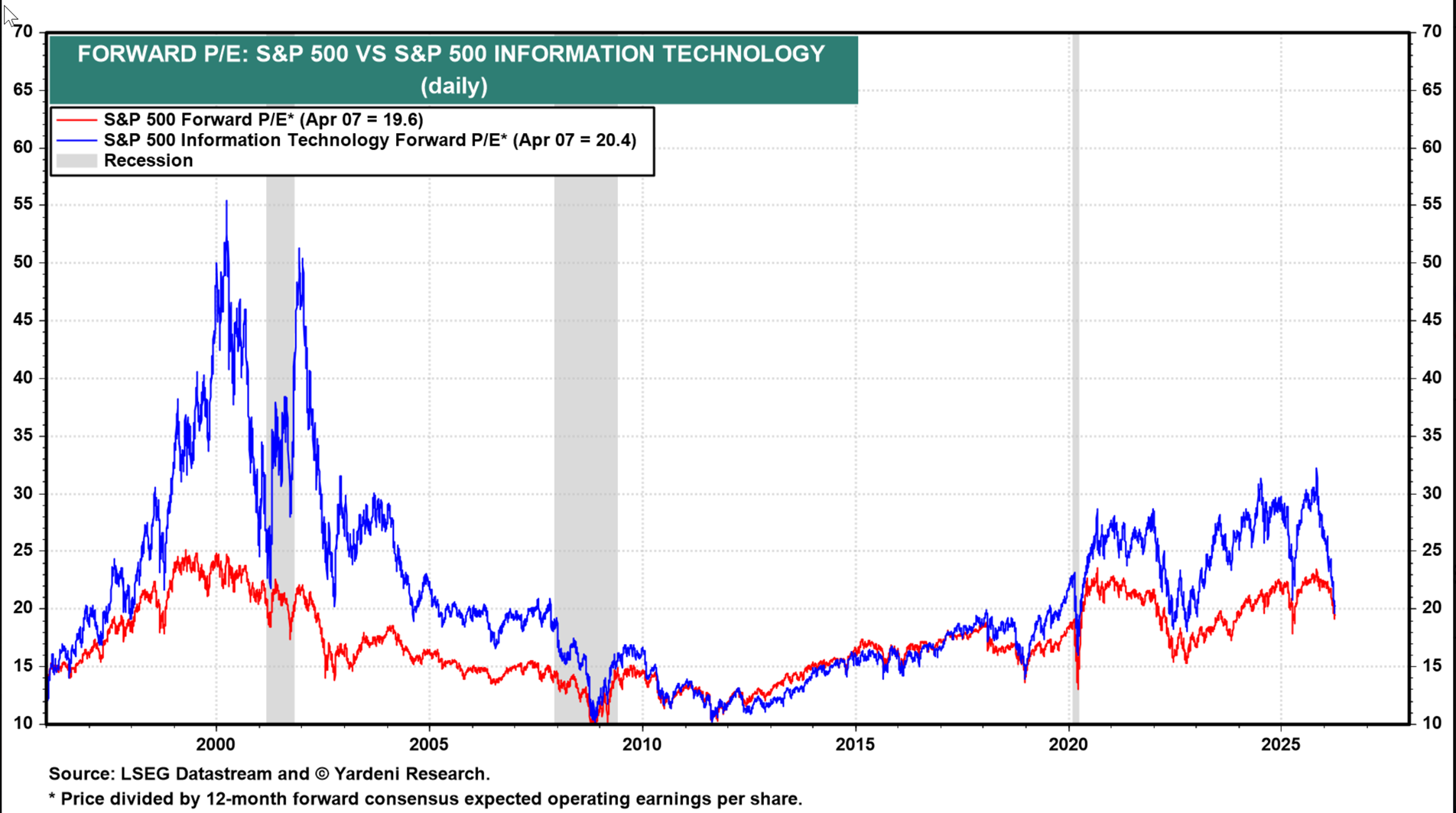
At the same time, I’m approaching this with caution as much as excitement. This progress will likely create even more incentive among the frontier labs to spend more—that continues to bolster the case for owning the “picks and shovels” companies of the AI boom. Happily, U.S. technology names have corrected since November 2025, and are now better value than they have been in some time. Yardeni Research illustrates that the premium in technology has completely disappeared making it a good value.
Balancing Opportunity and Risk in AI Portfolios
As your portfolio manager, my focus is always on turning moments like this into practical, retirement-friendly decisions. We’ve already adjusted portfolios to include a measured, balanced mix of AI enablers while keeping plenty of ballast in steadier sectors.
The lesson from Oppenheimer’s time still holds: once a technology like this exists, it can’t be uninvented. The atomic bomb brought both destruction and deterrence; AI will bring disruption and enormous change. Mythos isn’t the end of the story, it’s the start of a new chapter. (Unfortunately, you need to be a speed reader just to keep up!) Briana and I are working hard to ensure your portfolios are positioned thoughtfully to capture what upside makes sense while protecting against the downside that always comes with genuine change.
Glen