
What Happens When You Spend Time in Nature
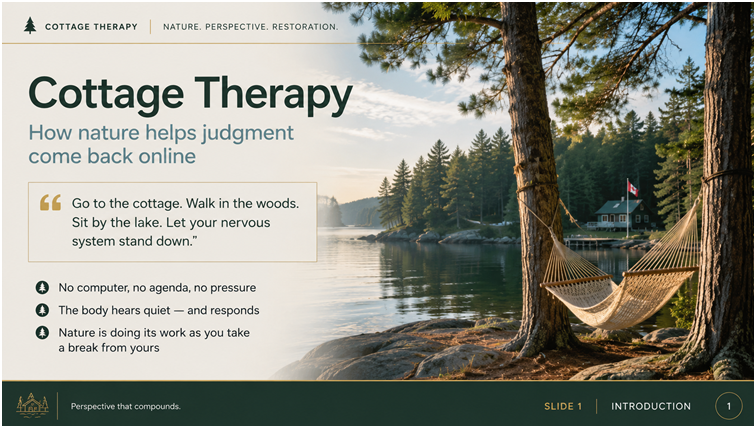
You arrive exhausted, needing a break: no computer, no agenda, no pressure. Looking out over the lake from the hammock strung between two massive white pines, you close your eyes and listen. The white noise of the wind through the pine needles carries their scent wirelessly to your olfactory senses. The songs of chick-a-dees and red squirrels recede as you focus on the hypnotic lapping of water against the granite shoreline. Gradually you suddenly become aware of a growing lightness rising in your chest like dawn.
Nature is doing its work, as you take a break from yours.
source: ChatGPT
The Science Behind Forest Therapy
This isn’t some new-age, Zen thing. This is your body experiencing what Japanese researcher Qing Li helped popularize as forest therapy. In Japan, they call it shinrin-yoku, or forest bathing. In Canada, we call it going to the cottage.
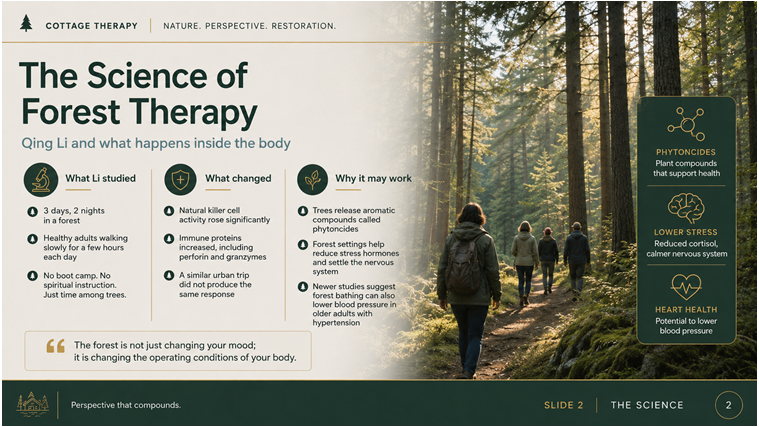
Li’s research began with a simple question: what actually happens inside the body when people spend time among trees? In one of his best-known studies, he took a small group of healthy adults on a three-day, two-night trip to a forest. They walked slowly for a few hours each day. Nothing strenuous. No boot camp. No spiritual instruction. Just walking among trees.
source: ChatGPT
The results were striking. After the forest trip, the activity of natural killer cells—part of the immune system’s first line of defence—rose significantly. So did several of the proteins those cells use to do their work, including perforin and granzymes. Some of the effect was still measurable days later. When Li compared this with a similar trip in an urban environment, the same immune response did not appear.
One possible reason is that trees release tiny aromatic compounds into the air called phytoncides. These are part of the tree’s own defence system against insects, bacteria, and fungi. When we walk through a pine or cedar forest, we breathe some of those compounds in. Li’s work suggests they may help stimulate natural killer cell activity, while the broader forest environment helps reduce stress hormones and settle the nervous system..
Why Stress Leads to Poor Investment Decisions
Newer studies have continued in the same direction, including evidence that forest bathing can lower blood pressure in older adults with hypertension. The larger point is simple: the forest is not just changing your mood; it is changing the operating conditions of your body.
Your nervous system notices the quiet because it is quiet. Cottage therapy in action. Your body reads the lake, the trees, the stillness, and the rhythm of the place as a signal that it can stand down. The world has not changed, but your state inside it has.
That matters for investors, because stress is not just a feeling; it is a decision-making environment. When the body is on alert, we shorten our time horizon, overreact to the latest headline, and confuse activity with control. Markets are very good at keeping us in that state. The cottage does the opposite: it lowers the noise, lengthens the view, and gives judgment a chance to catch up with events.
Lessons from Kingsmere and Mackenzie King
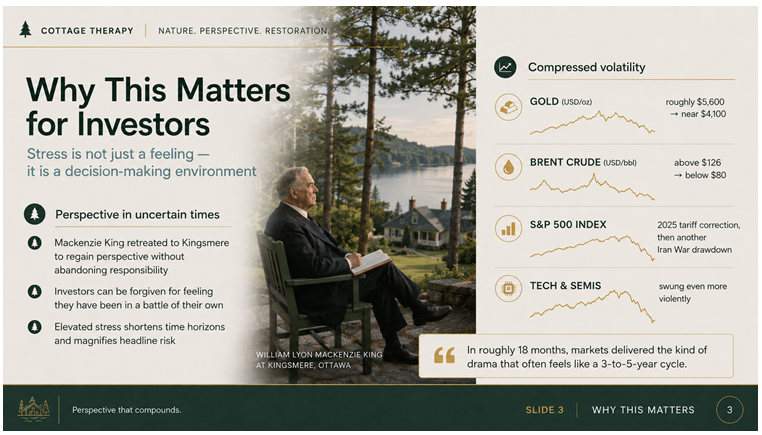
William Lyon Mackenzie King understood something like this. For decades, he retreated to Kingsmere in the Gatineau Hills, where the woods, gardens, stone ruins, and views gave him distance from Ottawa without removing him from the responsibilities of leadership. Kingsmere was not an escape from history; it was one of the places he went to recover enough perspective to face it.
Mackenzie King was leading Canada through a war and needed his best judgment. Investors can be forgiven for feeling they have been in a battle of their own—and more than a few investors’ blood pressure is probably elevated.
source: ChatGPT
Market Volatility and the Need for Perspective
The defining feature of President Donald Trump’s current term has been the compression of volatility. Gold surged to roughly $5,600/oz, then fell back near $4,100—a high-20s drawdown. Brent crude spiked above $126 during the Iran War panic and has since fallen below $80, a roughly 35–40% collapse.
Equities have endured their own rolling shocks. The 2025 tariff selloff pushed the S&P 500 into correction territory, while the Iran War triggered another fast drawdown before a sharp relief rally. Tech and semis swung even more violently. None of this is unprecedented alone; what is unusual is seeing commodity round trips, equity corrections, and AI-led air pockets compressed into roughly 18 months—market drama that normally feels like a 3-to-5-year cycle.
Why We’re Embracing Cottage Therapy This Summer
So this summer, we are going to take some of our own advice.
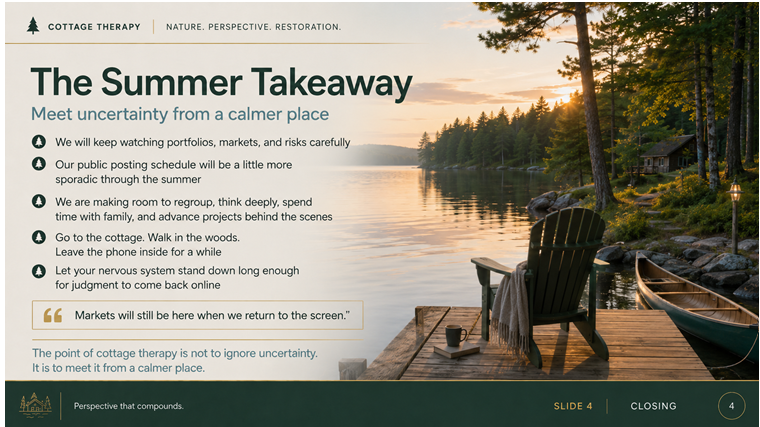
We will still be watching portfolios, markets, and risks carefully. That work does not stop. But our public posting schedule will become a little more sporadic through the summer as we make room to regroup, think deeply, spend time with family, and advance a few projects we have been working on behind the scenes.
source: ChatGPT
We hope you get the chance to do the same in your own way. Go to the cottage. Walk in the woods. Sit by the lake. Leave the phone inside for a while. Let your nervous system stand down long enough for your judgment to come back online.
Markets will still be here when we return to the screen. The point of cottage therapy is not to ignore uncertainty. It is to meet it from a calmer place.
Glen and Briana