
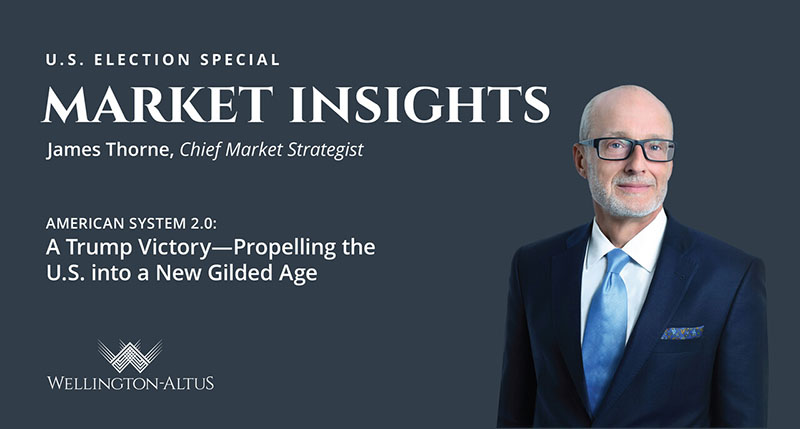
U.S. Election Special Market Insights: American System 2.0

By James Thorne, Chief Market Strategist

A Trump Victory – Propelling the U.S. into a New Gilded Age

Let us be brave in the face of hazards. Let us not fear wrongs, or wounds, or bonds, or poverty.” – Lucius Annaeus Seneca

Download PDF Here

As the Roman philosopher and statesman Lucius Annaeus Seneca once said: “Yield not to adversity; trust not to prosperity; keep before your eyes the full scope of Fortune’s power, as if she would surely do whatever is in her power to do.” This sentiment resonates as we examine the current economic landscape shaped by Donald Trump’s victory in the 2024 U.S. presidential election.

The New Economic Vision

We stand at a pivotal juncture as we transition from a wartime to peacetime economy. The U.S. Federal Reserve’s shift towards a more proactive monetary policy aligns with the new Trump administration, introducing uncertainties that could profoundly impact risk assets. The longstanding strategy of interest rate cuts and increasing liquidity, prevalent since the late 1980s, is now under scrutiny as we enter this new era.

In the wake of Donald Trump’s 2024 election victory, his team—featuring notable figures like Robert F. Kennedy Jr. and Elon Musk—aims to implement a transformative economic agenda reminiscent of the late 1800s. Dubbed “American System 2.0,” this modern iteration of the historical economic framework emphasizes protectionism, government efficiency, deregulation, and tax reform, encapsulated in Trump’s “America First” policies. The objective is to propel the U.S. economy into a new Gilded Age, fostering a renaissance that sets the stage for decades of economic growth and rebirth.

Supporters believe these measures will unlock economic potential and create jobs. However, critics caution that with global debt levels reaching unprecedented highs, there is considerable risk of a fiscal crisis in 2025 if unsustainable spending isn’t addressed. Yet, Wall Street seems unable to recognize that a balanced approach to deregulation and deficit reduction could be the key to resolving the current fiscal crisis.

Urgency for Reform

The current debt-to-gross domestic product (GDP) ratio in the U.S. stands at 125 per cent, with a projected fiscal deficit growth of 25 per cent in 2024, underscoring the urgency for reform. Despite ongoing debates about the effectiveness of Trump’s policies, evidence suggests his prior tax cuts positively impacted various income groups. Americans earning under US$100,000 benefited from an average tax cut of 16 per cent due to the Tax Cuts & Jobs Act. The Congressional Budget Office noted an increased tax contribution from the top one per cent, while lower earners experienced reduced burdens. However, the potential expiration of these tax cuts in 2025 could impose an additional US$1,500 in annual taxes on families earning US$75,000, while the Child Tax Credit may be halved, significantly affecting working parents. Advocates argue that this expiration would raise middle-class taxes amidst enduring inflation, whereas critics caution about the long-term deficit implications.

The Musk Factor: Efficiency and Innovation in Government

In a bold initiative, Trump has announced plans to establish a government efficiency commission led by billionaire entrepreneur Elon Musk. This initiative aims to audit federal spending and propose reforms to eliminate waste, potentially aiding deficit reduction. Musk’s appointment is noteworthy due to his leadership at innovative companies like Tesla and SpaceX, bringing a private sector mindset to government operations. Trump’s reference to Musk’s workforce reductions at X (formerly Twitter) highlights his ability to streamline processes and cut costs. As we enter the “age of efficiency,” restructuring governments for greater efficiency becomes a key aspect of our evolutionary journey. The implications for deficit reduction are significant, promising profound changes in how we manage public resources.

The commission would be tasked with the ambitious goal of saving “trillions of dollars” by identifying and eliminating fraud and improper payments within six months of its formation. Trump has highlighted that fraud and improper payments cost taxpayers hundreds of billions of dollars in 2022 alone. This focus on efficiency aligns with Trump’s broader economic strategy, which emphasizes reducing regulations and lowering corporate taxes. Musk has expressed his willingness to undertake this role, stating on his social media platform X, “I look forward to serving America if the opportunity arises. No pay, no title, no recognition is needed.” This altruistic stance resonates with Trump supporters, who view it as a commitment to public service.

The alliance between Trump and Musk could herald innovative solutions to longstanding governmental inefficiencies and address pressing concerns surrounding the deficit.

Global Economic Challenges and Policy Responses

The Federal Reserve faces the complex challenge of anticipating economic shifts while managing the long lags associated with monetary policy. Trump’s victory may exert pressure on the central bank’s independence, reminiscent of the dynamics between former President Ronald Reagan and former Federal Reserve Chair Paul Volcker. The president-elect’s critiques of recent Federal Reserve policies and calls for aggressive rate cuts could create tensions between the administration’s growth objectives and the central bank’s mandate for price stability.

The experiences of Japan and China serve as cautionary tales, illustrating the limitations of monetary policy. Despite high debt ratios and near-zero interest rates, both countries have struggled with low inflation and sluggish growth, challenging the notion that loose monetary policies are a cure-all.

Trump’s proposed tariffs, including a 60 per cent levy on Chinese goods and a 10 per cent universal tariff on all imports, promise to reshape global trade dynamics. While Japan may gain short-term advantages, the long-term outlook is less rosy, as Chinese firms may relocate production, potentially undermining Japan’s benefits.

The question remains whether Trump’s second term will live up to its promises. Economic studies suggest that his proposed tariffs could reduce long-run GDP by at least 0.8% and result in the loss of approximately 684,000 full-time equivalent jobs in the U.S. However, the actual implementation of these tariffs may diverge from campaign promises, and economic realities could temper their overall impact.

Trump’s victory also signals a revival of his first-term energy policies, focusing on domestic oil production. His “Drill Baby Drill” approach may boost supply and potentially lower oil prices, with some analysts forecasting West Texas Intermediate (WTI) crude could fall to US$50 per barrel by 2025. This bearish outlook is driven by anticipated oversupply across the Americas, combined with sluggish demand growth, especially from China.

The Path to Pre-GFC Interest Rates: A Post-Election Perspective

Deregulation and the Banking Sector
Achieving interest rates reminiscent of the pre-Global Financial Crisis (GFC) era hinges on one critical factor: deregulation. Under a Trump administration, the prospect of rolling back post-GFC regulations—such as raising the asset threshold for “systemically important” institutions and easing capital requirements—could empower banks to expand their lending activities and engage in more risk-taking. This shift would not just be beneficial; it is a necessary and sufficient condition for restoring the operational flexibility that characterized the pre-GFC environment. Remember my nuanced point of view—in normal times banks create money and credit, not central banks.

Implications for Monetary Policy
To transition back to pre-GFC interest rates, a transformation of the current regulatory framework is essential. The existing constraints on banks’ ability to create credit must be lifted. A more permissive regulatory environment would enable banks to respond more effectively to changes in interest rates, thereby enhancing the transmission of monetary policy. By fostering greater risk-taking and financial innovation, deregulation would support higher interest rates and more dynamic market conditions. As investors position themselves for these potential changes, the emphasis on deregulation underscores its critical role in revitalizing the banking sector and achieving the desired interest rate regime.

What Should Investors Do?

The anticipation of a Trump victory sparked a rally in U.S. equities, even during the traditionally weak October period. I project that the S&P 500 could reach 6,000 by year-end, with a potential to hit 7,000 by late 2025 or early 2026, provided favourable conditions arise. Risk assets, such as gold, appear attractive, with breadth expected to expand into late 2024 before contracting in mid to late 2025.

Transitioning to a peacetime economy under Trump’s economic policies presents both challenges and opportunities for investors. While the S&P 500 may achieve new highs, investors should prepare for potential volatility and shifts in market leadership. Alternative assets like gold and bitcoin may offer promising avenues, while the energy sector could face challenges from oversupply and technological advancements.

Developments in artificial intelligence (AI) have the potential to bolster the U.S. economy, possibly helping it narrowly avoid recession, although this optimism does not extend globally. With slowing growth worldwide and Saudi Arabia’s efforts to defend market share affecting oil prices, investors should remain cautious regarding international exposure. Banks would likely benefit from deregulation under a Trump administration, with the potential to fix the ineffective monetary policy transmission mechanism and introduce a new interest rate regime like in the pre-GFC era. Investors should prepare now.

While Wall Street focuses on current performance, discerning investors look 18 months ahead, recognizing that global liquidity—not just corporate performance—drives market dynamics. As we enter an era of global reflation, risk assets are likely to benefit.

The pressing question remains: when will investors acknowledge the fragility of private sector growth and the uncertainty surrounding a soft landing? With inflation at target and a balanced labour market, the federal funds rate should align with a natural rate of 2.75 per cent. Given the 18-month lag in monetary policy and the prospect of fiscal austerity, a hard landing in the U.S., while not my base case, remains plausible, with interest rates potentially dipping below two per cent by mid-2026.

As we look to 2025 and beyond, investors must stay vigilant and adaptable. The intersection of a peacetime economy and Trump’s economic policies creates a complex financial landscape. Success will depend on a nuanced understanding of global economic forces, monetary policy, and structural reforms. As Seneca reminds us, we must be prepared to seize the opportunities ahead. The coming years will test the resilience of our financial systems and the effectiveness of our economic strategies, rewarding those who navigate these challenges adeptly.

Recent Posts

May Market Insights: Mastery and the Terror Premium

Mastery of energy, again

Winston Churchill, as first lord of the Admiralty, tied Britain’s fate to Persian oil. United States President Donald Trump’s war in Iran, centred on Operation Epic Fury, could do the same for the West by removing Iran’s nuclear shadow, resetting oil toward US$60, and finally unlocking a modern peace dividend.

“Mastery itself was the prize of the venture.” Winston Churchill’s 1912–13 case for converting the Royal Navy from coal to oil—enshrined in historian Daniel Yergin’s The Prize: The Epic Quest for Oil, Money, and Power captured the brutal clarity of a great power energy strategy: accept dependence to command the seas. That wager framed the last century. In 2026, as Epic Fury grinds through the Gulf and Brent trades above US$100, the question is no longer whether oil confers mastery, but who holds it: a revolutionary theocracy astride the Strait of Hormuz, or a West intent on stripping the terror and nuclear risk now priced into every barrel out of the energy system—finally collecting a long‑deferred peace dividend.

Churchill’s shift bound Britain’s prosperity to distant wells and narrow waterways, welding energy supply to national survival. He understood that control of energy was not an adjunct to power, it was the metric. In April 2026, with Hormuz contested and Iranian missiles demonstrating reach beyond the Middle East, the same dilemma confronts policymakers and markets. Does the West still want that prize, and what is it prepared to stake to reclaim it from a regime that has spent half a century turning oil, terror, and nuclear brinkmanship into interchangeable tools of coercion? Assume Trump’s campaign does what it is now on course to do: not merely reopen a chokepoint, but neutralize a nascent tactical nuclear threat which, left intact, would hardwire a doomsday premium into global energy prices for a generation.

Iran’s war with the West has done what decades of shocks, embargoes, and “maximum pressure” could not: it has made the hidden tax on energy legible even on a Bloomberg screen. Strip out the terror and nuclear‑risk premiums in a post‑Trump‑Iran settlement, and Brent does not belong north of US$100; it sits much closer to the US$60 level implied by underlying supply and demand and pre‑war bank research. The gap between where oil trades in a world held hostage by a nuclear‑ambitious theocracy at Hormuz and where it would trade if flows were secure and de‑weaponized is more than a volatility surface. It is the unclaimed peace dividend of globalization, the energy market analogue of the windfall that followed the end of the Cold War, when the removal of an existential nuclear standoff released capital, confidence, and capacity back into the real economy.

The choice now facing the West is whether to lock in that outcome. Ending the Cold War removed the Sword of Damocles that had hung over every investment decision for half a century; a successful conclusion to Iran’s nuclear extortion would do something similar for the 21st‑century economy, collapsing a structural risk premium that has quietly taxed households, corporates, and sovereigns alike. The question, as Churchill would have recognized, is whether the West is prepared not just to win on the battlefield but to consolidate that victory into a new era of energy mastery, and to treat the potential verified removal of Iran’s enriched stockpile and fuel‑cycle capabilities as a security gain on the scale of the 1987 Intermediate-Range Nuclear Forces Treaty or the dissolution of the Soviet arsenal.

For Europe, the stakes are not abstract. Iranian missiles and drones have already shown that European Union territory and NATO logistics hubs sit uncomfortably close to the new strike envelope, shattering the illusion that Gulf risk could be quarantined to energy prices alone. The deeper reckoning is with Europe’s own energy strategy. The choice by many Western governments to anchor industrial policy primarily on climate targets while neglecting cheap and secure supply—is now coming home to roost. Prosperity in an artificial intelligence (AI)‑driven economy rests on abundant, reliable energy rather than on cheap consumer imports, echoing Churchill’s insight that mastery of energy is mastery of power. That logic points north as well as east: Canada with its hydrocarbons, hydropower, and critical minerals—looks less like a peripheral supplier and more like a potential resource superpower if it can cut through regulatory thickets and build the infrastructure to deliver secure barrels, electrons, and metals to allied markets.

U.S. hard power, the security backstop European, Canadian, and the United Kingdom economies long treated as a law of nature, now looks more contingent, more politically conditional, and more thinly spread across theatres. One could easily imagine Washington reverting to a post‑First World War stance, turning inward to rebuild its real economy, and no longer willing or able to offer security as a global public good. A successful Trump‑led settlement that removes both the nuclear overhang and the Hormuz chokepoint as instruments of coercion would not only stabilize Atlantic world energy supply but also underwrite a more credible NATO deterrent at lower long‑run cost—replacing the ersatz “peace dividend” of underfunded defence with a genuine one built on reduced threat rather than wishful budgeting.

For investors, a decisive outcome in Iran would not just redraw maps in the Gulf; it would refashion term premia. As the nuclear and terror discounts bleed out of the curve, gilt yields and U.S. Treasuries alike would begin to reflect lower expected inflation and slimmer risk premia rather than recurring energy shocks. Credit spreads-particularly for energy‑intensive sectors and fragile sovereigns—would compress as balance of payments and default risks ease. Equity markets would reprice in turn: structurally lower input costs and a thinner geopolitical risk layer would lift margins in manufacturing, transport, and consumer names, even as oil majors and defence stocks surrender some of their crisis rent. For the Square Mile and Wall Street, the real prize is not another trade on US$120 Brent; it is the re‑rating that comes when a structural doomsday premium is finally taken out of the system and the peace dividend—deferred since the end of the Cold War and repeatedly eroded by Iran—at last starts to be paid in cash flows rather than communiqués.

Churchill’s ghost at Hormuz

On the first day of April 2026, as Brent traded just above US$100, the world was relearning what Churchill meant when he called mastery the prize. As first lord of the Admiralty, he forced the Royal Navy off domestic coal and onto Persian oil, then secured that lifeblood by buying control of Anglo‑Persian Oil. He knew the bargain: oil conferred speed and reach, but at the price of dependence on distant fields and fragile sea lanes. Hence his warning to Parliament in 1913 that “on no one quality, on no one process, on no one country, on no one route, and on no one field must we be dependent” and his insistence that safety and certainty in oil lay “in variety, and in variety alone.”

That decision created the modern energy system and placed Iran at its centre. Four decades later, as prime minister, Churchill confronted the second act of his own gamble when Iran’s prime minister Mohammad Mossadegh nationalized Anglo‑Iranian Oil Company’s assets. The 1953 coup that restored the Shah was less a morality play than a confirmation that control over Iranian oil would be contested by empires, nationalists, and, eventually, revolutionaries. Churchill’s instinct to secure supply at the source and to dominate the sea lanes that connected it to Britain established a strategic architecture with a simple premise: mastery of energy flows was indistinguishable from mastery of global power.

The twist came in 1979, when that architecture was seized by those it had previously constrained. The Iranian Revolution toppled the Shah and installed Ayatollah Khomeini’s theocracy—a regime that viewed the U.S. as the “Great Satan,” embraced terrorism as statecraft, and sat astride the Strait of Hormuz. Oil workers struck, production collapsed, and prices more than doubled. The world discovered that the geographic fulcrum Churchill had chosen could just as easily be pulled by a revolutionary fist. From that moment, the markets began to price an Iran terror premium. It was distinct from OPEC’s cartel pricing power or conventional war risk. It recognized that a state sponsor of terrorism—with a web of proxies and control over the narrow channel through which roughly a fifth of seaborne oil must pass—would periodically weaponize that position. Each tanker attack in the 1980s “Tanker War,” each Hezbollah bombing, each missile launched at a Gulf facility added a sliver to that premium. Over time, slivers hardened into a slab.

Churchill’s maxim was inverted. Variety still existed geologically, with new barrels from the North Sea, Alaska, and deepwater, but strategically the system was again anchored on a single actor most willing to turn energy into a cudgel. Where Churchill had sought safety through variety, the world lived with uncertainty concentrated in one revolutionary capital. And where he had seen mastery as the prize of bold, deliberate ventures, mastery of energy risk quietly migrated to a regime that treated terror as an operating model.

How terror became a line item

The terror premium is no longer an academic calculation; it is a visible spread. In calmer phases of the cycle, geopolitical risk barely nudges price forecasts. In crisis, as in early 2026, the gap between pre‑war expectations for oil and the levels seen when Hormuz is threatened yawns wider, and futures curves kink as traders try to price the possibility of disruption. Even if part of that is fear and temporality, the underlying message is obvious. There is a structural surcharge on every barrel to account for the probability that Tehran or one of its proxies will, at some point, take terrorist action.

That surcharge has a history. The 1973–74 oil embargo revealed how quickly geopolitics could quadruple prices, but Iran was then still an ally. The true discontinuity came with the 1979 revolution and the Iran‑Iraq War. The Tanker War saw mines in the Gulf, neutral shipping attacked, and U.S. naval forces drawn in to reflag and escort tankers. Washington’s 1984 decision to designate Iran a state sponsor of terrorism, off the back of Hezbollah’s bombing of U.S. Marines in Beirut, made explicit what markets had intuited: one of the central suppliers to the system was also its most committed saboteur.

Read More »

Highlights from the 2026 Spring Economic Update

On April 28, 2026, Finance and National Revenue Minister François-Philippe Champagne released the 2026
Spring Economic Update (the Update). This was the first spring economic update after the federal budget was
moved to the fall in 2025. In the absence of a federal budget earlier this year and with the recent shift to a
majority government, Canadians have been awaiting clear direction on the federal government’s policy
focus and anticipated initiatives. Overall, the Update introduces relatively little that had not been previously
announced, while showing an improved fiscal outlook, with the projected deficit declining despite $37.5 billion
in net new spending.

Read More »

April Market Insights: Bretton Woods 2.0, the New Great Game, and Trump

U.S. President Donald Trump’s second term is not just another burst of tariff theatre; it is the opening move in a new great game over energy, artificial intelligence (AI), and money. By neutralizing Iran and Venezuela, squeezing Cuba, binding Canada, and courting Russia, Washington is trying to re-anchor oil in U.S. dollars and push BRICS’ [1] monetary ambitions to the margins. Layered on top are digital rails—dollar-backed stablecoins, tokenized Treasuries, gold, and even a strategic bitcoin reserve—designed to harden, not retire, King Dollar. If it works, Bretton Woods 2.0 will arrive not as a conference, but as the unannounced sequel to a crisis-ridden decade, with the U.S. once again writing the rules.

Read More »

March Market Insights: There is no Bronze Medal

“There’s only two cultures that are going to win in the next year. It’s going to be us or China.” The subtext of Palantir CEO Alex Karp’s widely cited speech from late 2025 sounds like tech‑bro theatre until you reflect on it. In artificial intelligence, there is no bronze medal. There will be a hegemon and a runner‑up. Everyone else will be a client.

Markets are not pricing that reality. Investors still treat the AI build-out as marginal cloud spend or another overhyped software cycle. They debate whether Big Tech is “exhausting its available capital” or whether capex “must mean revert,” as if infrastructure were optional and competition courteous. They are using valuation models from the wrong century for the wrong game.

AI is not an app store. It is a weapon system—and the operating system of the next industrial era. The capital going into it is not a bubble. It is rearmament.

Read More »

The information contained herein has been provided for information purposes only. The information has been drawn from sources believed to be reliable. Graphs, charts and other numbers are used for illustrative purposes only and do not reflect future values or future performance of any investment. The information does not provide financial, legal, tax or investment advice. Particular investment, tax, or trading strategies should be evaluated relative to each individual’s objectives and risk tolerance. This does not constitute a recommendation or solicitation to buy or sell securities of any kind. Market conditions may change which may impact the information contained in this document.  Wellington-Altus Private Wealth Inc. (WAPW) does not guarantee the accuracy or completeness of the information contained herein, nor does WAPW assume any liability for any loss that may result from the reliance by any person upon any such information or opinions.  Before acting on any of the above, please contact your financial advisor.

© 2024, Wellington-Altus Private Wealth Inc. ALL RIGHTS RESERVED. NO USE OR REPRODUCTION WITHOUT PERMISSION.

www.wellington-altus.ca