
What is the UN Climate Scenario Reset?
“UN Climate Panel Scraps Disaster Scenario.”
That was the translation of the front-page headline of de Volkskrant on May 4. Seems newsworthy, doesn’t it? Weirdly, the centre-left, progressive-liberal Dutch national paper, the ideological equivalent of the Toronto Star, was the only major newspaper anywhere in the world (that I’ve found) that put the story on the front page.
Think about that. Not the New York Times. Not the Washington Post. Not the BBC. Not the Guardian. Not the CBC, CTV, or the Toronto Star. The Globe and Mail did publish a Martha Hall Findlay op-ed making the policy case for postponing the Pathways project—but no Canadian outlet has covered the underlying scientific reset that strengthens her argument. So let me channel the great Paul Harvey and tell you “the Rest of the Story.”
The Rest of the Story

Why the Climate Story Barely Made Headlines
In April, the UN climate panel’s official scenario committee declared that the worst-case climate projections, which had anchored Canadian policy for a decade, were implausible. The International Energy Agency had been saying so for years. The UN climate panel itself admitted as much in 2021. It took five years.
To say this changes everything is an understatement.
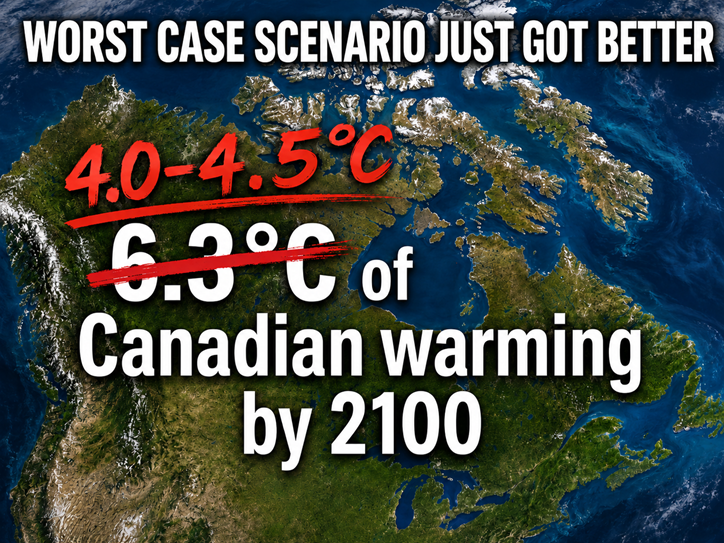
Translated to Canada, the upper bound drops from approximately 6.3°C to roughly 4.0–4.5°C. This is about a 30% reduction! This is genuinely good news. And almost no one noticed.
How Climate Scenarios Shape Canadian Policy
Here’s why this matters to Canadian investors like you and me. This isn’t an academic question. Every climate regulation in Canada is justified by the federal “social cost of carbon”, the dollar figure used to price climate damage. That number, and the industrial carbon price scheduled to rise to $170 per tonne by 2030, is anchored in the scenario the UN just discarded. Think about that—this changes everything.
Ironically, that might explain the silence.
Why Carbon Pricing Assumptions Matter for Investors
The price of industrial carbon and federal adaptation budgets hinged on an “implausible” scenario. The science has just detonated the bedrock on which our policy was based. Since our entire climate-policy mission was built on a target the science now calls implausible, perhaps we should rebrand it. Mission Implausible.
Martha Hall Findlay’s Warning on the Pathways Project
Or call it what Martha Hall Findlay called it last week.
Hall Findlay’s credentials are inconvenient for anyone hoping to dismiss her: former Liberal MP, former Liberal leadership contender, former president and CEO of the Canada West Foundation, former Chief Sustainability and Chief Climate Officer at Suncor, and now Director of the University of Calgary’s School of Public Policy.
She was also, until recently, Chief Sustainability and Climate Officer at Suncor—and on her own account, she helped build the Pathways carbon-capture proposal from its inception. On May 1, she published an op-ed in the Globe and Mail saying it was time to postpone the project. Three days later, she sat across from Senator Pamela Wallin on Wallin’s No Nonsense podcast and said in plain language what no Cabinet minister has been willing to say:
- “There’s no such thing as a green premium. Having worked on the Pathways Carbon Capture project from its inception, this was a very hard thing for me to conclude. But the world has changed… that particular CCUS project — the first phase alone would be well over $20 billion, and importantly contribute virtually nothing to global climate change.”
- “Climate change is a problem. But I also don’t think it’s appropriate for Canada to sacrifice the prosperity of Canadians for something the rest of the world isn’t doing anymore. For us to be so Boy Scoutish to think we still need to meet our Paris Agreement targets when no one else will, and spend billions of dollars that is not revenue-generating, makes absolutely no sense.”
- “This is based on a false arrogance of Canada’s role in the world and our contribution to climate.”
She put numbers on it in her Globe op-ed. Canada accounts for about 1.3% of global greenhouse gas emissions. The oil sands account for roughly 12.4% of Canada’s emissions (about 0.16% of global emissions). The first phase of Pathways, on her math, would reduce global emissions by less than 0.02%. At a cost of $20 billion-plus. That’s roughly a trillion public dollars per percentage point of global emissions reduction. Read that sentence again.
That’s not a Conservative ideologue. That’s not a denier. That’s the architect of the Pathways project saying the math doesn’t work.
The Economic Reality Behind Canada’s Climate Strategy
To recap: $20 billion in public money to “decarbonize” Canadian oil solves a problem the IPCC deems implausible, rests on a green premium that doesn’t exist, uses technology that can’t pay for itself at any carbon price, and would reduce global emissions by less than 0.02%.
So why aren’t we celebrating? Why isn’t this top of the fold on page one of the Globe and the Star?
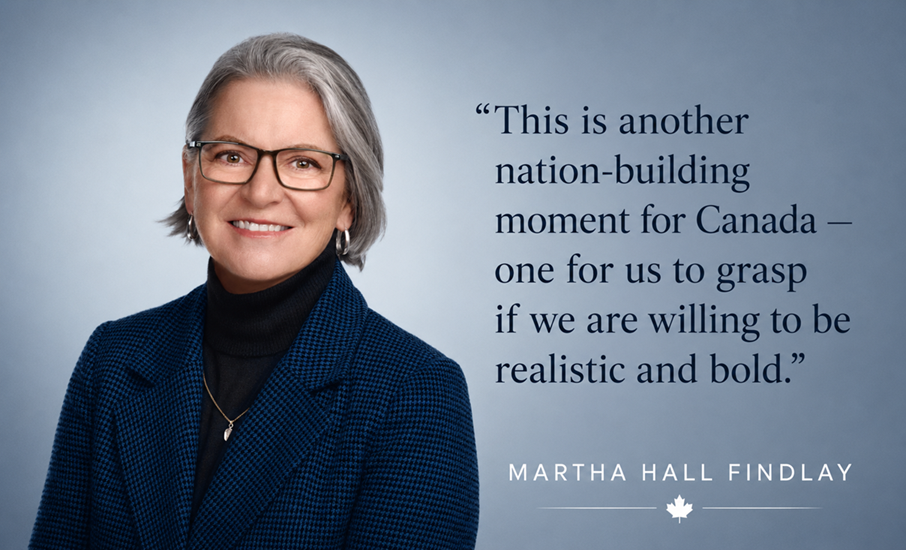
To be clear, climate change remains a real, costly, serious problem—but based on the IPCC’s new position, it is not an existential one. That opens a door. Hall Findlay’s Globe op-ed put it best: “This is another nation-building moment for Canada—one for us to grasp if we are willing to be realistic and bold.”
What the IPPC Reset Could Mean for Energy Investment
This is where Mark Carney’s background really matters. As a technocrat and central banker, he is nothing if not pragmatic. The IPCC reset gives him room to recalibrate, assuming his party will let him. Hall Findlay just modeled for all of us what using it looks like: “Having worked on the Pathways CCUS project from its inception, this was a very hard thing for me to conclude.”
That’s the sound of someone changing their mind because the science changed. We could all learn from that intellectual honesty and willingness to put Canada ahead of ideology.
Glen
Sources: Van Vuuren et al., Geoscientific Model Development (April 2026); Hall Findlay, “Canada should back away from carbon capture and storage and focus on infrastructure like pipelines,” The Globe and Mail (May 1, 2026); Hall Findlay on No Nonsense with Pamela Wallin (May 4, 2026); de Volkskrant front page coverage May 4, 2026, “UN Climate Panel Scraps Disaster Scenario.”