
Last Month in the Markets: July 1-31, 2026
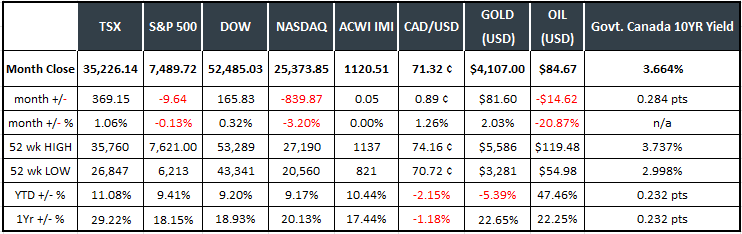
Index returns based on index value (source: Bloomberg https://www.bloomberg.com/markets, MSCI https://www.msci.com/end-of-day-data-search and ARG Inc. analysis. Price returns are reflected)
What happened in July?
Geopolitical developments in the Middle East remained an important influence on global markets during July. Renewed military activity involving the United States and Iran contributed to continued uncertainty, while developments surrounding shipping routes and energy infrastructure kept oil markets particularly sensitive to changing events.
Oil prices experienced renewed volatility throughout the month, rising following heightened tensions in early July before easing later in the month as markets responded to changing geopolitical developments. Despite the late-month decline, oil prices finished July more than 20 per cent above their levels at the end of February, reflecting the ongoing impact of geopolitical risk on global energy markets.
While geopolitical developments remained the primary focus for investors, economic data and central bank decisions continued to shape expectations for inflation and interest rates. The Bank of Canada and the U.S. Federal Reserve both maintained their policy interest rates during July, while inflation data suggested that price pressures remain above central bank targets despite some moderation from recent highs.
What’s ahead for August and beyond?
Geopolitical developments in the Middle East are expected to remain an important influence on energy markets, inflation expectations and investor sentiment. Although oil prices have moderated from their recent highs, sustained increases in energy costs could continue to influence inflation readings and the outlook for monetary policy.
Investors will also be closely watching upcoming inflation, employment, and economic growth data for further indications of how central banks may respond in the months ahead. Recent market expectations have shifted toward the possibility that the U.S. Federal Reserve could maintain higher interest rates for longer if inflation remains above its target.
As always, economic fundamentals including inflation, employment, interest rates, gross domestic product growth, and corporate earnings, together with geopolitical developments, will continue to shape market conditions and investor sentiment.
Events that influenced markets in July included:
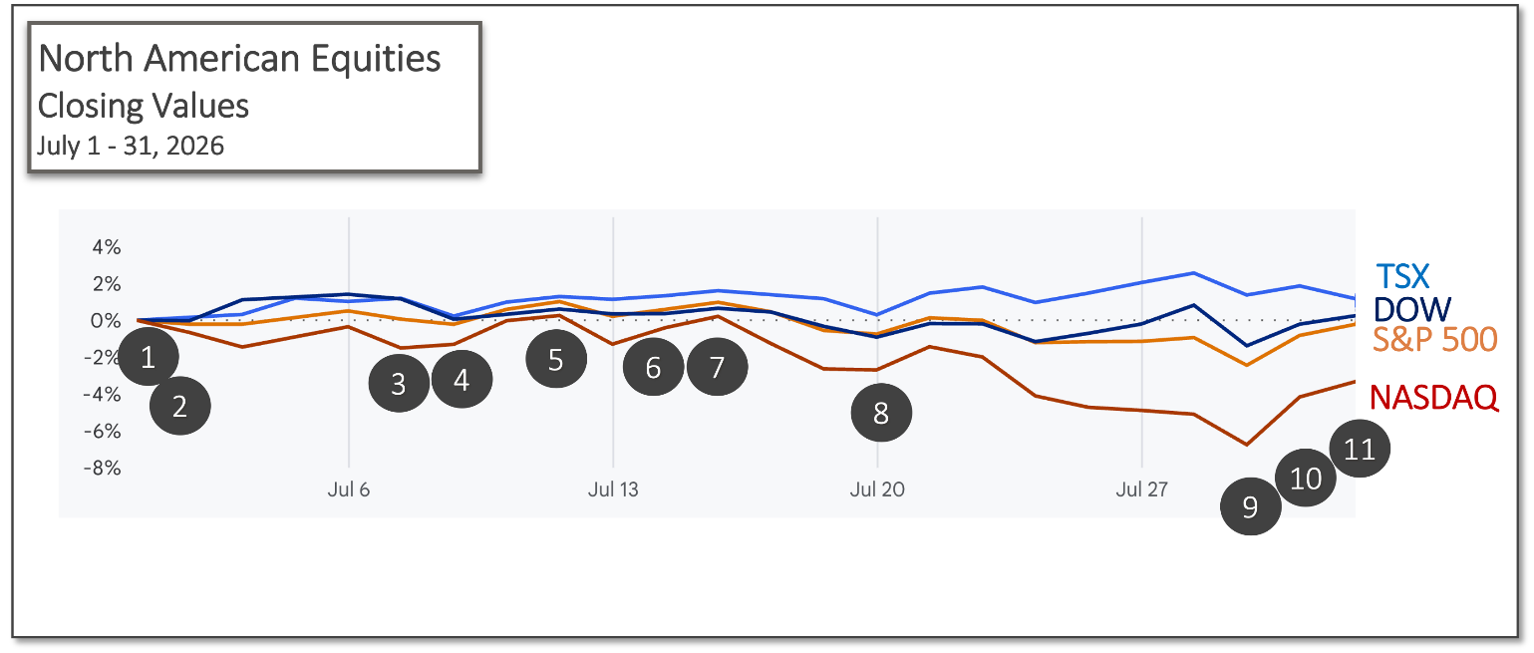
(source: Bloomberg https://www.bloomberg.com/marketsand ARG Inc. analysis)
1. June 30 – The growing Canadian economy led us into July
Real gross domestic product (GDP) grew 0.5 per cent in April, after contracting 0.1 per cent in March, on strength in both goods-producing (1.2 per cent) and services-producing industries (+0.3 per cent). The sectors driving growth were mining, quarrying, oil and gas extraction, the public sector, and transportation and warehousing. StatsCan GDP release
2. July 2 – U.S. jobs grew modestly
According to the U.S. Employment Situation Summary, total nonfarm employment grew by 57,000 in June. Employment gains were led by professional and business services (+36,000), social assistance (+25,000), and health care (+22,000). CNBC and EmpSit
3. July 7 – Canada’s trade surplus grew almost 25 per cent and U.S. trade deficit jumped in May
The merchandise trade surplus widened to $4.2 billion in May from $3.4 billion in April as exports grew more than imports. It was the third consecutive month with a trade surplus. StatsCan release
The U.S. trade deficit widened to $77.6 billion in May, up from $54.6 billion in April, a 42 per cent increase. The deficit grew as exports from the U.S. fell 3.2 per cent and imports to the U.S. increased 3.3 per cent, which accounted for the widening, net-negative trade gap. BEA trade release CNBC
4. July 8 – Renewed U.S.-Iran tensions increased market uncertainty
Following renewed military activity between the United States and Iran, President Donald Trump announced that the ceasefire had ended. Diplomatic communications between the two countries reportedly continued despite the renewed conflict. Politico and ceasefire
5. July 10 – Canadian jobs and unemployment rate improved slightly in June
StatsCan released its Labour Force Survey for June that showed employment increased slightly, up 18,000, and the unemployment rate declined by 0.1 percentage points to 6.5 per cent.
Employment increased among youth and core aged workers, while employment among older Canadians declined.
6. July 14 – U.S. inflation moderated in June but remained above the U.S. Federal Reserve’s target
On a month-over-month basis, U.S. inflation moderated during June. The Consumer Price Index decreased 0.4 per cent in June after rising 0.5 per cent in May. On an annual basis, it has slowed. Over the last 12 months, the all-items index increased 3.5 per cent. In May, the year-over-year consumer inflation rate was 4.2 per cent. Lower energy prices were a significant contributor to the moderation in headline inflation. BLS release CNBC and CPI
7. July 15 – Bank of Canada held rates unchanged and released its Monetary Policy Report
The Bank of Canada maintained its overnight rate at 2.25 per cent, the Bank Rate at 2.5 per cent and the deposit rate at 2.20 per cent. The rates were last changed on October 29, 2025, when they were lowered to their current levels, and have remained unchanged after six subsequent interest rate decisions. In its accompanying statement, the Bank cited higher oil prices, slower global economic growth, uneven Canadian GDP growth, resilient equity markets, higher U.S. bond yields, solid consumer spending and elevated inflation as important factors influencing its outlook.
The Bank of Canada also released its Monetary Policy Report (MPR) that reiterated the situation described above. The Monetary Policy Report also noted that Canada’s trade relationship with the United States and developments in the Middle East remain two of the most significant risks to the inflation outlook. BoC announcement CBC and Boc
8. July 20 – Canadian inflation eased in June
Canada’s Consumer Price Index increased 2.8 per cent in June on a year-over-year basis after May’s reading of 3.2 per cent. Excluding gasoline from the inflation calculations, the Consumer Price Index (CPI) in June and May was unchanged at 2.2 per cent. StatsCan CPI release
9. July 29 – U.S. Federal Reserve maintained policy rates
The U.S. Federal Reserve held its federal funds rate steady in a range of 3.5 to 3.75 per cent. While labour market conditions remained relatively stable, three of the twelve voting members supported an increase in the policy interest rate. Fed announcement CNBC and Fed
10. July 30 – U.S. inflation remained above target while GDP growth moderated
The U.S. Federal Reserve’s preferred inflation indicator, the Personal Consumption Expenditures Price Index (PCE) has risen 3.7 per cent compared with June 2025. Excluding food and energy, Core PCE, rose 3.3 per cent. Both headline and core inflation remained above the U.S. Federal Reserve’s 2 per cent target. PCE release
U.S. Gross Domestic Product (GDP) rose 1.5 per cent on an annualized basis in the second quarter, which is a slow-down compared to Q1 2026. GDP release
11. July 31 – Canadian economic growth continued to improve
In Canada, GDP grew 0.3 per cent in May, the second consecutive month of growth as both goods and services industries expanded. The increase was led by mining, quarrying and oil and gas extraction for the last two months. The government, construction, real estate, rental and leasing, manufacturing, finance and insurance, transportation, and warehousing were among the sectors contributing to economic growth. StatsCan GDP release