
Last Month in the Markets: August 1-31, 2026
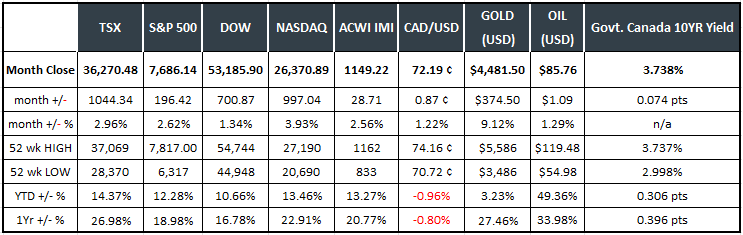
Index returns based on index value (source: Bloomberg https://www.bloomberg.com/markets, MSCI https://www.msci.com/end-of-day-data-search and ARG Inc. analysis. Price returns are reflected)
What happened in August?
August was the first month in more than two years in which all of the major indexes included in our market summary posted positive returns. Despite continued geopolitical and economic uncertainty, North American equity indexes and the All Country World Index moved higher. The TSX and S&P 500 gained nearly 3 per cent, the Dow advanced approximately 1.5 per cent and the NASDAQ rose almost 4 per cent.
Economic conditions continued to differ between Canada and the United States. Canadian inflation remained above the Bank of Canada’s target, while employment and economic growth showed continued resilience. In the United States, inflation also remained above target while employment growth showed signs of slowing.
Against this backdrop, both the Bank of Canada and the U.S. Federal Reserve continued to balance inflation and employment considerations when setting monetary policy. Expectations that U.S. interest rates could remain elevated, or potentially move higher, did not prevent equity markets from advancing during August.
Trade relations between Canada and the United States also remained an important area of focus. Negotiations ended without an agreement in August, adding another source of uncertainty for the Canadian economic outlook.
What’s ahead for September and beyond?
Trade negotiations, geopolitical developments in the Middle East, energy prices, inflation and interest rates are likely to remain important considerations for investors in the months ahead.
The Bank of Canada maintained its policy interest rate at 2.25 per cent on September 2. The next scheduled interest rate decision from the U.S. Federal Reserve will occur on September 16, followed by additional decisions from both central banks in October and December.
Future interest rate decisions will depend heavily on incoming economic data. In Canada, the Bank of Canada continues to balance inflationary pressures against employment and economic growth. In the United States, persistent inflation and evolving labour market conditions will be important considerations for the Federal Reserve.
Interest rates set by central banks are only one factor influencing borrowing costs. Government bond yields have also moved higher, reflecting a combination of inflation expectations, government borrowing requirements and broader economic conditions. Higher bond yields can increase borrowing costs for governments, businesses and consumers and remain an important factor to watch.
Geopolitical developments also continue to influence energy markets. Renewed tensions in the Middle East contributed to higher oil prices toward the end of August and into early September. Further developments may contribute to continued volatility in energy prices and broader financial markets.
Events that influenced markets in August included:
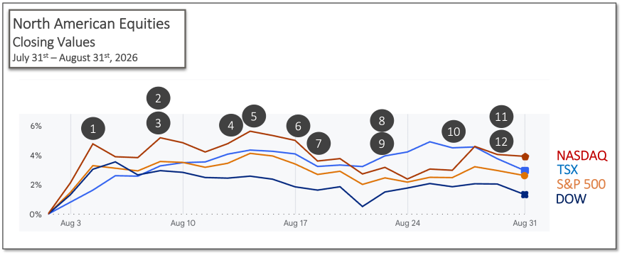
(source: Bloomberg https://www.bloomberg.com/marketsand ARG Inc. analysis)
1. August 4 – Canada’s trade surplus grew, again
The Canadian merchandise trade surplus widened slightly from $3.7 billion in May to $3.9 billion in June. Merchandise exports increased 0.4 per cent, more than the increase in imports at 0.2 per cent. June was the fourth consecutive month with a monthly surplus. StatsCan release
2. August 7 – Canadian jobs show continued resilience
Canada’s economy added 75,000 jobs in July according to StatsCan’s Labour Force Survey. Gains were split between full and part-time employment, and over 180,000 jobs have been added since April. The unemployment rate fell for the third consecutive month to 6.4 per cent, its lowest level in 2 years. CBC and jobs
3. August 7 – U.S. employment slipped
“Both nonfarm payroll employment (-23,000) and the unemployment rate (4.1 per cent) changed little in July” according to the Bureau of Labor Statistics’ Employment Situation Summary. Analysts had expected a gain of 83,000 for July. After downward revisions to previous months, the average monthly gain is down to 34,000.
4. August 12 – U.S. consumer inflation eased, but remained above goal
The Consumer Price Index (CPI) eased 0.1 per cent to 3.4 per cent on a year-over-year basis. On a monthly basis, prices increased 0.1 per cent in July compared to a 0.4 per cent increase in June. In July, shelter, food and food away from home contributed to the increase, while the energy index declined 1.5 per cent. BLS CPI release
5. August 13 – Wholesale prices also eased, but is still high
U.S. Producer Price Index (PPI) in July rose 4.7 per cent on a year-over-year basis down from 5.5 per cent in June. The PPI measures the change in prices paid by producers and wholesalers, not consumers. Changes in producer prices can provide insight into inflationary pressures that may eventually be reflected in consumer prices.
6. August 17 – Canadian inflation
The Canadian Consumer Price Index (CPI) rose 3.0 per cent on a year-over-year basis in July, up from the 2.8 per cent reading in June. Higher prices for gasoline and travel driven by World Cup attendees contributed to the acceleration in inflation. Price for food purchased from stores increased 3.1 per cent from one year earlier. StatsCan CPI release CBC and CPI
7. August 18 – Trade talks extended
About 90 minutes before Trump’s 50 per cent tariffs on more than $20 billion of Canadian imports were to take effect a three-day pause was announced by the President on social media. No details were released; negotiators have additional time to arrive at a comprehensive arrangement.
8. August 21 – Trade talks ended without any deal
Negotiations concluded without an agreement. The details from the Canadian perspective were communicated in an address by Prime Minister Carney.
9. August 21 – U.S. government debt breached $40 trillion
In news that will reverberate across global capital markets the U.S. federal debt rose to $40 trillion. Rising government debt and borrowing requirements remain important considerations for bond markets. Increased government borrowing can place upward pressure on bond yields and borrowing costs, although a variety of economic and market factors influence interest rates. Fed FOMC minutes
10. August 26 – U.S. inflation remained above target in July
The Federal Reserve’s preferred inflation indicator, the Personal Consumption Expenditures price index (PCE), showed that consumer prices rose 3.7 per cent compared to July 2025. The Fed’s goal for inflation is 2 per cent. Core PCE, which excludes more volatile food and energy, rose 3.3 per cent from one year ago. The Federal Reserve’s next rate decision is scheduled for September 16. This inflation report, along with upcoming employment data, will be among the economic indicators considered ahead of the Federal Reserve’s September interest rate decision. BEA PCE release CNBC and PCE
11. August 28 – Canadian economic growth strengthened in the second quarter
Canada’s Gross Domestic Product (GDP) grew 0.8 per cent in the second quarter of 2026, representing an annualized growth rate of 3.3 per cent. Growth was supported by a 3.6 per cent increase in exports, led by passenger cars and light trucks. Auto production had declined during the previous two quarters, with increased production and exports contributing to the stronger second quarter results. Higher U.S. tariffs on Canadian vehicles could affect production and exports in subsequent quarters. StatsCan GDP release CBC ad GDP
12. August 28 – Federal Reserve Chair addressed inflation outlook
Federal Reserve Chair Kevin Warsh addressed the outlook for inflation and monetary policy during the annual Jackson Hole Economic Symposium. His comments reinforced the Federal Reserve’s continued focus on bringing inflation closer to its 2 per cent target and highlighted the importance of incoming economic data in determining future interest rate decisions. Following the speech, market expectations reflected in the CME’s FedWatch tool shifted toward a greater probability of a rate increase at an upcoming meeting. These probabilities reflect market expectations and can change as new economic data becomes available.