
Last Month in the Markets: October 1-31, 2026
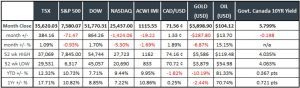
Index returns based on index value (source: Bloomberg https://www.bloomberg.com/markets, MSCI https://www.msci.com/end-of-day-data-search and ARG Inc. analysis. Price returns are reflected)
What happened in October?
Equity markets delivered mixed results in October, with increased volatility during the latter part of the month. Several factors contributed to changing investor sentiment, including geopolitical developments, higher energy prices, persistent inflation, international trade tensions, and uncertainty surrounding the upcoming U.S. midterm elections.
The ongoing conflict involving the United States and Iran continued to influence global energy markets. Restrictions affecting shipping through the Strait of Hormuz and the Bab al Mandab Strait contributed to higher oil prices, which have risen more than 80 per cent since the beginning of 2026. Elevated prices for crude oil, gasoline, and diesel have broader economic implications, as energy is an important input for transportation, manufacturing, and many other goods and services.
Inflation remained a central concern for policymakers. Higher energy costs and international trade restrictions contributed to inflationary pressures, while investors continued to assess the possibility of additional interest rate increases. In October, the Bank of Canada raised its policy interest rate by 0.25 percentage points, while the U.S. Federal Reserve maintained its existing rate.
Bond markets also remained sensitive to changing expectations for inflation and monetary policy. Higher government bond yields placed pressure on existing bond valuations, particularly for longer duration securities. At the same time, higher yields have increased the income available from newly issued fixed income investments.
The upcoming U.S. midterm elections added another source of uncertainty, as investors considered the potential implications for fiscal, regulatory, and trade policies. Despite these challenges, economic fundamentals and corporate earnings continued to influence market performance.
What’s ahead for November and beyond?
Inflation, interest rates, geopolitical developments, and international trade will remain important considerations for investors as we approach the end of 2026. Both the Bank of Canada and U.S. Federal Reserve are scheduled to announce their next interest rate decisions on December 9. Market expectations currently favour another U.S. rate increase, although incoming economic data could influence that outlook.
With uncertainty surrounding inflation, energy prices, monetary policy, and political developments, both equity and bond markets may experience further fluctuations. Maintaining a diversified, disciplined investment approach remains important as economic conditions continue to evolve.
Events that influenced markets in October included:
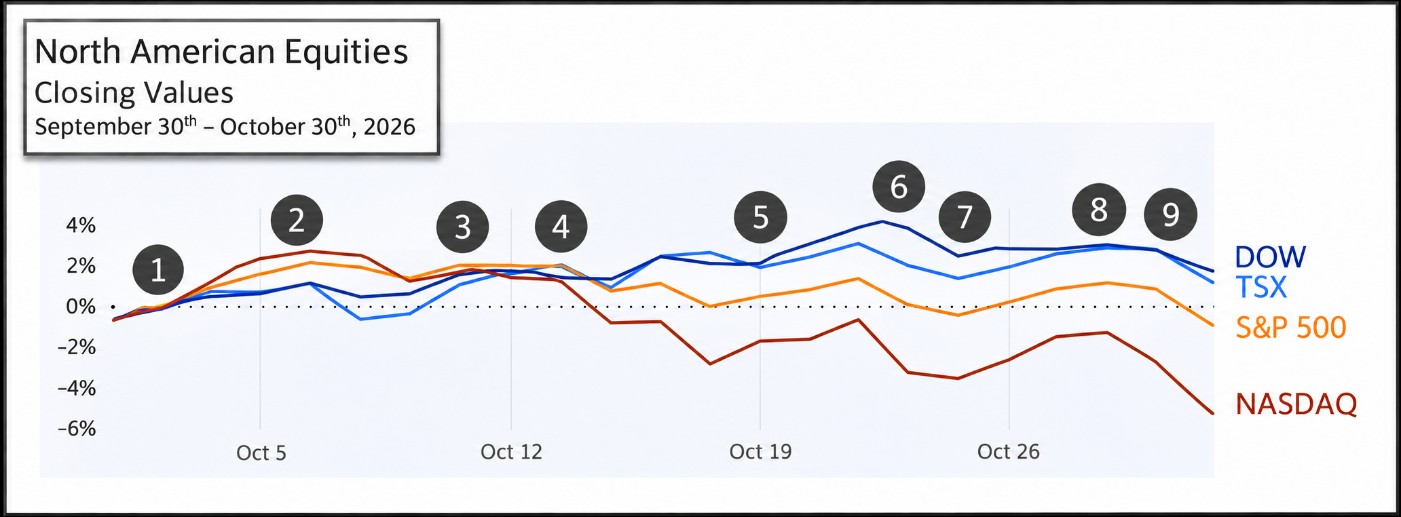
(source: Bloomberg https://www.bloomberg.com/marketsand ARG Inc. analysis)
1) October 2: U.S. employment growth slowed in September
According to the U.S. Bureau of Labor Statistics, nonfarm payroll employment increased by 29,000 in September, while the unemployment rate remained relatively unchanged at 4.2 per cent. The number of unemployed Americans was approximately 7.1 million, including 1.9 million who had been unemployed for an extended period. Employment changes were modest across most industries, reflecting slower overall job creation. BLS ESS release
2) October 6: U.S. trade deficit widened while Canada’s trade surplus increased
The U.S. goods and services trade deficit increased to $105.6 billion in August, compared with $92.8 billion in July. Imports rose 4.3 per cent, while exports increased 1.4 per cent. The goods trade deficit widened to approximately $137 billion, while the services trade surplus remained near $31 billion. BEA release
Canada’s merchandise trade surplus increased for the sixth consecutive month, reaching $4.2 billion in August compared with $787 million in July. Exports increased 2.5 per cent while imports declined 2.0 per cent. Export growth was recorded in eight of eleven sectors, including a 17 per cent increase in refined petroleum energy products. Currency movements also influenced the reported Canadian dollar value of international trade. StatsCan release
3) October 9: Canadian employment declined in September
Canadian employment declined by 68,000 in September, while the unemployment rate increased to 6.5 per cent from 6.4 per cent in August. Employment losses were divided approximately equally between full time and part time positions.
Declines were most pronounced in Quebec and British Columbia, among younger workers and core aged women, and in educational services, health care and social assistance, and manufacturing. StatsCan Labour Force Survey
4) October 14: U.S. consumer inflation accelerated in September
The U.S. Consumer Price Index increased 0.6 per cent in September, following a 0.4 per cent increase in August. Over the previous 12 months, consumer prices rose 3.7 per cent, compared with 3.4 per cent in August.
Gasoline prices increased 9.1 per cent during September and accounted for approximately half of the monthly increase in the overall index. Higher energy prices continued to be an important contributor to inflation. BLS CPI release
5) October 19: Canadian inflation increased modestly in September
Canada’s Consumer Price Index increased 3.1 per cent on a year over year basis in September, compared with 3.0 per cent in August.
Higher gasoline prices contributed to the increase in headline inflation. Excluding gasoline, consumer prices rose 2.2 per cent, while the measure excluding food and energy increased 2.4 per cent. These differences highlight the influence of energy prices on overall inflation. StatsCan CPI release
6) October 22: Canadian producer prices increased in September
Prices for products manufactured in Canada, as measured by Statistics Canada’s Industrial Product Price Index, increased 2.0 per cent in September and 14.5 per cent compared with the same month in 2025.
Producer prices provide insight into cost pressures faced by manufacturers. Sustained increases in production costs can contribute to consumer inflation, although the extent and timing of these increases being passed along to consumers can vary. IPPI release
7) October 23: Canadian retail sales rebounded in August
Canadian retail sales increased 1.2 per cent in August to $74.6 billion, following a 0.7 per cent decline in July.
Sales increased across all nine retail subsectors and six provinces, with motor vehicle and parts dealers contributing to the overall improvement. The results reflected continued consumer spending despite broader economic uncertainty. StatsCan retail sales
8) October 28: Bank of Canada raised interest rates while Federal Reserve held steady
The Bank of Canada increased its policy interest rate by 0.25 percentage points to 2.50 per cent, marking its first increase in three years. The Bank noted that persistently elevated energy prices and increasing production and transportation costs were contributing to inflationary pressures.
The Bank also acknowledged that Canadian economic growth had been stronger than previously anticipated, although uncertainty surrounding trade relations with the United States remained elevated. BoC release CBC and BoC
The U.S. Federal Reserve maintained its benchmark interest rate within a range of 3.75 to 4.00 per cent. The U.S. Federal Reserve acknowledged that inflation remained elevated and indicated that future policy decisions would depend on incoming economic data and the outlook for inflation and employment.
Both central banks are scheduled to announce their next interest rate decisions on December 9.
9) October 29: U.S. inflation remained above the Federal Reserve’s target
The U.S. Bureau of Economic Analysis reported that the Personal Consumption Expenditures (PCE) Price Index increased 0.5 per cent in September and 3.6 per cent compared with the same month in 2025.
The PCE Price Index is the U.S. Federal Reserve’s preferred measure of inflation. The latest reading remained above the central bank’s 2 per cent target, reinforcing the importance of inflation data in determining future monetary policy decisions. BEA PCE release BEA GDP release