
Last Month in the Markets: September 1-30, 2026
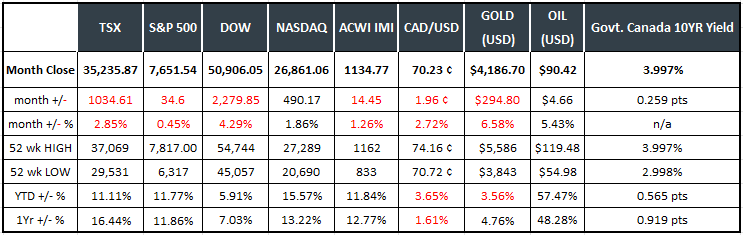
Index returns based on index value (source: Bloomberg https://www.bloomberg.com/markets, MSCI https://www.msci.com/end-of-day-data-search and ARG Inc. analysis. Price returns are reflected)
What happened in September?
September was a more challenging month for investors concentrated in North American equities, although results remained stronger when viewed over the broader three-month period.
Many of the factors influencing markets over the past several months remained in focus. Inflation continued to run above central bank targets, contributing to interest rate increases from both the U.S. Federal Reserve and the European Central Bank during September. The Bank of Canada maintained its policy interest rate at 2.25 per cent.
Bond markets also experienced a difficult month as yields moved higher and bond prices declined. Concerns surrounding persistent inflation, higher energy prices, government borrowing and the outlook for interest rates contributed to the increase in yields. Longer term U.S. Treasury yields reached levels not seen in more than two decades, increasing borrowing costs and adding another source of pressure for financial markets.
Energy prices remained an important contributor to inflation. Ongoing geopolitical tensions in the Middle East continued to influence crude oil, gasoline and diesel prices, while investors monitored the potential implications for inflation, interest rates, and economic growth.
What’s ahead for October and beyond?
Inflation, interest rates, energy prices, and international trade are expected to remain important areas of focus for investors in the months ahead.
The Bank of Canada and U.S. Federal Reserve are scheduled to announce their next interest rate decisions on October 28, followed by additional decisions in December and January. Future interest rate decisions will depend on incoming economic data, particularly inflation, employment, and economic growth. Market expectations for future U.S. Federal Reserve decisions continue to evolve as new information becomes available.
Bond markets will also remain an important area to watch. After yields moved higher and bond prices declined during September, future performance will be influenced by inflation expectations, central bank policy, energy prices, and government borrowing requirements. While higher yields can create short term pressure on existing bond values, they also increase the income available from newly issued bonds. Continued volatility is possible as markets adjust their expectations for the path of inflation and interest rates.
Energy prices will also remain an important consideration. Continued geopolitical tensions in the Middle East and uncertainty surrounding major shipping routes could contribute to fluctuations in oil prices, with potential implications for inflation and economic activity.
Trade relations between Canada and the United States remain another source of uncertainty. Changes to tariffs and other trade measures can affect the cost and flow of goods between the two countries and may influence inflation, business investment, and economic growth.
Each of these factors remains uncertain and could contribute to periods of market volatility. Maintaining a diversified, long term investment approach remains important as economic and market conditions continue to evolve.
Events that influenced markets in September included:
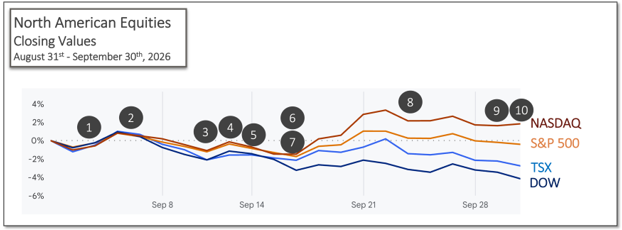
(source: Bloomberg https://www.bloomberg.com/marketsand ARG Inc. analysis)
1) September 2 – Bank of Canada maintained its policy interest rate
The Bank of Canada (BoC) maintained its policy rate at 2.25 per cent. The BoC cited the continued geopolitical tensions in the Middle East and uncertainty surrounding trade and tariff negotiations between Canada and the United States as important factors affecting the economic outlook. Both situations were characterized by the BoC as fluid. BoC announcement
2) September 4 – Canadian employment declined while U.S. employment increased
Canadian employment declined by 42,000 in August according to Statistics Canada’s Labour Force Survey (LFS). The unemployment rate remained unchanged at 6.4 per cent. Employment results were weaker than analysts had anticipated. CBC and LFS
In the United States, total nonfarm payroll employment increased by 162,000 in August, exceeding analyst expectations. The results reflected continued differences between Canadian and U.S. labour market conditions. CNBC and ESS
3) September 10 – European Central Bank raised interest rates
The European Central Bank (the ECB) increased its benchmark interest rate by 0.25 percentage points in response to continued inflationary pressures. The ECB noted that geopolitical developments in the Middle East continue to contribute to inflation pressures and that inflation is expected to remain above target for an extended period. ECB release
4) September 11 – U.S. consumer inflation remained elevated
U.S. consumer prices increased 0.4 per cent in August following a 0.1 per cent increase in July, according to the Bureau of Labor Statistics. Gasoline prices increased almost 4 per cent during the month and accounted for approximately one third of the monthly increase.
Over the previous 12 months, the Consumer Price Index increased 3.4 per cent, unchanged from the annual inflation rate reported in July. CPI release
5) September 14 – Canadian inflation remained at 3 per cent
Canada’s Consumer Price Index increased 3 per cent on a year over year basis in August, unchanged from July. Gasoline prices increased at a slower pace than in the previous month, while higher prices for travel and rent contributed to the overall inflation reading. StatsCan CPI CBC and CPI
6) September 16 – Federal Reserve raised its policy interest rate
The U.S. Federal Reserve increased its benchmark interest rate by 0.25 percentage points, marking its first increase in three years. The U.S. Federal Reserve cited continued elevated inflation and its commitment to returning inflation to its 2 per cent target. Fed statement
The U.S. Federal Reserve also released its updated Summary of Economic Projections including the closely followed “dot plot,” which reflects individual committee members’ expectations for the future path of interest rates. The projections indicated that committee members continue to see the potential for further changes to interest rates as they assess inflation and broader economic conditions. CNBC and rates
7) September 16 – Canada and European Union discussed closer economic ties
Prime Minister Mark Carney met with European Union leaders to discuss opportunities for closer economic and strategic cooperation. The discussions align with the Canadian government’s stated objective of expanding and diversifying Canada’s international trade relationships.
Details surrounding any potential changes to the relationship between Canada and the European Union remain under discussion. CNBC and Canada/EU
8) September 24 – Canadian retail sales declined
Canadian retail sales declined 0.7 per cent in July to $73.7 billion, following a 1.2 per cent increase in June. The decline was led by general merchandise retailers and was broad based, with eight of nine subsectors reporting lower sales.
Retail spending is an important component of economic activity and provides insight into changing consumer behaviour and economic conditions. StatsCan release
9) September 29 – Canadian economic growth was unchanged in July
Canadian real Gross Domestic Product was unchanged in July following growth of 0.4 per cent in June. Overall activity in both goods producing and services producing industries was relatively unchanged during the month.
Construction was one area of strength, recording its fourth consecutive month of growth with an increase of 1.3 per cent in July. StatsCan GDP release
10) September 30 – U.S. inflation remained above the Federal Reserve’s target
The Bureau of Economic Analysis reported that the Personal Consumption Expenditures Price Index, the U.S. Federal Reserve’s preferred measure of inflation, increased 0.3 per cent in August.
Compared with August 2025, the PCE Price Index increased 3.4 per cent. Core PCE, which excludes the more volatile food and energy categories, increased 3 per cent over the same period. Both measures remained above the U.S. Federal Reserve’s 2 per cent inflation target. PCE release