
Reflections & Resources

Last Month In The Markets – A Difficult Month To Endure

Click here to download this article as PDF.

Last Month in the Markets: March 1st – 31st, 2023
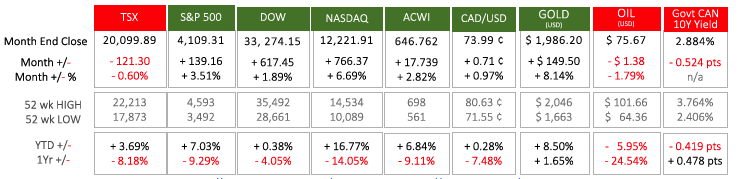
Last Month in the Markets- March 1st – 31st, 2023

 (source: Bloomberg https://www.bloomberg.com/markets, MSCI https://www.msci.com/end-of-day-data-search and ARG Inc. analysis) 

What happened in March?

 Last month was difficult to endure for investors concentrated in North American equities, especially those with significant holdings in financial services, which includes many Canadians. By the end of March, the TSX finished almost where it began the month, and the U.S. equities indexes rose 2 to 6½ percent. 

Rates of interest and inflation continued their influential roles, but the failure of two U.S. banks, concern over many more institutions, and a Swiss government-led acquisition of Credit Suisse by UBS consumed most of the attention as markets rose, dropped swiftly, and then steadily regained (or improved) their position. 
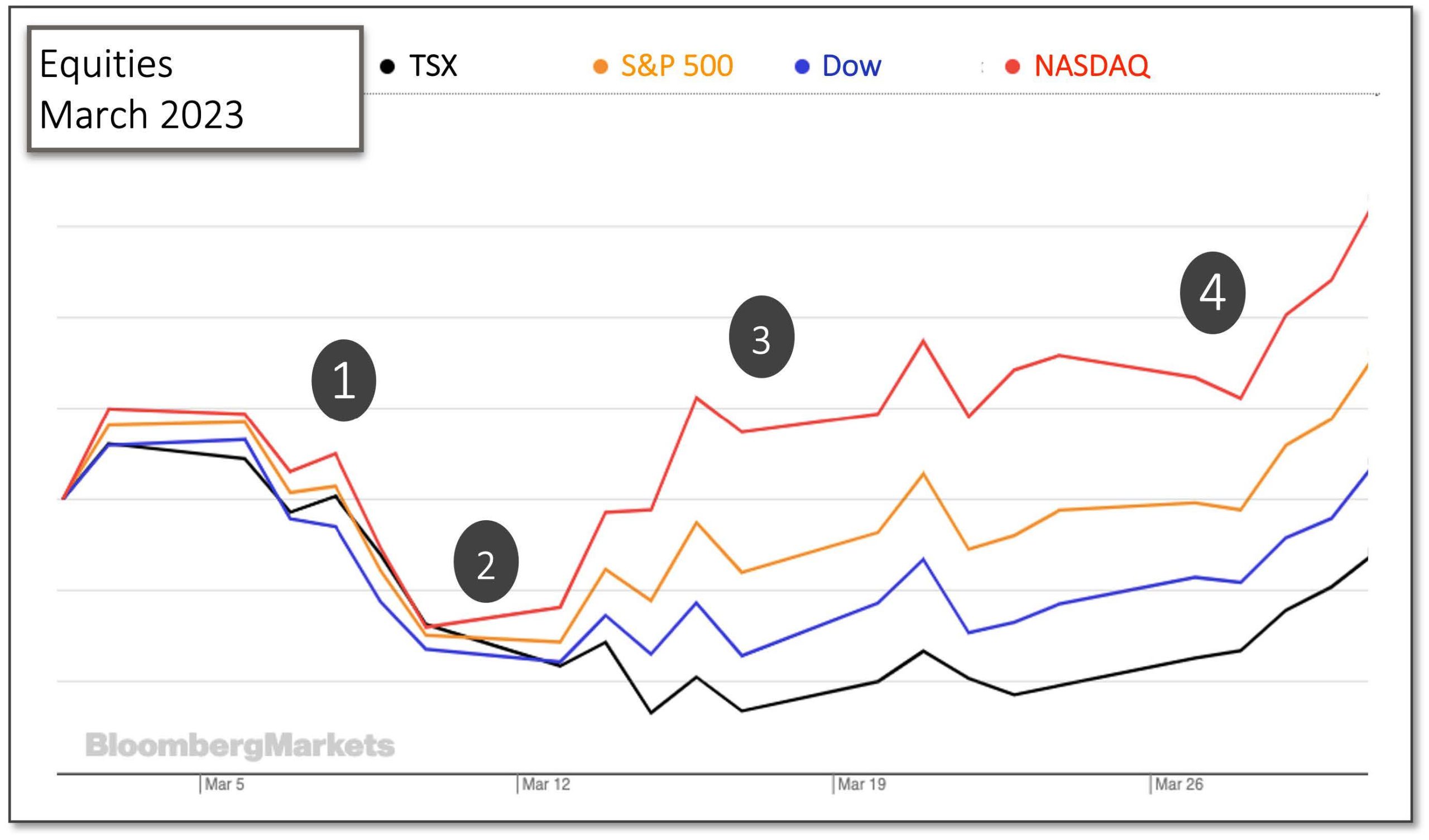
Equities March 2023

 (source: Bloomberg https://www.bloomberg.com/marketsand ARG Inc. analysis) 

March 2023 will be remembered more for its turmoil than the results posted by month-end: 

  1. On March 7th, U.S. Federal Reserve Chair, Jerome Powell, testified in Washington where he reiterated the central bank’s commitment to reduce inflation to the target of 2%. Coupled with the strength of the U.S. economy, “which suggests that the ultimate level of interest rates is likely to be higher than previously anticipated.” Despite the other good news for the economy (employment, GDP), continuing to increase interest rates can lower the value of equities as the fear or likelihood of recession increases. Watch Powell video
  2. Much attention has been paid to the effect on consumers from rising interest rates, but financial institutions can be exposed, too. As short-term rates rise, and banks are forced to pay current rates on deposits, their long-term investments at lower rates of return can cause a narrowing of margins. A confidence-crisis and bank-run resulted, and regulators in California shut down Silicon Valley Bank on March 10th. This led to additional scrutiny and wider worries for bank solvency and was amplified when the FDIC shuttered Signature Bank on March 12th. The confidence crisis in banking triggered a decline for equity indexes. SVB Fallout Spreads
  3. Equity markets began a tentative recovery after the U.S. Treasury Department, Federal Reserve and Federal Deposit Insurance Corporation added increased protections for depositors and introduced a new borrowing facility to allow banks to meet short-term cash Joint release
    • The effects of increasing interest rates were not limited to the United States. The nascent recovery was imperilled when Credit Suisse was exposed and was rescued by UBS under very generous conditions. The deal was brokered by the Swiss government to protect depositors, some investors, and the Swiss banking The reputation of Swiss bank security and discretion could be damaged further as Switzerland’s Attorney General has launched a criminal investigation into the takeover. Swiss investigation CS/UBS
  4. As the failures, takeovers and concerns for banks continued so did the analysis and reflection. The growing sentiment is that many of the most at-risk banks had problems with managing traditional assets, not complicated derivatives, and were largely exposed to interest-rate-risk. As government institutions stepped-in to protect depositors and reassure investors share prices have begun to respond CNBC and bank contagion

What’s ahead for April and beyond in 2023?

Although the risk and issues for banks seem to be easing, the health of the financial sector will likely play a significant role for markets. As Jerome Powell stated during his press conference following the interest rate decision on March 22nd, it is expected that lenders will raise requirements, which will limit access to capital in the marketplace. This will allow banks to either hold cash for liquidity or increase income through higher rates.

Central banks will continue to monitor overall economic growth (Gross Domestic Product), employment, as well as inflation. Inflation growth has ebbed and has begun to decline, if only slightly, yet remains far from the shared target of 2%. The next scheduled interest rate decisions from the Bank of Canada, Federal Reserve and European Central Bank are April 12, May 3, and May 4, respectively.

BoC monetary policy                 Fed monetary policy                 ECB monetary policy


Wagner Investment Management Team contributors: Susyn Wagner & Karen Routledge

Recent Posts

Beyond ESG Ratings: How We Evaluate Responsible Investments

Beyond ESG ratings: How we evaluate responsible investments

Understanding our responsible investing process

Responsible investing has become an increasingly important part of the investment landscape. As environmental, social, and governance (ESG) investing has become more widely adopted, many investors are surprised to learn that different ESG research organizations often assign different ratings to the same company.

Rather than viewing these differences as a weakness, we believe they reflect the complexity of evaluating corporate sustainability. No single research provider captures every dimension equally well.

For this reason, we developed a proprietary ESG assessment methodology that combines multiple independent sources of research into one disciplined and consistent investment framework.

Why this matters

Responsible investing is about more than simply selecting companies with favourable ESG ratings. It requires a disciplined investment process that balances sustainability considerations with sound financial analysis.

Our methodology is designed to identify companies that demonstrate responsible corporate behaviour while continuing to meet the financial characteristics we believe are important for long-term investment success.

Our layers of ESG due diligence

Read More »

July 2026 Market Update – Middle East Uncertainty, Central Bank Caution, and Resilient Economic Growth

What happened in July? Geopolitical developments in the Middle East remained an important influence on global markets during July. Renewed military activity involving the United States and Iran contributed to continued uncertainty, while developments surrounding shipping routes and energy infrastructure kept oil markets particularly sensitive to changing events. Oil prices experienced renewed volatility throughout the month, rising following heightened tensions in early July before easing later in the month as markets responded to changing geopolitical developments. Despite the late-month decline, oil prices finished July more than 20 per cent above their levels at the end of February, reflecting the ongoing impact of geopolitical risk on global energy markets. While geopolitical developments remained the primary focus for investors, economic data and central bank decisions continued to shape expectations for inflation and interest rates. The Bank of Canada and the U.S. Federal Reserve both maintained their policy interest rates during July, while inflation data suggested that price pressures remain above central bank targets despite some moderation from recent highs.

Read More »

Summer 2026 Newsletter – The Wagner Investment Management Team

As we move through summer 2026, it’s a great time to take a step back from the headlines and focus on the bigger picture of your financial plan.

Discover how evolving market dynamics are shaping the investing landscape, explore the lessons that Jevons Paradox may offer for energy markets and artificial intelligence, and learn practical ways to support the next generation through homeownership, tax planning, and financial education. Plus, gain valuable estate-planning insights on navigating the transition when children reach adulthood.

Let’s make this summer a season of perspective, preparation, and opportunity – helping you stay focused on your long-term goals while we continue to navigate changing markets together.

Read More »

June 2026 Market Update – Middle East Tensions, Oil Price Swings, and Easing Energy Concerns

Geopolitical tensions in the Middle East remained a key influence on global markets during June. Developments involving the U.S., Iran, Israel, Gaza, and Lebanon contributed to periods of heightened uncertainty, particularly in energy markets. Concerns surrounding shipping through the Strait of Hormuz, a key global oil transit route, led to temporary increases in oil prices during the month. However, as tensions eased, oil prices retreated approximately 30 per cent from their June 3 intraday high, ending the month near where they finished in late February.

Read More »

The information contained herein has been provided for information purposes only. The information has been drawn from sources believed to be reliable. The information does not provide financial, legal, tax or investment advice. Particular investment, tax, or trading strategies should be evaluated relative to each individual’s objectives and risk tolerance. This does not constitute a recommendation or solicitation to buy or sell securities of any kind. Wellington-Altus Private Wealth Inc. (WAPW) does not guarantee the accuracy or completeness of the information contained herein, nor does WAPW assume any liability for any loss that may result from the reliance by any person upon any such information or opinions. Before acting on any of the above, please contact your financial advisor.

© 2024, Wellington-Altus Private Wealth Inc. ALL RIGHTS RESERVED. NO USE OR REPRODUCTION WITHOUT PERMISSION. www.wellington-altus.ca