Big Events in Calgary
Calgary International Bluesfest: This festival is one of Western Canada’s premier blues events. It takes place July 30-August 2 at The Confluence in Calgary, bringing together acclaimed blues artists and emerging talent for four days of live music, community, and celebration.
For more information, visit Calgary Bluesfest
Taste of Calgary: This is the city’s signature food and beverage festival, bringing together diverse restaurants, drink vendors, local musicians, artisans, and interactive experiences. This free-admission event takes place at Cowboys Park. from July 30–August 3,
To learn more, visit Taste of Calgary
EXECUTIVE SUMMARY
Reflection and Outlook
- Markets weathered early geopolitical shocks and went on to reach new all-time highs — a testament to their underlying resilience.
- Market leadership is broadening beyond U.S. mega-cap technology; diversification is being rewarded again.
- U.S. growth and employment remain resilient, though inflation is sticky and central banks are keeping rates higher for longer.
- Canada’s economy is showing tentative signs of rebound, and the global earnings of TSX-listed companies provide added resilience.
- This remains an earnings-driven bull market, and Canadian and international markets continue to offer attractive opportunities.
- On November’s U.S. midterms: stay invested — pre-election volatility is normal and has historically been followed by above-average returns.
- Portfolios remain broadly diversified across global equities, private credit, and high-quality bonds, balancing long-term growth with risk management.
Family Office
- Building a lasting legacy means preparing the next generation for the responsibilities of wealth, not just the inheritance itself.
- Sharing your family’s values, history, and financial philosophy can be just as important as passing on financial assets.
- Family meetings and ongoing financial education help foster confidence, communication, and informed decision-making across generations.
- Thoughtful governance and proactive planning can help preserve both family wealth and family harmony for years to come.
REFLECTION AND OUTLOOK
The first half of this year has been one of the more eventful periods in recent memory. Markets came under pressure early in the year amid geopolitical tensions involving Iran, which disrupted energy shipments and briefly sent oil prices sharply higher. These developments ultimately proved to be a temporary disruption rather than a lasting obstacle: markets recovered quickly, and major U.S. equity indices went on to reach a series of new all-time highs. More recently, tensions in the region have re-emerged, contributing to a modest recovery in oil prices. While we are monitoring these developments closely, we believe any further rise in oil prices is likely to be more measured than the spike experienced earlier this year, and it is worth noting that Canada, as a significant energy producer, tends to benefit from firmer commodity prices even as consumers feel them at the pump.
One of the most encouraging developments this year has been the broadening of market leadership. After several years in which returns were dominated by a small group of large U.S. technology companies, gains have spread more widely — international markets, smaller companies, and sectors tied to the real economy have all participated meaningfully. In short, diversification is being rewarded again, which is a healthy sign for long-term investors.
The economic backdrop offers both encouraging signs and areas to watch. In the U.S, growth and the labour market have remained resilient, supported by continued business investment, particularly in artificial intelligence, and steady consumer spending. Inflation, however, has stayed somewhat elevated on both sides of the border, lifted in part by higher energy prices. As a result, central banks have adopted a patient, wait-and-see stance: both the U.S. Federal Reserve, now under new leadership, and the Bank of Canada have held interest rates steady in recent months, and borrowing costs may remain higher for longer than many had hoped. In Canada, the economy contracted slightly at the start of the year as trade tensions and tariffs weighed on exports and business investment, but more recent data point to a tentative rebound, and the labour market has shown signs of stabilizing. Ongoing trade discussions with the United States remain an important factor to watch in the months ahead.
Against this backdrop, markets have largely looked through near-term uncertainty, supported by exceptionally strong corporate earnings, particularly from technology companies benefiting from the continued build-out of artificial intelligence. Importantly, this has been an earnings-driven market rather than one fuelled purely by rising valuations, which we view as a firmer foundation. Following a significant rally, markets appear to be undergoing a healthy period of consolidation, and we continue to believe the longer-term bull market remains intact. That said, valuations in some areas of the U.S. market remain elevated after an extended period of strong performance. By contrast, Canadian and international markets continue to offer attractive opportunities, including higher income potential and greater exposure to businesses tied to real assets such as energy, materials, and industrials. And while the Canadian economy has slowed, less than half of the earnings generated by TSX-listed companies originate within Canada, allowing many Canadian businesses to remain resilient even if domestic growth weakens.
Over the past year, we have intentionally increased diversification across portfolios to reflect the evolving risk-reward landscape, designed to help portfolios remain resilient across a wide range of potential market scenarios. A strategic allocation across global equities, private credit, and high-quality government and corporate bonds provides the opportunity to participate in long-term growth while helping to manage risk and volatility. As always, our approach is grounded in prudent stewardship: participating in long-term growth while thoughtfully managing volatility along the way. We remain confident that our disciplined, well-diversified investment approach is well positioned to navigate the current environment and whatever lies ahead.
FAMILY OFFICE FEATURE:
Preparing the Next Generation Early to be Strong Stewards of Wealth
For many families, one of the greatest priorities is ensuring the wealth they have worked so hard to build continues to benefit future generations. While much attention is often given to wills, trusts, and tax planning, one of the most important aspects of a successful wealth transfer is preparing the next generation to become thoughtful stewards of that wealth.
Wealth is more than financial assets
Family wealth extends far beyond financial capital. It includes the values, traditions, relationships, experiences, and shared purpose that define a family’s legacy, together with the human and intellectual capital of each family member. Nurturing the knowledge and growth of individual family members is one of the most important investments a family can make to ensure the long-term preservation of a family as a whole.
Start the conversation early
Financial education is most effective when it evolves over time. While the discussions will naturally differ depending on age and life stage, introducing financial concepts early can help build confidence and encourage responsible decision-making.
As children mature, conversations together with parents and siblings can expand to topics such as budgeting, investing, charitable giving, taxation, and long-term financial planning. The goal is not to create financial experts overnight, but to foster curiosity, sound judgement, and an appreciation for the opportunities—and responsibilities—that wealth can provide. During these conversations, family members learn to leverage their financial strengths while leaning into the skills of the family’s advisory team.
The value of family meetings
Many successful families have found that regular family meetings create an opportunity for open dialogue about financial matters in a comfortable and collaborative environment.
These conversations need not focus solely on investment performance or estate plans. Instead, they can provide a forum to discuss family values, long-term goals, charitable initiatives, business succession, or significant life events. Involving younger family members in age-appropriate discussions helps them better understand the family’s vision while encouraging questions and participation.
When held consistently, these meetings often strengthen communication, reduce uncertainty, and help prevent misunderstandings in the future.
Governance creates clarity
As family wealth grows, so too can the complexity of managing it. Establishing simple governance practices can help families make decisions more effectively while promoting transparency and accountability.
Governance does not necessarily require formal structures. It may begin with clearly defining roles and responsibilities, documenting shared objectives, or establishing a process for making important family decisions. For some families, this evolves into more formal family councils or governance frameworks over time.
The objective is clarity, not bureaucracy.
Preparing for a lasting legacy
A successful wealth transition is measured not only by preserving financial assets, but by preparing future generations to manage them with confidence and purpose.
The most enduring legacies are built through education, communication, and a shared commitment to supporting the growth, well-being, and happiness of each family member. By investing time in preparing heirs today, families can help ensure that future generations are equipped to make informed decisions, preserve family harmony, and carry forward the legacy they are stewarding.
INVESTMENT MANAGEMENT FEATURE:
The 2026 U.S. Midterms: What a Century of Market History Tells Us
This November, Americans vote on control of Congress. Election seasons generate headlines and anxiety in equal measure, so it is worth asking what markets have actually done around midterm elections using data reaching back to 1926, when reliable U.S. stock index records begin.
Midterm election years have historically been the weakest of the four-year presidential cycle. Since 1948, U.S. large-company stocks (the S&P 500) have averaged a gain of roughly 4.6% in midterm years, versus about 11.2% in the other three years. Studies spanning 125 years show a similar drag in the twelve months leading into the vote.
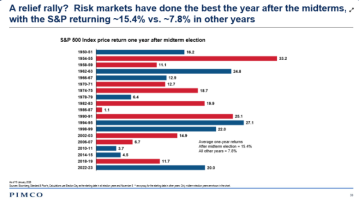
The year after the vote is a different story. Since 1950, the S&P 500 has averaged roughly 13–15% in the twelve months following a midterm (about double a typical year) and has not posted a negative twelve-month return after any of the past 19 midterms—a streak spanning recessions, wars, and a financial crisis. The likely reason is simple: elections create uncertainty about future taxes, spending, and regulation, and once results are known, investors and businesses get back to work, whoever wins.
Markets are measurably bumpier in midterm years. Since 1970, price swings in midterm years have run above other years (a median of roughly 16% annualized versus 13%), with the choppiest stretch typically in the weeks before Election Day. Market “fear gauges” such as the VIX (CBOE Volatility Index) have historically peaked around October and eased once results are in; the U.S. Federal Reserve research confirms expected volatility reliably falls after outcomes become known. Pre-election turbulence has historically been the price of admission for the stronger period that follows—not a signal to exit.
Across every combination of White House and Congress since 1926, stocks have delivered positive average returns. Markets have historically welcomed divided government: since 1951, the S&P 500 averaged about 9.9% per year under split control versus about 8% under one-party rule, and a split Congress specifically has been among the strongest settings under presidents of either party. Even in the setup pollsters consider most likely this year—the governing party losing full control—stocks still rose about 10% on average in the six months after the vote.
Our read is that a move toward split government in Washington would likely be received well by markets—less policy surprise, more visibility. Nevertheless, earnings, interest rates, and inflation remain the true drivers of stock market returns. The practical conclusion is not to trade the election, but to stay invested through it: volatility around the vote is normal and has historically been followed by above-average returns. Simply put, assuming the Trump administration can be tempered through a split government, this likely improves market outcomes with less policy uncertainty and hopefully less noise day to day.
As always, thank you for your continued trust. If you have questions about your portfolio or would like to discuss strategy in more detail, please feel free to reach out.
Sincerely,
Andrew, Kelly, Justin & the West Oak Team